

What Role Does Artificial Intelligence Play in Modern Logistics Management?
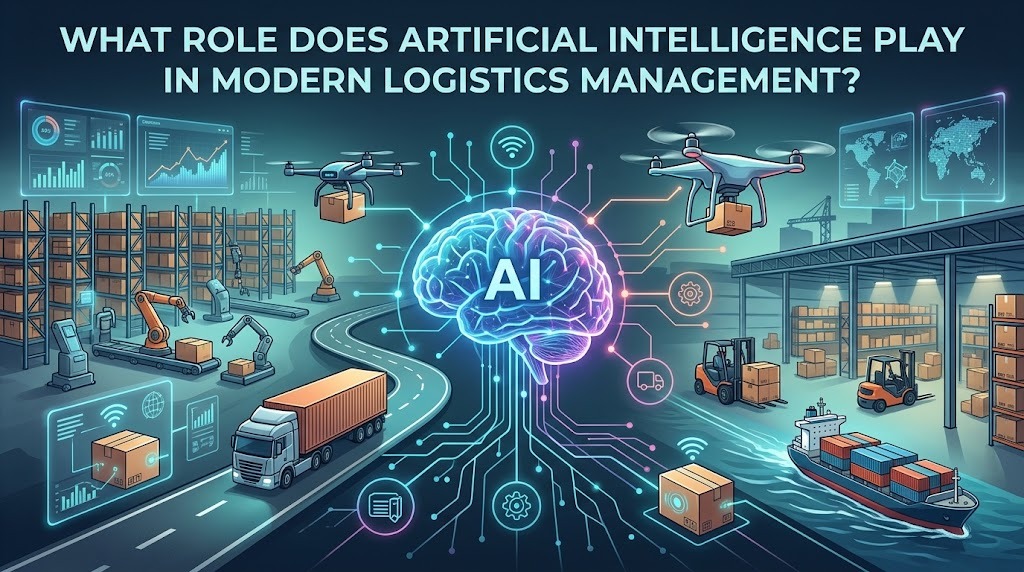
Artificial intelligence is transforming modern logistics management by helping businesses improve transportation, inventory control, warehouse operations, and delivery planning. As customer expectations increase, companies need faster and more accurate ways to manage products and shipments. Traditional logistics methods often depend on manual processes that can be time-consuming and vulnerable to human error. Artificial intelligence (AI) offers solutions by analyzing large amounts of data, identifying patterns, and supporting better operational decisions. By adopting suitable AI technologies, businesses can improve logistics efficiency, reduce costs, and provide more reliable services to customers.
UNDERSTANDING ARTIFICIAL INTELLIGENCE IN LOGISTICS
Artificial intelligence in logistics refers to the use of computer systems that perform tasks such as analyzing information, recognizing patterns, making predictions, and supporting decisions. These systems can process data from transportation networks, warehouse operations, inventory records, and customer orders. Unlike traditional systems that mainly follow fixed instructions, some AI applications can adjust their recommendations when new information becomes available. This capability helps logistics teams respond to changing conditions more effectively. However, AI still depends on accurate data, appropriate system design, and human oversight.
Businesses can apply AI in several areas of logistics management. For example, AI-powered software can estimate delivery times, forecast product demand, identify unusual inventory changes, and recommend efficient transportation routes. Automated systems can also help warehouse employees locate products and prioritize orders. Machine learning, a branch of AI, allows computer systems to identify patterns in historical data and use them to improve predictions. When implemented carefully, these technologies help companies make more informed decisions and manage logistics activities more efficiently.
IMPROVING TRANSPORTATION AND ROUTE OPTIMIZATION
Transportation is a major part of logistics management because it affects delivery speed, fuel consumption, and operational expenses. AI-powered route optimization can analyze traffic conditions, weather information, road restrictions, vehicle capacity, and delivery locations to recommend suitable routes. This helps logistics companies avoid unnecessary detours and respond to changing road conditions. More efficient route planning can reduce travel time and help drivers complete more deliveries within their working schedules. It can also support better vehicle utilization and lower transportation costs.
AI systems can also help companies predict potential transportation disruptions. By analyzing historical delivery records and current traffic information, these systems may identify routes that are more likely to experience delays. Logistics managers can then adjust delivery schedules or select alternative routes before problems become more serious. However, AI recommendations must account for road safety, local regulations, and practical delivery requirements. Combining AI with experienced human decision-making helps businesses achieve safer and more reliable transportation operations.
ENHANCING INVENTORY MANAGEMENT AND DEMAND FORECASTING
Inventory management is another area where AI can provide significant benefits. Businesses need enough stock to meet customer demand without keeping excessive quantities that increase storage expenses. AI systems can analyze historical sales, seasonal patterns, promotional activities, and other relevant information to estimate future demand. These predictions help managers determine when to replenish products and how much stock to maintain. More accurate forecasting can reduce stockouts, overstocking, and unnecessary purchasing costs.
AI can also help identify unusual inventory movements and potential recording errors. When connected to digital inventory systems, it can analyze stock changes and alert employees when quantities appear inconsistent with expected activity. Some applications can recommend replenishment schedules based on supplier lead times and changing demand patterns. Nevertheless, forecasts may become less reliable when data is incomplete or unexpected market changes occur. Businesses should regularly review AI-generated forecasts and combine them with employee knowledge to maintain accurate inventory decisions.
AUTOMATING WAREHOUSE OPERATIONS
Modern warehouses handle numerous activities, including receiving goods, storing products, picking orders, packing shipments, and preparing deliveries. AI-powered warehouse automation can improve these processes by helping businesses organize tasks and use storage space more effectively. Intelligent software can recommend suitable product locations based on demand and picking frequency. In some facilities, AI also supports robots that move goods, assist with picking, or transport items between warehouse areas. These applications can reduce repetitive work and improve operational productivity.
AI can also support warehouse planning by analyzing order volumes, employee workloads, and equipment availability. Managers can use these insights to allocate resources during busy periods and reduce bottlenecks. Automated scanning and computer vision may help identify products, read labels, and detect certain packaging problems. However, warehouse automation requires suitable infrastructure, maintenance, and employee training. A well-planned combination of AI and human workers can improve warehouse speed and accuracy while maintaining flexibility when unexpected situations arise.
REDUCING COSTS AND IMPROVING CUSTOMER SATISFACTION
AI can help businesses control logistics expenses by identifying inefficient activities and recommending operational improvements. For example, it may highlight routes that consume excessive fuel, warehouses that process orders slowly, or inventory patterns that create unnecessary storage costs. Predictive maintenance systems can also analyze vehicle or equipment data to identify signs of possible mechanical problems before failures occur. This may reduce unexpected downtime and expensive emergency repairs. The actual savings depend on implementation costs, data quality, and how effectively businesses use the recommendations.
Customer satisfaction can also improve when AI supports more accurate delivery estimates and faster communication. Automated customer service tools can answer routine questions about order status, delivery schedules, and shipment tracking. AI systems may also help logistics teams identify delayed shipments and prioritize actions that reduce the impact on customers. However, automated responses should provide reliable information and allow customers to contact human staff when necessary. By combining faster logistics operations with transparent communication, businesses can build stronger customer relationships and improve service quality.
CHALLENGES OF IMPLEMENTING AI IN LOGISTICS
Although AI offers many benefits, implementing it in logistics management can create challenges. High implementation costs may prevent smaller businesses from adopting advanced systems, particularly when new software must be integrated with existing equipment and processes. Companies may also need to invest in employee training, technical support, and ongoing system maintenance. In addition, AI predictions can be inaccurate when the data used for analysis is incomplete, outdated, or biased. These limitations make careful planning essential before adopting new technology.
Data security and human oversight are also important considerations. Logistics systems may process sensitive information about customers, suppliers, shipments, and business operations. Companies should use appropriate security controls, limit unauthorized access, and establish clear policies for handling data. Employees should understand how AI recommendations are produced and when decisions require human review. Businesses should begin with clearly defined problems, measure performance, and expand successful applications gradually. This approach helps organizations gain the benefits of AI while managing risks and controlling unnecessary expenses.
CONCLUSION
Artificial intelligence plays an important role in modern logistics management by improving transportation planning, inventory forecasting, warehouse automation, cost control, and customer communication. AI technologies help businesses analyze data, identify operational problems, and make faster decisions. However, their effectiveness depends on accurate information, suitable infrastructure, employee training, and responsible implementation. Companies should evaluate their needs carefully and combine automated systems with human expertise. When applied strategically, AI in logistics can improve efficiency, increase delivery reliability, and help businesses remain competitive in a rapidly changing market.
Recent Posts

Bagaimana Sistem SKS pada Program Kuliah... 22.11.2026/60 View

How Does Technology Make Daily Evaluation... 21.11.2026/87 View

Apa Strategi Menghadapi Kesenjangan antara Kompetensi... 21.11.2026/85 View

Mengapa Inventaris Aset Penting bagi Kelancaran... 21.11.2026/83 View

When Should Musicians Join a Record... 21.11.2026/87 View
