

What Role Does Scientific Literacy Play in Olympiad Success?
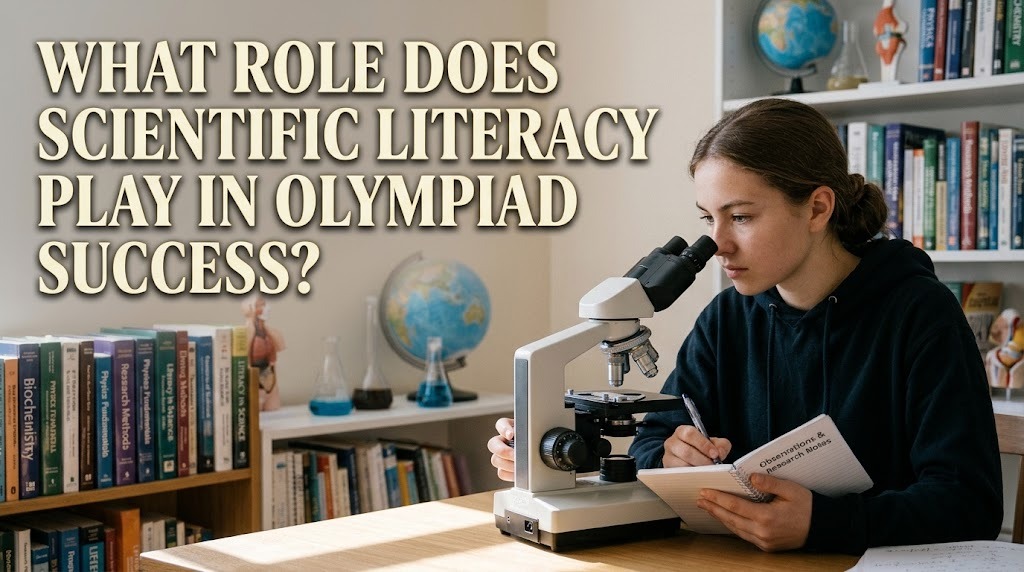
Scientific literacy is an important foundation for students who participate in Science Olympiad competitions. It involves the ability to understand scientific concepts, interpret evidence, evaluate information, and apply knowledge to real-world situations. These abilities help students approach challenging questions with logical reasoning rather than relying entirely on memorization.
Science Olympiad competitions often require participants to analyze unfamiliar problems, understand scientific data, and explain relationships between different concepts. Students with strong scientific literacy can approach these tasks more systematically because they understand how scientific knowledge is developed and applied. Therefore, developing scientific literacy can support both competition performance and long-term academic growth.
IMPROVING UNDERSTANDING OF SCIENTIFIC CONCEPTS
Scientific literacy helps students understand the principles behind scientific phenomena. Instead of memorizing formulas, definitions, and theories, they learn why certain processes occur and how different concepts are connected.
For example, students studying physics need to understand relationships between force, motion, and energy. Biology participants may explore how cells function, how organisms interact, and how biological systems maintain balance.
This deeper understanding makes it easier to apply knowledge to unfamiliar questions. Students can recognize relevant principles and use them to develop appropriate solutions during competitions.
STRENGTHENING CRITICAL THINKING ABILITIES
Science Olympiad questions frequently require students to examine information and determine whether a conclusion is supported by evidence. Scientific literacy encourages them to question assumptions, compare explanations, and evaluate the accuracy of scientific claims.
Students with strong critical thinking skills do not immediately accept every explanation they encounter. Instead, they examine the available information and consider whether the reasoning is logical.
This ability is particularly valuable when competition questions present unfamiliar situations. Participants can analyze the problem carefully and select answers based on scientific principles rather than guessing.
DEVELOPING DATA INTERPRETATION SKILLS
Scientific literacy includes the ability to understand information presented through tables, graphs, diagrams, and numerical data. These forms of information are commonly used to explain scientific relationships and experimental results.
Students may need to identify patterns, compare measurements, calculate differences, or determine relationships between variables. Without sufficient data interpretation skills, even participants who understand the basic theory may struggle to answer these questions correctly.
Regular practice with scientific data can improve their ability to recognize important information. It also helps students develop more accurate conclusions based on available evidence.
ENCOURAGING EVIDENCE-BASED REASONING
Scientific knowledge is built through observation, experimentation, and systematic investigation. Scientific literacy helps students understand why evidence is necessary when developing explanations or making conclusions.
During Olympiad preparation, participants may encounter questions that require them to compare different hypotheses or interpret experimental findings. They need to determine which explanation is most consistent with the available evidence.
This approach reduces dependence on unsupported assumptions. Students become more careful when evaluating information and learn to distinguish scientific evidence from personal opinions.
SUPPORTING PROBLEM-SOLVING ABILITIES
Science Olympiad competitions often present complex problems that require students to combine knowledge from several scientific topics. Scientific literacy helps them identify the concepts involved and understand how those concepts can be applied.
For example, a question about environmental pollution may involve chemistry, biology, and ecological relationships. Students need to understand these connections before developing a logical answer.
By strengthening scientific literacy, participants can approach problems from different perspectives. They also become more capable of breaking complicated questions into smaller parts and solving them systematically.
CONNECTING SCIENCE WITH REAL-WORLD SITUATIONS
Scientific literacy allows students to connect classroom knowledge with events and problems in everyday life. They can understand how scientific principles explain natural phenomena, technological developments, and environmental changes.
For example, knowledge of biology can help students understand disease transmission and ecosystem balance. Chemistry can explain food preservation and material properties, while physics provides insights into electricity, transportation, and energy.
These connections make scientific learning more meaningful. They also prepare students to answer Olympiad questions that use real-world situations as the basis for scientific problems.
IMPROVING RESEARCH AND INFORMATION EVALUATION
Students preparing for Science Olympiads often need additional learning materials beyond regular textbooks. Scientific literacy helps them identify reliable references and evaluate whether information is accurate and relevant.
Participants may use scientific journals, educational publications, textbooks, and trusted online resources. They need to consider the credibility of these materials rather than accepting every statement they find.
The ability to evaluate information also helps students avoid misleading scientific claims. This is increasingly important because digital platforms provide access to large amounts of information with varying levels of accuracy.
BUILDING CONFIDENCE IN SCIENTIFIC DISCUSSIONS
Scientific literacy also supports students' ability to explain ideas and participate in academic discussions. Students who understand scientific concepts can communicate their reasoning more clearly and respond to questions with relevant evidence.
During group training, participants may need to discuss experimental results, compare problem-solving methods, or explain why a particular answer is correct. These activities encourage them to organize their thoughts and express scientific ideas accurately.
As their understanding improves, students may become more confident when presenting explanations or discussing difficult topics with teachers, mentors, and fellow participants.
DEVELOPING CURIOSITY AND INDEPENDENT LEARNING
Scientific literacy encourages students to remain curious about how the world works. Instead of studying only for examinations, they become interested in investigating questions and discovering explanations independently.
Students may explore additional scientific topics, conduct simple experiments, or search for answers to questions that arise during classroom discussions. These activities help them become more active learners.
Independent learning is especially useful during Olympiad preparation because competition materials can be extensive and challenging. Students who can study independently are better prepared to identify their knowledge gaps and improve their understanding.
HOW STUDENTS CAN STRENGTHEN SCIENTIFIC LITERACY
Developing scientific literacy requires regular learning activities and opportunities to apply scientific knowledge. Students can improve these abilities through several practical methods:
- Read Scientific Materials: Study textbooks, scientific articles, and educational publications to expand subject knowledge.
- Analyze Scientific Data: Practice interpreting graphs, tables, diagrams, and experimental results.
- Conduct Experiments: Observe scientific phenomena and record findings using systematic procedures.
- Discuss Scientific Questions: Exchange explanations and evaluate different ideas with teachers or classmates.
- Evaluate Information Sources: Check the credibility of references before accepting scientific claims.
- Connect Theory With Practice: Apply scientific concepts to everyday situations and real-world problems.
Consistent practice helps students develop a stronger understanding of science and become more prepared for challenging competition questions.
CONCLUSION
Scientific literacy plays an important role in Science Olympiad success because it strengthens conceptual understanding, critical thinking, data interpretation, and evidence-based reasoning. It also helps students connect scientific theories with real-world situations and evaluate information more carefully.
Beyond improving competition preparation, scientific literacy encourages curiosity, independent learning, and effective communication. Students who develop these abilities can approach scientific challenges more confidently and build a strong foundation for future academic opportunities.
Recent Posts

Bagaimana Sistem SKS pada Program Kuliah... 22.11.2026/48 View

How Does Technology Make Daily Evaluation... 21.11.2026/76 View

Apa Strategi Menghadapi Kesenjangan antara Kompetensi... 21.11.2026/78 View

Mengapa Inventaris Aset Penting bagi Kelancaran... 21.11.2026/73 View

When Should Musicians Join a Record... 21.11.2026/78 View
