

What Shaped the Early History of a City?
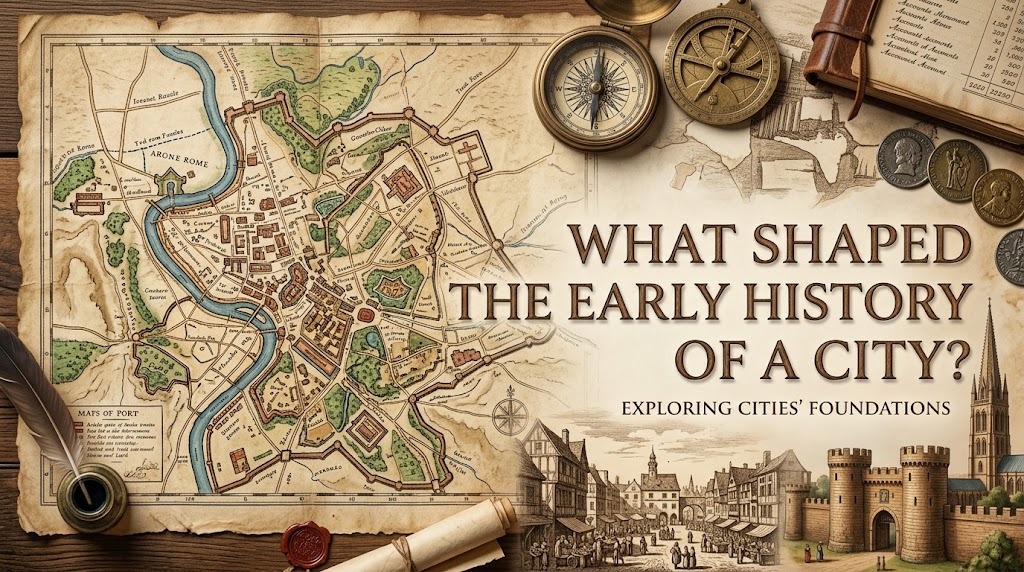
The early history of a city is shaped by a combination of geography, economic activity, political decisions, cultural traditions, and the movement of people. Cities rarely develop by accident because their locations often provide important advantages for settlement and trade. Rivers, coastlines, fertile land, transportation routes, and natural resources can encourage communities to grow in particular areas. Over time, these geographical advantages interact with social and political changes to create the foundations of an urban center.
GEOGRAPHICAL LOCATION AND NATURAL RESOURCES
Geography is one of the most important factors influencing the early development of a city. Settlements often emerge near rivers, coastlines, valleys, or fertile agricultural areas because these locations provide access to water, food, and transportation. Natural resources such as timber, minerals, and productive farmland can also attract communities and support economic activities.
A favorable location can allow a settlement to grow from a small community into a larger urban center. Rivers may provide transportation routes and support irrigation, while coastal locations can facilitate fishing and maritime trade. However, geographical conditions can also create challenges, including flooding, drought, earthquakes, or difficult terrain.
TRADE AND ECONOMIC ACTIVITIES
Trade often plays a major role in transforming an early settlement into a city. Communities located along important land or water routes can become places where merchants exchange agricultural products, raw materials, and manufactured goods. Markets encourage people to settle permanently and create businesses that support growing populations.
As economic activity increases, cities may develop specialized occupations such as craftsmen, traders, transport workers, and administrators. Increased commercial activity can also generate wealth that supports the construction of roads, markets, public buildings, and other infrastructure. In this way, economic opportunities can accelerate urban growth.
POLITICAL POWER AND GOVERNANCE
Political decisions can strongly influence the development of a city. Rulers may establish settlements as administrative centers, military bases, royal residences, or regional capitals. Government institutions can attract officials, soldiers, merchants, and workers who contribute to population growth.
Political stability can also encourage investment and long-term settlement. Conversely, wars, changes in leadership, or conflicts over territory can interrupt urban development. The location of government buildings, defensive structures, and public facilities may continue to influence the city's layout for generations.
MIGRATION AND POPULATION GROWTH
The movement of people is another important factor in a city's early history. People may migrate to urban settlements because of employment opportunities, trade, fertile land, security, or political changes. As more people arrive, demand increases for housing, markets, transportation, education, and public services.
Different groups of migrants can also contribute languages, traditions, skills, foods, and cultural practices. Over time, these interactions can create a distinctive urban identity. Population growth may therefore influence not only the size of a city but also its social and cultural character.
CULTURAL AND RELIGIOUS INFLUENCES
Cultural and religious institutions often shape the development of early cities. Places of worship, schools, community centers, and ceremonial spaces can become important gathering points. These institutions may influence where neighborhoods and public spaces are established.
Cultural traditions can also affect architecture, festivals, crafts, and patterns of community life. Historical buildings and cultural landmarks may preserve evidence of the values and practices that influenced the city's early development. As generations pass, these traditions can become important parts of the city's identity.
DEFENSE AND SECURITY
Security considerations have historically influenced where and how cities were built. Settlements may develop near naturally defensible locations such as hills, river crossings, or elevated ground. Walls, forts, gates, and watchtowers can also be constructed to protect residents and important economic centers.
The need for defense can influence street patterns and the location of residential, commercial, and administrative areas. When security conditions improve, cities may expand beyond their original defensive boundaries. Some modern urban layouts still reflect the boundaries and structures established during earlier periods.
TRANSPORTATION AND INFRASTRUCTURE
Transportation networks help connect a city with surrounding settlements and economic regions. Roads, bridges, ports, canals, and later railways can increase the movement of people and goods. A settlement located at a transportation junction may gain an advantage because travelers and merchants regularly pass through it.
Infrastructure also supports internal urban growth. Reliable water systems, drainage, roads, marketplaces, and public facilities allow larger populations to live and work in the same area. As infrastructure develops, the city can expand and become more economically connected to its surrounding region.
ENVIRONMENTAL AND HISTORICAL EVENTS
Natural and historical events can change the direction of a city's development. Floods, fires, epidemics, earthquakes, wars, and economic crises may destroy buildings or force residents to relocate. In some cases, reconstruction creates new streets, public spaces, and architectural styles.
Major historical events can also cause a city to gain or lose political and economic importance. A change in trade routes, the establishment of a new government center, or the construction of major transportation infrastructure may transform an area's future. These events often become important turning points in urban history.
CONCLUSION
The early history of a city is shaped by interconnected geographical, economic, political, social, cultural, and environmental factors. A favorable location may attract settlers, while trade creates economic opportunities and political institutions provide administrative importance. Migration, cultural traditions, transportation, defense, and major historical events then influence how the settlement grows and changes. Understanding these factors helps explain why cities develop distinctive identities and urban landscapes over time.
Recent Posts

Bagaimana Sistem SKS pada Program Kuliah... 22.11.2026/50 View

How Does Technology Make Daily Evaluation... 21.11.2026/79 View

Apa Strategi Menghadapi Kesenjangan antara Kompetensi... 21.11.2026/79 View

Mengapa Inventaris Aset Penting bagi Kelancaran... 21.11.2026/75 View

When Should Musicians Join a Record... 21.11.2026/80 View
