

What Skills Are Measured In An Aptitude Test?
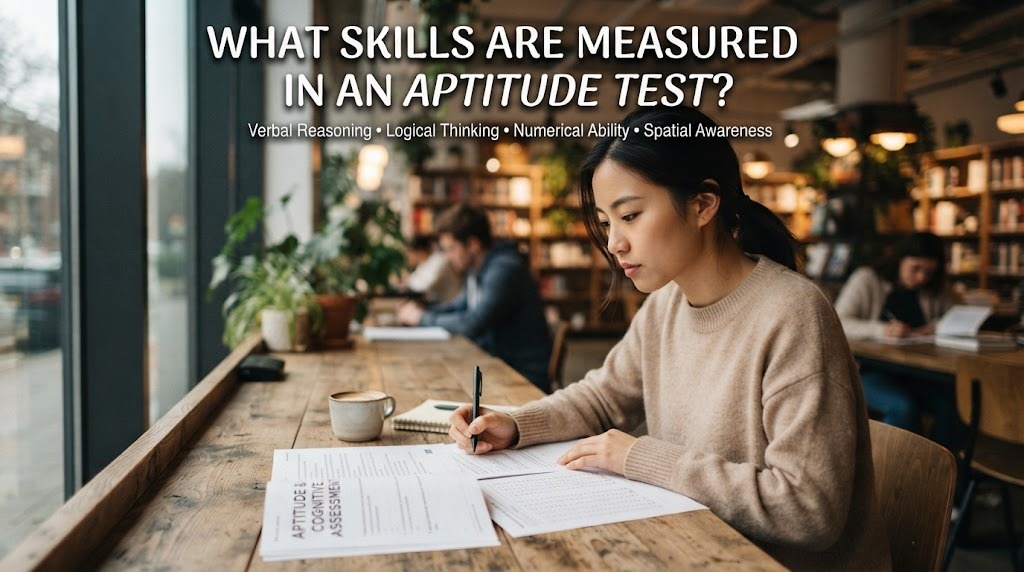
An aptitude test is designed to measure specific abilities that can be useful in education, training, or work. Different tests may focus on different types of skills depending on their purpose. Common areas include verbal reasoning, numerical ability, logical thinking, and spatial reasoning. Understanding these skills can help people know what an aptitude test is actually measuring.
VERBAL REASONING
Verbal reasoning measures how well a person understands and works with information presented through words. Questions may involve word relationships, written information, meanings, or logical conclusions from short passages. This skill can show how effectively someone processes language-based information. It is useful in many activities that require reading and communication.
Verbal reasoning is not simply about knowing a large vocabulary. It also involves understanding relationships between ideas and interpreting information correctly. Good performance can be useful in fields that involve communication, reading, writing, or analyzing written information.
NUMERICAL REASONING
Numerical reasoning measures how well a person works with numbers and numerical information. Questions may include calculations, number sequences, percentages, ratios, graphs, or tables. The focus is often on understanding and applying numerical information rather than advanced mathematics. This ability can be relevant to many educational and workplace activities.
Numerical reasoning also involves accuracy and logical thinking. A person may need to identify patterns, compare values, or choose the correct conclusion from numerical data. These skills can be useful in areas such as business, finance, science, technology, and data-related work.
LOGICAL REASONING
Logical reasoning measures how well a person identifies relationships, rules, and patterns in information. Questions may ask test takers to determine what comes next in a sequence or which conclusion follows from given information. The ability involves analyzing information and reaching a reasonable conclusion. It is commonly included in aptitude assessments.
Logical reasoning is useful because many tasks require people to solve problems in a structured way. Strong reasoning can help when dealing with unfamiliar situations where the answer cannot simply be recalled from memory. It can therefore be relevant across many different fields.
ABSTRACT REASONING
Abstract reasoning focuses on recognizing patterns and relationships between shapes, symbols, or other nonverbal information. Questions may show a sequence of figures and ask the test taker to identify the missing or next figure. This requires the person to notice changes and relationships without relying heavily on language. It can provide information about nonverbal problem-solving ability.
Abstract reasoning can be useful when people need to understand new patterns or unfamiliar information. It is often included in assessments because the tasks can focus on reasoning rather than specific school knowledge. However, performance can still be influenced by familiarity with the question format.
SPATIAL REASONING
Spatial reasoning measures the ability to understand objects, shapes, positions, and relationships in space. Questions may involve rotating objects mentally, matching shapes, or identifying how objects relate to each other. This skill involves creating and manipulating mental images. It can be relevant to tasks involving design, construction, engineering, architecture, and technical work.
Spatial reasoning is not limited to one profession. Many everyday and professional activities require people to visualize objects and understand physical relationships. Different aptitude tests may measure this ability in different ways.
MECHANICAL REASONING
Mechanical reasoning measures understanding of basic mechanical and physical principles. Questions may involve tools, gears, levers, pulleys, forces, or simple machines. The goal is usually to see whether a person can understand how mechanical systems work. This type of assessment may be relevant to certain technical or vocational fields.
Mechanical reasoning does not necessarily require advanced engineering knowledge. Instead, it often focuses on basic principles and practical problem solving. The exact content depends on the purpose and design of the test.
CLERICAL AND ACCURACY SKILLS
Some aptitude assessments measure clerical ability and accuracy. These tasks may involve comparing information, identifying errors, organizing data, or working with details quickly. They can provide information about attention to detail and the ability to process simple information accurately. Such skills can be relevant to administrative and information-handling tasks.
Speed and accuracy may both be important in these assessments. A person may need to complete many simple tasks within a limited period. Therefore, the results can reflect how effectively someone handles routine information and detailed work under test conditions.
GENERAL COGNITIVE ABILITY
Some aptitude tests measure broader cognitive abilities rather than focusing on only one skill. These assessments may combine verbal, numerical, logical, and other reasoning tasks. They are designed to provide a broader picture of how a person processes information and solves problems. The exact skills included depend on the assessment.
A general cognitive assessment should still be interpreted carefully. One test cannot measure every aspect of human ability. Creativity, motivation, personality, practical experience, and many other qualities may not be fully represented.
WHY ARE THESE SKILLS MEASURED?
These skills are measured because they can provide information about how a person handles different types of learning and problem-solving tasks. The results may be useful when exploring education, training, recruitment, or career development. They can help identify relative strengths and areas that may benefit from further development. However, the meaning of a result depends on the purpose and quality of the test.
Aptitude results are most useful when combined with other information. Interests, experience, education, motivation, and personal goals can also influence a person's choices and development. Therefore, an aptitude test should be considered a useful source of information rather than a complete description of a person.
CONCLUSION
An aptitude test can measure several skills, including verbal reasoning, numerical reasoning, logical reasoning, abstract reasoning, spatial reasoning, and mechanical reasoning. Some assessments may also measure clerical accuracy or broader cognitive abilities. Different tests use different combinations of skills based on their purpose.
Understanding what each skill means can help people interpret test results more effectively. However, test results should be combined with interests, experience, education, and personal goals when making decisions about learning or career development.
Recent Posts

Bagaimana Sistem SKS pada Program Kuliah... 22.11.2026/21 View

How Does Technology Make Daily Evaluation... 21.11.2026/63 View

Apa Strategi Menghadapi Kesenjangan antara Kompetensi... 21.11.2026/65 View

Mengapa Inventaris Aset Penting bagi Kelancaran... 21.11.2026/62 View

When Should Musicians Join a Record... 21.11.2026/60 View
