

What Skills Do Students Develop Through Science Olympiads?
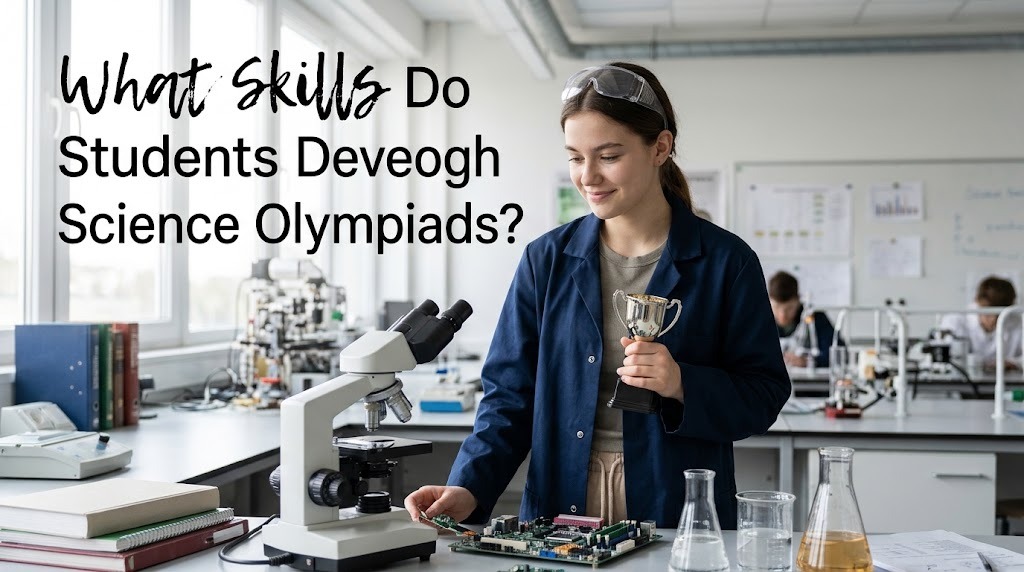
Science Olympiads provide students with opportunities to explore scientific knowledge, solve challenging problems, and develop their academic abilities. These competitions usually involve subjects such as mathematics, physics, chemistry, biology, and other scientific fields. Beyond testing what students have learned in the classroom, Olympiads encourage participants to think critically, work independently, and approach complex questions systematically. The preparation process also teaches students how to manage their time, handle challenges, and learn from mistakes. Through these experiences, students can develop valuable skills that support their education and future careers.
CRITICAL THINKING AND ANALYTICAL SKILLS
Critical thinking is one of the most important abilities students develop through science Olympiads. Participants must examine questions carefully, identify relevant information, and determine which concepts can be used to solve a problem. They learn to evaluate different approaches instead of immediately choosing the first answer that seems correct. Analytical skills also help students recognize patterns, compare evidence, and understand relationships between scientific concepts. These abilities are useful not only in competitions but also in everyday learning and decision-making.
PROBLEM-SOLVING ABILITIES
Science Olympiads challenge students with questions that often require more than memorizing formulas or definitions. Participants need to break complicated problems into smaller parts and apply appropriate methods to reach a solution. They may need to combine knowledge from different topics to answer unfamiliar questions. This process encourages flexibility because one problem can sometimes be solved through several approaches. Regular practice helps students become more confident when facing difficult academic challenges.
SCIENTIFIC REASONING AND CURIOSITY
Scientific reasoning allows students to understand how knowledge is developed through observation, evidence, and logical explanations. During Olympiad preparation, students learn to question assumptions, examine information, and distinguish between reliable evidence and unsupported conclusions. They also become more curious about how scientific principles work in real-life situations. This curiosity can encourage them to explore topics beyond the school curriculum and conduct further research. Developing scientific reasoning helps students build a more systematic understanding of the world around them.
TIME MANAGEMENT AND DISCIPLINE
Preparing for a science Olympiad requires consistent practice and effective time management. Students often need to balance competition preparation with regular lessons, homework, and other school responsibilities. Creating a study schedule helps them organize learning activities and prioritize important topics. During competitions, they must also manage the limited time available to understand questions and complete answers. These experiences develop discipline, responsibility, and the ability to work toward long-term academic goals.
INDEPENDENT LEARNING AND SELF-CONFIDENCE
Science Olympiads encourage students to take greater responsibility for their own learning. They may need to study additional materials, explore unfamiliar concepts, and practice questions independently. This process helps them recognize their strengths and identify topics that require further improvement. As their understanding develops, students can become more confident in expressing ideas and approaching challenging assignments. Independent learning also prepares them to adapt to more demanding academic environments.
CREATIVITY AND INNOVATIVE THINKING
Although science involves established principles and methods, solving complex problems often requires creative thinking. Students may discover that familiar concepts can be applied in different ways to reach a solution. Some Olympiad activities also involve experiments, scientific investigations, or practical challenges that encourage participants to explore alternative approaches. Creativity helps students move beyond routine exercises and develop new perspectives on scientific questions. This ability can support innovation in education, research, and future professional activities.
ACCURACY AND ATTENTION TO DETAIL
Scientific problems often require careful calculations, precise observations, and accurate interpretation of information. A small mistake in a formula, measurement, or unit conversion can affect the final result. Through Olympiad practice, students learn to check their work, follow instructions, and pay attention to important details. They also develop the habit of explaining their reasoning clearly rather than focusing only on the final answer. These habits are valuable in scientific research and many other academic activities.
RESILIENCE AND EMOTIONAL CONTROL
Science Olympiads can introduce students to difficult questions, competitive pressure, and unexpected results. Not every participant achieves the outcome they hope for, but these experiences can teach them how to respond constructively to setbacks. Students learn that mistakes are part of the learning process and can use feedback to improve their understanding. They also practice maintaining concentration when facing challenging situations. Developing resilience helps students continue working toward their goals without becoming discouraged by temporary difficulties.
COMMUNICATION AND COLLABORATION
Some science Olympiad activities involve group investigations, practical experiments, or team-based challenges. These experiences encourage students to explain scientific ideas, listen to different opinions, and share responsibilities. Effective communication helps team members discuss possible solutions and understand one another's reasoning. Collaboration also teaches students to respect different perspectives and combine their knowledge to complete a task. Even in individual competitions, students can develop communication skills by discussing problems with teachers, mentors, and fellow participants.
PREPARATION FOR FUTURE EDUCATION AND CAREERS
The skills developed through science Olympiads can support students as they continue their education. Critical thinking, problem-solving, research, and independent learning are useful in many university subjects and professional fields. Students may also discover an interest in careers related to science, technology, engineering, mathematics, healthcare, or research. Participation can provide valuable learning experiences and help students understand the demands of advanced academic study. However, success in an Olympiad does not automatically determine future achievement; consistent learning and practical experience remain important.
CONCLUSION
Science Olympiads help students develop a wide range of academic and personal skills. Through competition preparation and challenging scientific questions, participants strengthen critical thinking, problem-solving, scientific reasoning, creativity, and time management. They also learn discipline, resilience, communication, and independent learning. These abilities extend beyond competition results and can support students throughout their educational journeys. By participating in science Olympiads, students gain opportunities to explore their potential and build skills that are valuable for future challenges.
Recent Posts

Bagaimana Sistem SKS pada Program Kuliah... 22.11.2026/49 View

How Does Technology Make Daily Evaluation... 21.11.2026/76 View

Apa Strategi Menghadapi Kesenjangan antara Kompetensi... 21.11.2026/78 View

Mengapa Inventaris Aset Penting bagi Kelancaran... 21.11.2026/74 View

When Should Musicians Join a Record... 21.11.2026/78 View
