

What Skills Must Every Professional Accountant Have?
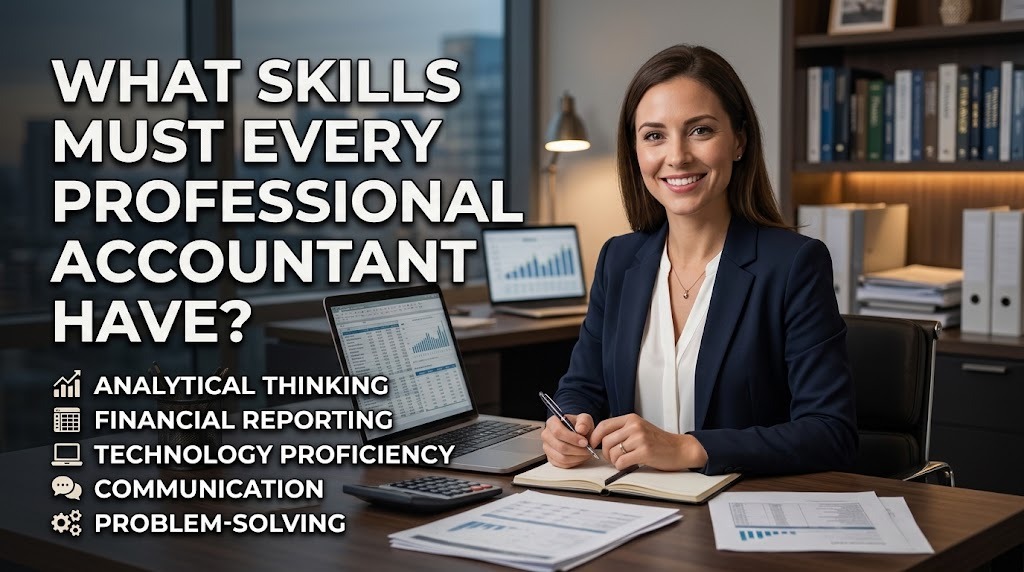
To thrive in today's fast-paced corporate landscape, a professional accountant must possess a dynamic blend of technical proficiency, analytical acumen, and interpersonal communication abilities. The modern financial role has expanded far beyond simple arithmetic and ledger balancing into high-level strategic advisory and risk management. Accounting practitioners are expected to interpret complex quantitative datasets, identify operational inefficiencies, and guide executive decision-making. Developing a comprehensive skill set ensures that an accountant can navigate evolving market demands and safeguard enterprise solvency. Technical competence combined with strategic vision forms the foundation of professional accounting leadership.
In addition, the rapid digital transformation of corporate finance requires accountants to adapt continuously to automated tools and emerging technologies. Employers seek versatile professionals who can bridge the gap between complex financial data and practical business execution. Mastering both hard quantitative disciplines and soft leadership skills creates a distinct competitive advantage in the global job market. Whether working in public audit practices, corporate finance departments, or independent consulting, well-rounded skills drive long-term career success. Investing in holistic skill development ensures lasting relevance and professional authority.
WHAT ARE THE ESSENTIAL TECHNICAL ACCOUNTING SKILLS?
At the core of every accountant's capability is deep mastery of technical financial accounting standards and statutory reporting frameworks. Practitioners must understand double-entry bookkeeping, general ledger maintenance, and the precise rules governing revenue recognition and asset valuation. They must possess the expertise to prepare, review, and finalize accurate financial statements, including balance sheets, income statements, and cash flow summaries. Technical mastery ensures that corporate financial disclosures comply fully with national standards and international financial reporting standards (IFRS). Precise technical execution protects organizations from administrative errors and statutory audit penalties.
Furthermore, a comprehensive understanding of tax law and statutory tax compliance is mandatory for managing corporate liabilities effectively. Accountants must know how to calculate corporate income tax, handle value-added tax filings, and navigate regional tax incentives legally. Performing routine internal controls, such as detailed bank reconciliation procedures, safeguards company liquidity and detects fraudulent activity early. Technical competence also encompasses cost accounting, capital budgeting, and financial ratio analysis to evaluate operational efficiency. Mastery of these core technical disciplines serves as the fundamental engine of financial integrity.
WHY IS ANALYTICAL AND CRITICAL THINKING VITAL FOR ACCOUNTANTS?
Analytical thinking enables accounting professionals to look beyond surface-level figures and understand the commercial narrative behind financial data. In a modern corporate setting, accountants must dissect complex financial models to evaluate product margins, overhead expenses, and working capital trends. Critical thinking allows practitioners to detect subtle anomalies, identify operational bottlenecks, and forecast future cash flow patterns accurately. Rather than merely reporting historical numbers, analytical accountants provide predictive insights that inform high-stakes executive strategy. Strong analytical skills turn raw data into actionable business intelligence.
Additionally, critical problem-solving is essential when designing robust internal control systems and mitigating enterprise risk. When unexpected financial discrepancies arise, an analytical accountant systematically investigates root causes to resolve operational errors promptly. This skill is particularly vital during internal and external audits, where professionals must evaluate corporate risk exposure objectively. Analyzing complex commercial contracts and financial structures protects organizations from unforeseen liabilities and bad debt exposure. High-level critical thinking elevates an accountant from a back-office controller to an indispensable strategic partner.
HOW IMPORTANT ARE DIGITAL LITERACY AND DATA ANALYTICS SKILLS?
As automation reshapes corporate workflows, digital literacy has become an indispensable requirement for every modern accounting specialist. Professionals must be proficient in cloud accounting software, enterprise resource planning (ERP) platforms, and advanced spreadsheet modeling tools. Embracing technological tools streamlines routine data entry and automates ledger updates, allowing accountants to focus on higher-level strategic analysis. Understanding digital financial technology enables professionals to design seamless, automated workflows that reduce operational error rates. Technological adaptability is essential for maintaining corporate efficiency in a digital economy.
Moreover, expertise in data analytics tools—such as SQL, Power BI, and data visualization software—allows accountants to process massive datasets efficiently. Modern financial leaders use predictive analytics to model scenario outcomes, track real-time key performance indicators, and optimize inventory management. Data-driven decision-making enables companies to respond rapidly to shifting market conditions and competitive pressures. Accountants who embrace digital tools deliver faster, more accurate financial reporting to corporate stakeholders. Mastering technology transforms standard accounting practices into a powerful competitive driver.
WHY ARE COMMUNICATION AND INTERPERSONAL SKILLS NECESSARY?
Technical expertise carries limited value if an accountant cannot communicate complex financial findings clearly to non-financial stakeholders. Professional accountants must translate intricate accounting jargon, tax codes, and financial models into accessible, actionable business insights for executive boards, sales directors, and clients. Exceptional verbal and written communication skills build strong client relationships and foster seamless cross-departmental collaboration. Presenting financial reports persuasively ensures that leadership teams understand the financial implications of their strategic choices. Clear communication bridges the gap between financial analysis and corporate strategy.
Interpersonal skills, including active listening, empathy, and conflict resolution, are equally vital when managing audit teams, negotiating vendor terms, or handling client inquiries. Accountants must build trust and credibility across all organizational levels to enforce internal financial policies effectively. Working collaboratively within multi-disciplinary teams requires adaptability, professional diplomacy, and strong interpersonal rapport. Leadership and team management abilities are critical for accountants aspiring to transition into executive management roles like Chief Financial Officer (CFO). Effective communication turns technical knowledge into organizational influence.
HOW DOES UNCOMPROMISING ETHICAL JUDGMENT DEFINE A PROFESSIONAL ACCOUNTANT?
Uncompromising ethical judgment is the defining moral skill that protects public trust in the accounting profession and broader global markets. Accountants routinely handle sensitive corporate data, confidential salary records, and major financial assets, requiring absolute honesty, objectivity, and discretion. Possessing strong ethical judgment enables professionals to resist corporate pressure to manipulate earnings or conceal operational liabilities. Adhering strictly to professional codes of conduct ensures that financial reporting remains transparent, unbiased, and compliant. Moral integrity is non-negotiable for long-term professional standing.
Furthermore, earning prestigious credentials like the certified public accountant (CPA) designation mandates strict adherence to established ethical standards and public accountability rules. Ethical practitioners exercise professional skepticism, continuously questioning financial assumptions and verifying source documentation thoroughly. Exercising moral courage during financial disputes protects companies, investors, and employees from catastrophic fraud and legal penalties. A reputation for absolute integrity is an accountant’s most valuable professional asset. Unwavering ethics guarantee the credibility and sustainability of financial systems worldwide.
CONCLUSION
Mastering a complete skill set enables a professional accountant to manage financial accounting, perform thorough bank reconciliation, ensure strict tax compliance, analyze complete financial statements, and achieve long-term certified public accountant career success.
Recent Posts

Bagaimana Sistem SKS pada Program Kuliah... 22.11.2026/53 View

How Does Technology Make Daily Evaluation... 21.11.2026/82 View

Apa Strategi Menghadapi Kesenjangan antara Kompetensi... 21.11.2026/81 View

Mengapa Inventaris Aset Penting bagi Kelancaran... 21.11.2026/77 View

When Should Musicians Join a Record... 21.11.2026/82 View
