

What Teaching Strategies Can Improve Numeracy Literacy in Schools?
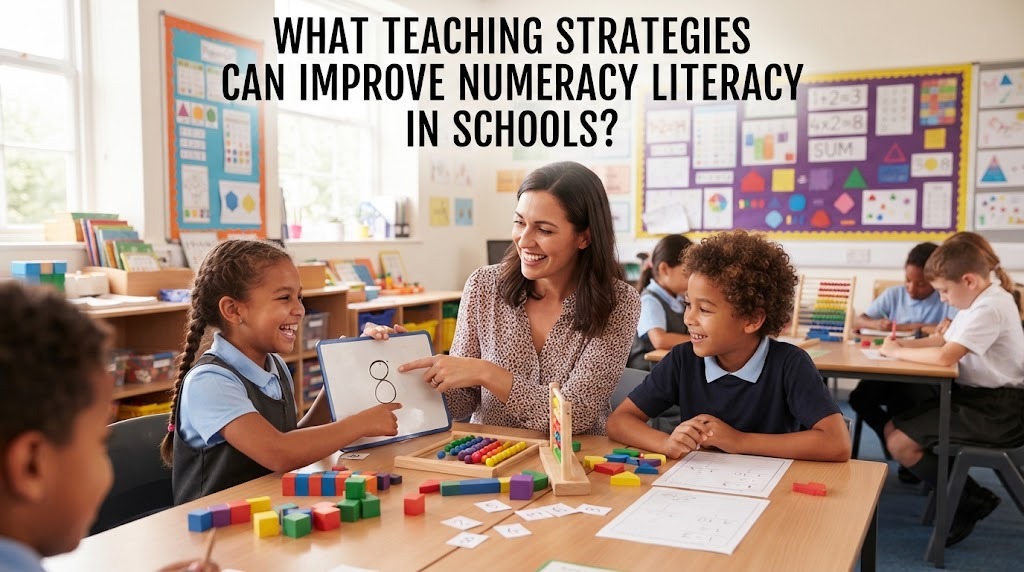
Numeracy literacy is an important part of education because it helps students understand numbers, interpret data, solve problems, and apply mathematical concepts in daily life. However, developing numeracy literacy requires more than memorizing formulas or completing routine exercises. Students need learning activities that encourage them to think, reason, and use mathematics in meaningful situations. For this reason, teachers need effective teaching strategies that make numeracy learning practical, engaging, and relevant.
Schools can improve numeracy literacy by combining classroom instruction with real-life problems, discussions, technology, projects, and regular assessment. These approaches allow students to understand how mathematical knowledge can be used beyond textbooks. With consistent practice and appropriate guidance, students can gradually become more confident in working with numbers and data.
USE REAL-LIFE PROBLEMS IN LEARNING
Using real-life problems is one effective way to improve numeracy literacy in schools. Teachers can create questions based on situations that students commonly experience, such as calculating shopping costs, comparing prices, planning a budget, or measuring distances. These activities help students understand that mathematics is useful in everyday life. They also encourage students to apply concepts rather than simply remember formulas.
Real-life problems can be adjusted according to students' ages and abilities. Younger students may work with simple counting and measurement activities, while older students can analyze percentages, statistics, or financial information. This approach makes lessons more meaningful because students can see a clear connection between classroom learning and their surroundings. It can also encourage students to participate more actively in discussions and problem-solving activities.
ENCOURAGE PROBLEM-SOLVING ACTIVITIES
Problem-solving activities can strengthen students' ability to think logically and systematically. Instead of always giving students questions with one familiar procedure, teachers can provide problems that require students to identify information, choose a strategy, and explain their reasoning. This allows students to understand the process behind an answer. It also helps them recognize that some problems can be solved through different methods.
Teachers should give students enough time to explore possible solutions before providing the correct answer. Students can work individually, in pairs, or in small groups to compare their approaches. When students explain how they reached a conclusion, teachers can identify misunderstandings and provide appropriate guidance. Regular problem-solving practice can therefore build confidence and improve mathematical reasoning.
DEVELOP DATA INTERPRETATION SKILLS
Understanding data is an important component of numeracy literacy. Students encounter numerical information through tables, graphs, charts, percentages, surveys, and reports. Teachers can use simple datasets that are relevant to students, such as classroom attendance, daily temperatures, transportation preferences, or sports statistics. Students can then practice reading the information and explaining what the numbers mean.
Data interpretation activities should not focus only on finding numerical answers. Students should also learn to compare information, identify patterns, and draw reasonable conclusions from the available evidence. Teachers can ask questions such as why a number changes or what a particular trend might indicate. This approach helps students become more careful when interpreting numerical information in school and everyday life.
USE COLLABORATIVE LEARNING
Collaborative learning gives students opportunities to discuss mathematical ideas with their classmates. Group activities can involve solving problems, analyzing data, creating charts, or completing practical projects. During these activities, students can explain their reasoning and listen to different approaches. Such interaction can help them discover alternative ways to understand a mathematical concept.
Teachers should organize groups and tasks carefully so that every student has an opportunity to contribute. Students who understand a concept well can explain it to classmates, while those who are still learning can ask questions in a supportive environment. Group discussions can also develop communication and reasoning skills alongside numeracy literacy. As a result, mathematics becomes a more interactive learning experience.
INTEGRATE NUMERACY ACROSS SUBJECTS
Numeracy literacy should not be taught only during mathematics lessons. Teachers can integrate numerical activities into subjects such as science, geography, economics, technology, and social studies. For example, science students can analyze measurements, geography students can interpret population data, and social studies students can examine statistical information. This demonstrates that numerical thinking is useful across different areas of knowledge.
Cross-subject learning also helps students understand why numeracy skills are important. They can practice the same skills in different contexts and gradually become more flexible when applying mathematical knowledge. Teachers can coordinate activities so that students encounter numbers and data in various lessons. This approach supports a broader understanding of numeracy literacy throughout the school curriculum.
TAKE ADVANTAGE OF DIGITAL LEARNING TOOLS
Digital learning tools can provide additional opportunities for students to practice numeracy skills. Interactive applications, digital simulations, spreadsheets, and educational platforms can present mathematical concepts through visual and practical activities. These tools can make difficult concepts easier to explore because students can observe changes and results directly. However, technology should support learning rather than replace teachers' explanations and guidance.
Teachers should select digital tools that match the learning objectives and students' abilities. They can combine technology with discussions and hands-on activities to ensure students understand the underlying concepts. For example, students might use a spreadsheet to organize data and then explain the patterns they find. This combination can help students develop both numerical understanding and useful digital skills.
APPLY PROJECT-BASED LEARNING
Project-based learning can improve numeracy literacy by allowing students to use mathematics to complete meaningful tasks. A class might create a simple school budget, conduct a survey, analyze energy use, or plan a small event. Students can collect information, perform calculations, organize data, and present their findings. These activities provide practical experience with mathematical concepts.
Projects should have clear objectives and manageable steps so students understand what they need to accomplish. Teachers can provide guidance while allowing students to make decisions about how to approach the project. At the end, students can present their calculations and explain the reasoning behind their conclusions. This process connects numeracy with communication, teamwork, creativity, and problem-solving.
PROVIDE REGULAR ASSESSMENT AND FEEDBACK
Regular assessment helps teachers understand students' progress in numeracy literacy. Assessment does not always need to take the form of formal examinations. Short exercises, classroom questions, practical tasks, projects, and observations can provide useful information about students' understanding. Teachers can use these results to identify concepts that require additional explanation or practice.
Feedback should focus on the reasoning process as well as the final answer. When students make mistakes, teachers can explain where their reasoning needs improvement and encourage them to try again. Constructive feedback helps students view mistakes as part of the learning process. Continuous assessment and feedback can therefore support steady improvement in numeracy skills.
CONCLUSION
Effective teaching strategies can significantly support the development of numeracy literacy in schools. Real-life problems, problem-solving activities, data interpretation, collaborative learning, cross-subject instruction, digital tools, and project-based learning give students opportunities to apply mathematics in meaningful situations. Regular assessment and constructive feedback can further help teachers identify learning needs and support student progress.
The most important goal is to help students understand that numeracy is not simply about calculating numbers. It is also about reasoning, interpreting information, solving problems, and making informed decisions. When schools provide varied and practical learning experiences, students can develop stronger numeracy skills that remain useful in their education and everyday lives.
Recent Posts

Bagaimana Sistem SKS pada Program Kuliah... 22.11.2026/33 View

How Does Technology Make Daily Evaluation... 21.11.2026/67 View

Apa Strategi Menghadapi Kesenjangan antara Kompetensi... 21.11.2026/67 View

Mengapa Inventaris Aset Penting bagi Kelancaran... 21.11.2026/65 View

When Should Musicians Join a Record... 21.11.2026/66 View
