

What Tests Determine a Bomb Disposal Robot's Reliability?
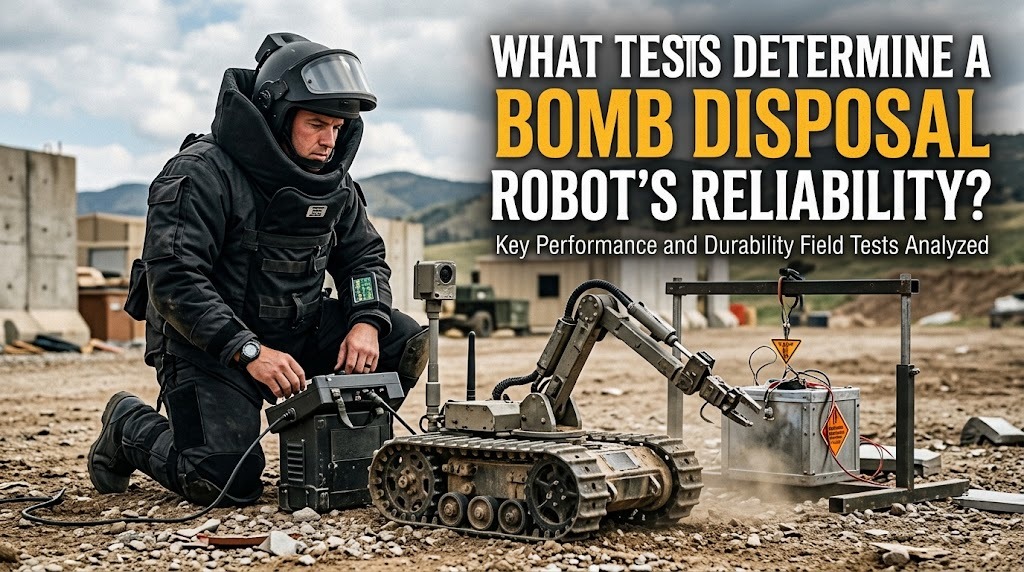
Bomb disposal robots help explosive ordnance disposal teams inspect suspicious objects and handle potentially dangerous situations from a safer distance. Because these robots operate in high-risk environments, their reliability is essential for protecting personnel and supporting successful missions. Before deployment, they must undergo extensive testing to evaluate mobility, control accuracy, sensor performance, communication stability, and mechanical durability. These assessments help determine whether a robot can perform its intended tasks consistently under demanding conditions.
MOBILITY AND TERRAIN TESTING
Mobility testing evaluates whether a bomb disposal robot can navigate challenging environments. Testers examine its ability to move across uneven ground, climb suitable slopes, cross small obstacles, and maneuver through confined spaces. Different surfaces, such as gravel, concrete, and loose soil, help reveal limitations in traction and stability. Engineers also assess whether the robot can recover from minor positioning errors without becoming stuck. Reliable mobility is important because restricted movement can prevent operators from reaching a suspicious object safely.
ROBOTIC ARM AND GRIPPER TESTS
A bomb disposal robot's manipulator must move accurately and handle objects within its designed operating limits. Tests evaluate the robotic arm's range of motion, positioning accuracy, grip stability, and ability to perform repeated movements. Engineers may use representative test objects to assess whether the gripper can hold items securely without unintended slipping. They also examine whether the arm maintains stable control when extended or carrying an appropriate load. These tests help verify that the robot can perform manipulation tasks without unpredictable movement.
SENSOR AND CAMERA PERFORMANCE TESTS
Cameras and sensors provide operators with information about suspicious objects and surrounding conditions. Testing examines image clarity, focus, field of view, low-light performance, and resistance to environmental interference. Depending on the system, additional sensors may measure distance, temperature, orientation, or other relevant conditions. Engineers evaluate whether the collected information remains dependable when visibility changes or the robot moves through different environments. Clear and accurate sensor data are necessary for operators to make informed decisions.
COMMUNICATION AND CONTROL RELIABILITY
Bomb disposal robots often rely on remote control systems to transmit commands and return video or sensor data. Communication testing evaluates signal stability, operating range, latency, and the system's response to temporary interference. Engineers also verify how the robot behaves when communication is interrupted. A reliable system should follow predefined safe-state procedures rather than continue uncontrolled movements. These tests help determine whether operators can maintain effective control under realistic operating conditions.
BATTERY LIFE AND POWER MANAGEMENT
Battery testing determines how long a robot can operate before requiring recharging or replacement. Engineers measure operating duration under different movement patterns, manipulator workloads, and sensor configurations. They also examine battery indicators, charging behavior, temperature management, and low-power warnings. A robot that loses power unexpectedly may become difficult to recover or leave an inspection incomplete. Reliable power management therefore helps teams plan missions and identify when a robot needs maintenance.
DURABILITY AND ENVIRONMENTAL RESISTANCE
Robots used in hazardous environments must withstand repeated operation and exposure to conditions such as dust, moisture, vibration, and temperature changes. Durability tests evaluate structural strength, joint wear, cable protection, and the performance of exposed electronic components. Environmental testing checks whether the robot continues to function within its specified operating limits. Engineers may also perform repeated movement cycles to identify components that deteriorate over time. These assessments help establish maintenance intervals and reduce the risk of unexpected mechanical failure.
FAILSAFE AND EMERGENCY RESPONSE TESTS
Failsafe testing examines how a robot responds when a component malfunctions or an operating limit is exceeded. Test scenarios may include loss of communication, low battery levels, sensor faults, and control-system errors. Engineers verify that emergency stops and other protective mechanisms operate as intended. They also check whether the robot provides clear fault notifications and enters an appropriate safe state. Because the consequences of failure can be severe, these procedures should follow established engineering standards and be performed in controlled test environments.
REPEATED PERFORMANCE AND FIELD VALIDATION
A single successful demonstration cannot establish long-term reliability. Repeated testing measures whether a robot produces consistent results across multiple operating cycles and representative scenarios. Engineers record failures, maintenance requirements, task completion rates, and variations in performance. Field validation then evaluates the system in environments that resemble its intended operational setting, using appropriate safety controls. Results help identify design weaknesses and determine whether further improvements are needed before deployment.
CONCLUSION
A bomb disposal robot's reliability is determined through a combination of mobility, manipulation, sensor, communication, battery, durability, and failsafe testing. Repeated performance assessments and controlled field validation provide additional evidence of its readiness for demanding operations. No single test can guarantee complete reliability, so evaluation must consider the robot as an integrated system. Thorough testing, regular maintenance, and trained operators are essential for dependable performance in hazardous environments.
Recent Posts

Bagaimana Sistem SKS pada Program Kuliah... 22.11.2026/49 View

How Does Technology Make Daily Evaluation... 21.11.2026/77 View

Apa Strategi Menghadapi Kesenjangan antara Kompetensi... 21.11.2026/78 View

Mengapa Inventaris Aset Penting bagi Kelancaran... 21.11.2026/74 View

When Should Musicians Join a Record... 21.11.2026/79 View
