

What Types of Books Are Suitable for Audiobooks?
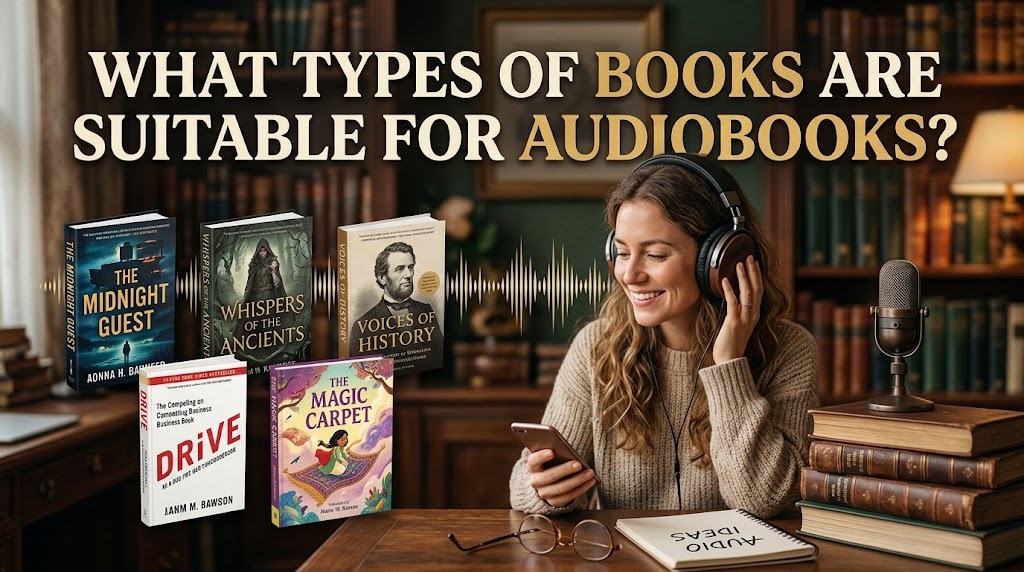
Audiobooks have become a popular way to enjoy books through recorded narration. Instead of reading printed pages, listeners can follow stories, explore new ideas, and learn information by listening to a narrator. However, not every book works equally well in audio format. Some books rely heavily on storytelling and dialogue, while others contain complex diagrams, tables, or visual details that may be easier to understand through printed text.
Understanding the types of books suitable for audiobooks can help listeners choose content that matches their interests and listening habits. Fiction, biographies, self-development books, educational materials, and other genres can work well when the narration and presentation suit the content. By considering the purpose of a book and how its information is delivered, listeners can find audiobooks that provide an enjoyable and useful experience.
FICTION AND NOVELS
Fiction is one of the book categories that can work particularly well as an audiobook. Novels often contain characters, dialogue, plot development, and descriptive passages that can be communicated effectively through narration. A narrator's voice, tone, and pacing can help listeners follow the storyline and understand the emotions of different characters.
Genres such as mystery, romance, fantasy, adventure, and science fiction can be enjoyable in audio format. For example, a mystery novel may encourage listeners to pay attention to clues and character conversations, while fantasy stories can use expressive narration to make fictional worlds more engaging. Some productions also use multiple narrators to distinguish characters. However, listeners who find it difficult to remember names or follow complicated plots may benefit from shorter listening sessions or revisiting earlier chapters. Choosing fiction audiobooks that match personal interests can make listening more enjoyable.
BIOGRAPHIES AND MEMOIRS
Biographies and memoirs are also suitable for audiobook formats because they often focus on personal experiences, important events, and life stories. Narration can make these books feel conversational, allowing listeners to follow the experiences of individuals from different backgrounds. When authors narrate their own memoirs, listeners may also hear the tone and emphasis the authors use when describing significant moments.
These books can introduce listeners to historical figures, artists, athletes, entrepreneurs, and other people whose experiences provide useful perspectives. A well-organized biography can be easier to follow when events are presented in chronological order or divided into clear chapters. Listeners can also pause to reflect on important lessons or return to sections they find meaningful. Biography audiobooks can therefore provide an engaging way to explore personal histories, achievements, challenges, and experiences.
SELF-DEVELOPMENT AND PERSONAL GROWTH BOOKS
Self-development books often discuss habits, communication, productivity, motivation, and personal goals. These subjects can work well in audio format because the material is frequently organized around explanations, examples, and practical suggestions. Listeners can absorb the main ideas while following a structured narration, making these books useful for people who want to explore personal growth.
To gain more from a self-development audiobook, listeners should avoid treating the content as background noise. It can be helpful to pause after an important section, reflect on the advice, and write down ideas that may be useful in everyday life. Some recommendations may not suit every situation, so listeners should evaluate them based on their circumstances. Self-development audiobooks are most useful when the information is understood critically and applied thoughtfully rather than accepted without consideration.
EDUCATIONAL AND LANGUAGE-LEARNING BOOKS
Educational books and language-learning materials can also be suitable for audiobooks, particularly when the content includes explanations, examples, and spoken-language practice. Students may use audio materials to review concepts, become familiar with new vocabulary, or listen to explanations outside classroom hours. Language learners can benefit from hearing pronunciation, sentence rhythm, and expressions used in context.
However, the effectiveness of educational audiobooks depends on the subject and how the material is presented. A book that relies heavily on mathematical equations, scientific diagrams, charts, or detailed visual instructions may require a printed or digital text alongside the audio. Learners can improve comprehension by pausing to summarize key ideas, replaying difficult sections, or following the narration with the written material. Educational audiobooks can complement other learning resources, especially when selected according to the learner's goals and current level.
HISTORY, CULTURE, AND GENERAL NONFICTION
History, culture, science communication, and general nonfiction can be effective audiobook choices when the information is presented clearly. These books often explain events, people, discoveries, and social developments through organized chapters and descriptive storytelling. Narration can help listeners follow a sequence of events and understand the connections between different ideas.
Historical narratives and cultural studies may be especially engaging when they include personal accounts, real-world examples, and clear explanations of unfamiliar terms. Some nonfiction subjects, however, contain detailed statistics, technical vocabulary, or visual evidence that listeners may need to examine separately. In those cases, an audiobook can be combined with articles, reference materials, or the printed edition. Choosing nonfiction audiobooks with a clear structure and suitable narration can help listeners explore new subjects while recognizing when additional resources are necessary.
CONCLUSION
The types of books suitable for audiobooks include fiction, biographies, memoirs, self-development books, educational materials, history, culture, and general nonfiction. These categories often contain narratives, explanations, or ideas that can be communicated effectively through spoken language. A clear narrator and well-organized content can make the listening experience more enjoyable and easier to follow.
Nevertheless, the most suitable format depends on the book's content and the listener's needs. Books that rely heavily on diagrams, equations, tables, or detailed visual information may be better understood when audio is combined with written materials. By choosing audiobook genres that match personal interests and learning goals, listeners can enjoy a wider variety of books and make listening a useful part of their daily routines.
Recent Posts

Bagaimana Sistem SKS pada Program Kuliah... 22.11.2026/40 View

How Does Technology Make Daily Evaluation... 21.11.2026/72 View

Apa Strategi Menghadapi Kesenjangan antara Kompetensi... 21.11.2026/73 View

Mengapa Inventaris Aset Penting bagi Kelancaran... 21.11.2026/69 View

When Should Musicians Join a Record... 21.11.2026/73 View
