

What Types Of Questions Can Be Included In A Question Bank?
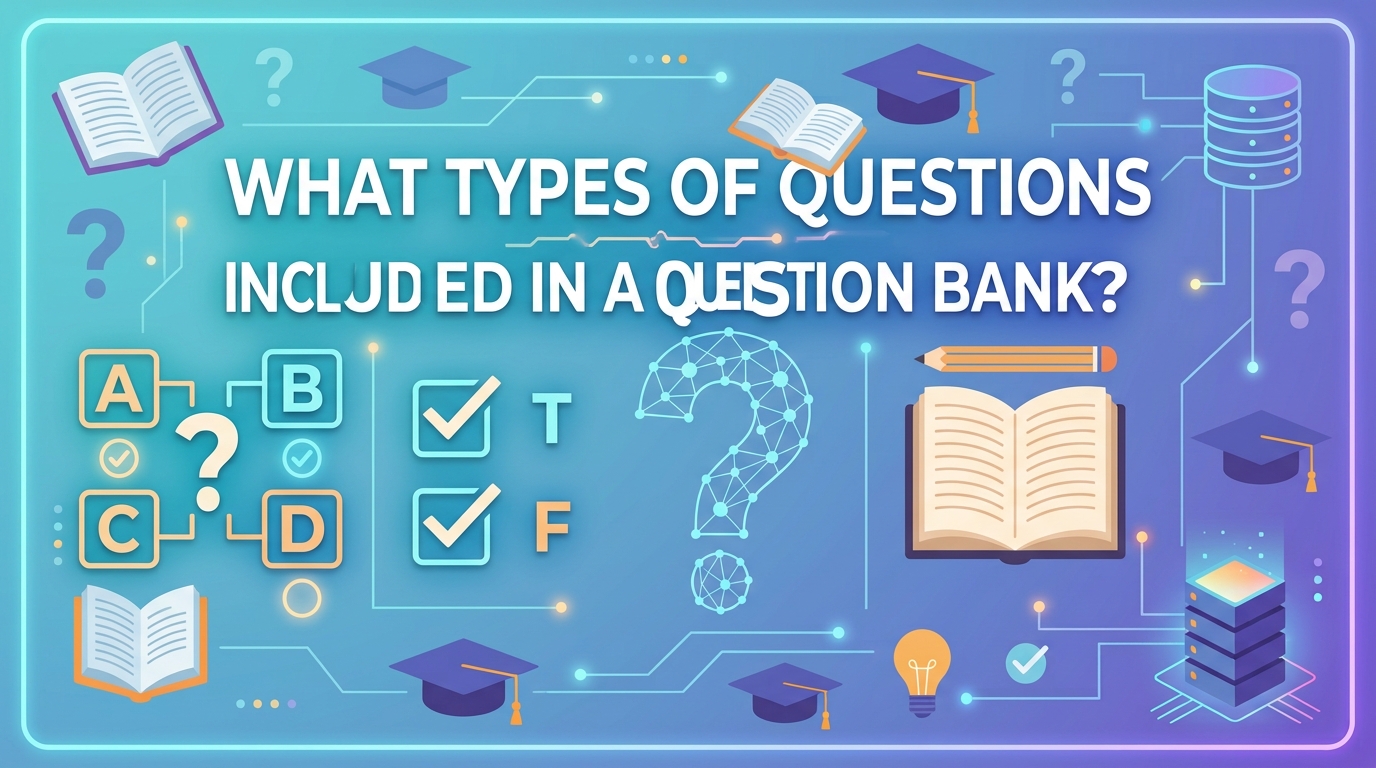
A question bank is an organized collection of questions used to support learning, practice, quizzes, and examinations. It can contain different question formats designed to measure students’ knowledge, understanding, and practical skills. Teachers can select questions based on learning objectives, subject areas, and students’ educational levels. Including a variety of question types helps educators assess different abilities instead of focusing only on memorizing information. By organizing questions carefully, a question bank can become a useful resource for improving teaching methods and helping students prepare for assessments.
MULTIPLE-CHOICE QUESTIONS
Multiple-choice questions present a question or statement followed by several possible answers. Students must select the option that best answers the question. This format is widely used because teachers can assess many topics within a limited amount of time. Multiple-choice questions can measure basic knowledge, understanding, and the ability to apply concepts when they are designed appropriately.
Teachers should ensure that each question has one clearly correct or best answer and that the other options are reasonable but incorrect. For example, a biology question may ask students to identify the main function of plant roots. These questions are also suitable for digital assessments because many platforms can score them automatically. However, teachers should avoid unclear wording and overly obvious options that make questions too easy to answer without understanding the material.
TRUE OR FALSE QUESTIONS
True-or-false questions ask students to decide whether a statement is correct or incorrect. They are useful for checking students’ understanding of facts, definitions, and basic concepts. For example, a teacher may ask whether plants use sunlight during photosynthesis. This format allows educators to assess several statements quickly and is easy for students to understand.
However, students have a relatively high chance of guessing the correct answer because there are usually only two choices. Teachers should write statements that focus on one clear idea and avoid confusing language. They should also provide explanations when reviewing incorrect answers so students understand the reasons behind the correct responses. True-or-false questions work best when combined with other formats that provide deeper insight into student understanding.
SHORT-ANSWER QUESTIONS
Short-answer questions require students to provide brief responses using their own words. They may ask students to define a term, explain a concept, identify a process, or provide a specific example. This format helps teachers evaluate whether students can recall information and express their understanding without relying on prepared answer choices. For example, students may be asked to explain the meaning of supply and demand in economics.
These questions can assess knowledge more directly than some selected-answer formats. Teachers should prepare clear instructions and establish appropriate marking criteria before using them in an assessment. Answers may vary in wording while still expressing the same correct idea, so scoring should focus on the required information rather than exact wording alone. Short-answer questions are useful for checking understanding while keeping assessments relatively concise.
ESSAY QUESTIONS
Essay questions require students to develop longer answers, explain ideas, or present arguments supported by relevant information. They are suitable for evaluating critical thinking, reasoning, writing skills, and the ability to organize knowledge. For example, students may be asked to discuss how digital technology influences modern education. Answering this type of question requires more than recalling facts because students must connect ideas and explain their reasoning.
Teachers should provide clear instructions about the topic, expected content, and answer length when necessary. A scoring rubric can help evaluate important elements such as accuracy, organization, supporting evidence, and clarity. Although essay questions provide detailed information about student understanding, they usually take longer to answer and assess. Therefore, they should be included when the learning objectives require explanation, analysis, or well-supported arguments.
MATCHING QUESTIONS
Matching questions ask students to connect related items from two lists. One list may contain terms, while the other includes definitions, descriptions, examples, or functions. For instance, students studying biology may match different organs with their functions. This format is useful for checking relationships between concepts and assessing knowledge of vocabulary or basic facts.
Teachers should ensure that the items in each list are clearly related and that the instructions explain how to complete the task. The lists should also be organized carefully to avoid unnecessary confusion. Matching questions can be scored quickly and may work well for subjects that contain many related terms. However, they are less suitable for measuring complex reasoning unless they are designed around more challenging relationships.
FILL-IN-THE-BLANK QUESTIONS
Fill-in-the-blank questions contain sentences or statements with missing words, numbers, or phrases that students must supply. They are useful for assessing vocabulary, formulas, definitions, and important facts. For example, an English teacher may provide a sentence with a missing verb, while a mathematics teacher may ask students to complete a calculation. This format encourages students to recall information without seeing a list of possible answers.
To make these questions effective, teachers should ensure that the missing information is clearly defined by the context. They should also consider whether more than one answer could be correct. When several answers are acceptable, the marking criteria should recognize appropriate alternatives. Fill-in-the-blank questions are particularly useful for practice activities that focus on accurate recall and understanding of essential information.
PRACTICAL AND PROBLEM-SOLVING QUESTIONS
Practical and problem-solving questions require students to apply their knowledge to a situation, calculation, case study, or real-world problem. These questions are useful for subjects such as mathematics, science, business, and vocational education. For example, marketing students may be asked to calculate a product’s profit or suggest a suitable promotional strategy for a small business. This format helps teachers determine whether students can use what they have learned in practical situations.
Teachers should design problems that match students’ abilities and the intended learning objectives. The questions may require students to show their calculations, explain their decisions, or describe the steps used to reach an answer. Assessment criteria should consider both the accuracy of the final result and the reasoning process when relevant. Including these questions helps a question bank measure application skills, logical thinking, and problem-solving abilities.
HOW TO CHOOSE THE RIGHT QUESTION TYPES
Selecting appropriate question types begins with identifying the learning objectives of an assessment. If teachers want to measure factual knowledge, multiple-choice, true-or-false, and fill-in-the-blank questions may be suitable. If the goal is to evaluate reasoning, communication, or the application of knowledge, short-answer, essay, and problem-solving questions may be more effective. Combining several formats can provide a broader understanding of student performance.
Teachers should also consider students’ educational levels, the time available, and the subject being assessed. Questions must use clear language, contain accurate information, and have suitable levels of difficulty. Every question should be reviewed regularly to ensure that it remains relevant to the curriculum. A balanced question bank helps teachers create assessments that are meaningful, fair, and aligned with what students are expected to learn.
CONCLUSION
A question bank can include multiple-choice, true-or-false, short-answer, essay, matching, fill-in-the-blank, and practical problem-solving questions. Each format serves a different purpose, from checking basic knowledge to evaluating critical thinking and the application of concepts. By combining suitable question types, teachers can assess students’ abilities more comprehensively.
The most effective question bank is not simply the one with the largest number of questions. It is a collection of clear, accurate, varied, and relevant questions that match learning objectives. Regular reviews and appropriate scoring criteria help maintain its quality. When carefully developed, a question bank can support effective teaching, meaningful assessment, and better student learning.
Recent Posts

Bagaimana Sistem SKS pada Program Kuliah... 22.11.2026/61 View

How Does Technology Make Daily Evaluation... 21.11.2026/87 View

Apa Strategi Menghadapi Kesenjangan antara Kompetensi... 21.11.2026/85 View

Mengapa Inventaris Aset Penting bagi Kelancaran... 21.11.2026/83 View

When Should Musicians Join a Record... 21.11.2026/87 View
