

What Types of Questions Commonly Appear in Verbal Reasoning Tests?
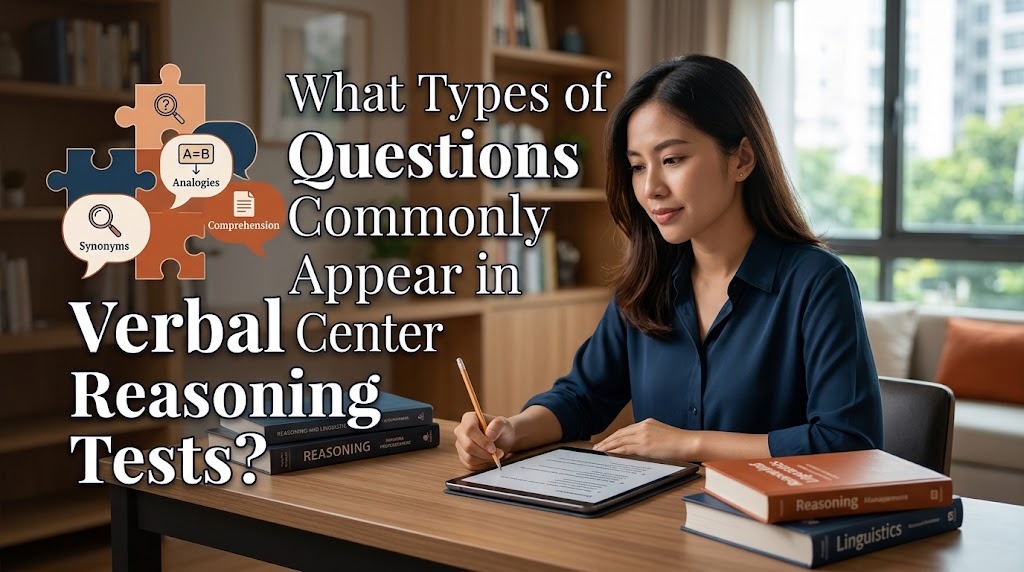
Verbal reasoning tests are commonly used in job recruitment, university admissions, scholarship selections, and academic assessments to evaluate a person's ability to understand written information and think logically. These tests contain different types of questions that examine how well candidates interpret words, recognize relationships, analyze statements, and draw conclusions from information. Each question type measures a particular aspect of verbal ability, so candidates need to understand the different formats before taking the assessment.
Knowing the types of questions commonly found in verbal reasoning tests can make preparation more effective. Candidates who understand the question patterns can develop suitable answering strategies, reduce mistakes, and manage their time more efficiently. Therefore, learning about these question types is an important step toward achieving better results in verbal reasoning assessments.
READING COMPREHENSION QUESTIONS
Reading comprehension questions are among the most common types of questions in verbal reasoning tests. Candidates are usually given a short passage or paragraph and asked to answer questions based on the information presented. The questions may focus on the main idea, supporting details, the author's purpose, or specific information contained in the passage.
To answer these questions correctly, candidates must understand the overall meaning of the text rather than simply recognize individual words. They should identify important sentences, distinguish main points from supporting information, and pay attention to details that directly relate to the questions. Some questions may also require candidates to understand implied meanings without adding assumptions that are not supported by the passage.
For example, a passage may discuss the importance of technology in education, followed by a question asking about its main benefit. Candidates must identify the central message and select the answer that accurately represents the information. Regular reading practice can help improve comprehension, concentration, and the ability to identify relevant information quickly.
SYNONYM AND ANTONYM QUESTIONS
Synonym and antonym questions evaluate a candidate's understanding of word meanings and vocabulary. Synonyms are words that have similar meanings, while antonyms are words that have opposite meanings. These questions usually present one word and ask candidates to select another word with a similar or opposite meaning from several available options.
For synonym questions, candidates need to recognize words that express similar ideas even when their spelling and pronunciation are different. For antonym questions, they must understand the original word clearly before identifying its opposite. Some words may have different meanings depending on their context, so understanding how a word is used is essential.
For example, the word accurate has a similar meaning to correct, while its opposite is inaccurate. Candidates who regularly read articles, study new vocabulary, and practice word exercises can improve their ability to answer these questions. A stronger vocabulary also supports performance in other sections of verbal reasoning tests.
WORD ANALOGY QUESTIONS
Word analogy questions measure a person's ability to recognize relationships between two or more words. These questions usually present a pair of related words and ask candidates to identify another pair that has a similar relationship. The connection may involve function, category, cause and effect, characteristics, or other logical relationships.
For example, the relationship between doctor and hospital is based on a professional working in a particular place. Candidates may then need to identify a similar relationship, such as teacher and school. The important part is not simply finding words with related meanings but understanding the exact connection between them.
To answer analogy questions effectively, candidates should identify the relationship in the first pair before examining the available options. They can also explain the relationship using a short sentence to make the connection easier to recognize. Practicing different analogy patterns can improve logical thinking and reduce confusion when answering unfamiliar questions.
TRUE FALSE AND CANNOT SAY QUESTIONS
True, false, and cannot say questions are commonly used to evaluate how accurately candidates interpret written information. In this question format, candidates receive a passage containing specific information, followed by several statements that must be evaluated based on the passage. They must determine whether each statement is supported, contradicted, or not sufficiently explained by the available information.
A true answer means the statement agrees with the information provided in the passage. A false answer means the passage contains information that directly contradicts the statement. Meanwhile, cannot say means there is not enough information to determine whether the statement is true or false.
For example, if a passage states that a company operates in three cities, a statement claiming that it operates in three cities is true. A statement claiming that it operates in five cities is false. However, a statement claiming that the company has the largest market share may be classified as cannot say if the passage does not provide any information about market share.
The most important strategy is to avoid using personal knowledge or assumptions when evaluating statements. Candidates should rely entirely on the information presented in the passage. Careful reading is particularly important because small differences in wording can change the correct answer.
SENTENCE COMPLETION AND WORD MEANING QUESTIONS
Sentence completion questions assess a candidate's ability to understand context and select words that make a sentence logically and grammatically appropriate. Candidates are usually given a sentence with one or more missing words and several answer options. They must choose the word or phrase that produces the most suitable meaning.
These questions require more than vocabulary knowledge because candidates must understand how different parts of a sentence relate to one another. For example, words indicating contrast, cause, comparison, or sequence can influence which answer is most appropriate. Understanding these relationships helps candidates recognize the intended meaning of the sentence.
Another related question format focuses on identifying the meaning of a word based on its context. A word may have several possible definitions, but only one meaning fits the surrounding sentence. Candidates should therefore read the entire sentence before selecting an answer instead of focusing on the unfamiliar word alone.
Improving vocabulary, studying sentence structures, and practicing contextual exercises can help candidates become more familiar with these questions. These skills are useful not only for verbal reasoning assessments but also for academic writing and everyday communication.
LOGICAL DEDUCTION AND STATEMENT ANALYSIS QUESTIONS
Logical deduction questions measure the ability to analyze statements and determine whether a particular conclusion follows from the available information. These questions often present several facts or conditions that candidates must examine before choosing an appropriate conclusion. Unlike ordinary reading comprehension questions, they focus more heavily on the logical connections between statements.
For example, a question may state that all employees in a particular department must complete training and that Rina works in that department. Candidates must determine whether Rina is required to complete the training. The correct conclusion follows directly from the two statements without requiring additional information.
Statement analysis questions may also ask candidates to identify assumptions, evaluate arguments, or determine whether a conclusion is logically supported. These formats help assess critical thinking, analytical reasoning, and decision-making abilities.
To answer these questions effectively, candidates should examine each statement carefully and avoid conclusions that go beyond the information provided. Breaking complex statements into smaller parts can also make the reasoning process easier. Regular practice can improve accuracy and help candidates become more confident when facing challenging verbal reasoning questions.
CONCLUSION
Verbal reasoning tests contain several types of questions designed to measure different language and thinking abilities. Common formats include reading comprehension, synonyms and antonyms, word analogies, true false and cannot say questions, sentence completion, and logical deduction. Each format evaluates how effectively candidates understand information, recognize relationships, and draw reasonable conclusions.
Understanding these question types can help candidates prepare more systematically for university admissions and job recruitment assessments. By improving vocabulary, practicing reading comprehension, developing logical thinking, and reviewing previous mistakes, candidates can strengthen their verbal reasoning abilities and achieve better test performance.
Recent Posts

Bagaimana Sistem SKS pada Program Kuliah... 22.11.2026/45 View

How Does Technology Make Daily Evaluation... 21.11.2026/73 View

Apa Strategi Menghadapi Kesenjangan antara Kompetensi... 21.11.2026/75 View

Mengapa Inventaris Aset Penting bagi Kelancaran... 21.11.2026/71 View

When Should Musicians Join a Record... 21.11.2026/75 View
