

When Are Tethered Robots Better Than Wireless Alternatives?
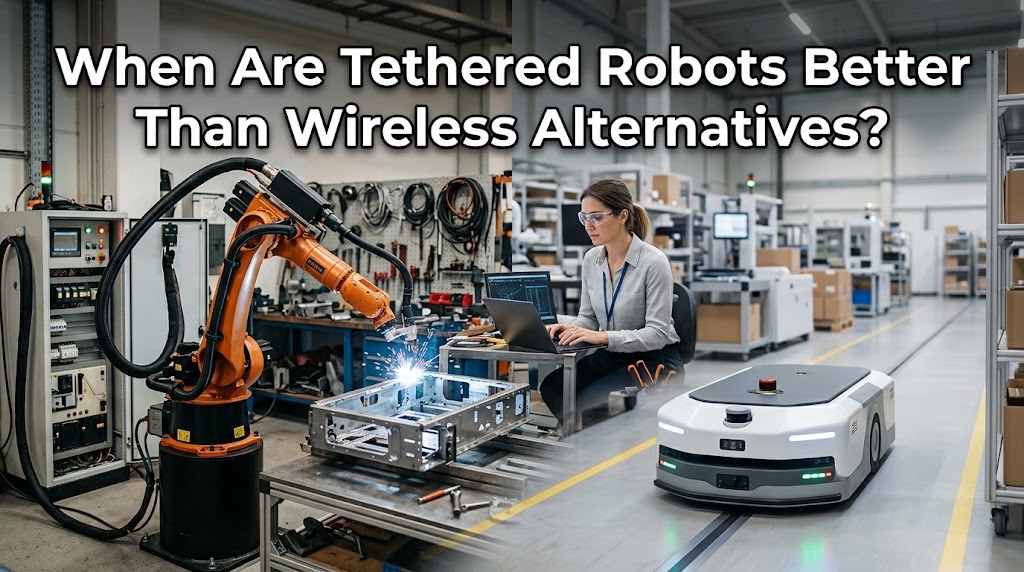
Robots rely on communication systems to receive commands, transmit sensor data, and coordinate their movements. While wireless robots offer greater freedom of movement, tethered robots use physical cables to maintain a direct connection with an operator or control system. The choice between these designs depends on the operating environment, power requirements, communication reliability, and mission duration. Understanding their differences helps engineers select the most suitable robotic system for industrial, underwater, and hazardous applications.
UNDERSTANDING TETHERED AND WIRELESS ROBOTS
Tethered robots connect to an external system through a physical cable that may carry electrical power, communication signals, or both. This connection can provide a stable data link and reduce dependence on onboard batteries. Wireless robots communicate through technologies such as Wi-Fi, radio frequency, or other wireless networks, allowing them to move without a physical connection. However, wireless performance can vary depending on distance, obstacles, interference, and available power. Each approach offers distinct advantages depending on the task.
WHEN COMMUNICATION RELIABILITY IS ESSENTIAL
Tethered robots are often preferable when uninterrupted communication is critical. A physical data connection can reduce problems caused by wireless interference, signal congestion, or radio-frequency restrictions. This is particularly valuable when robots transmit high-resolution video, detailed sensor readings, or large amounts of operational data. For example, a remotely operated inspection robot may use a tether to maintain a dependable video feed while examining industrial equipment. However, cable damage, connector failure, and excessive cable length can still interrupt communication.
WHEN ROBOTS NEED CONTINUOUS POWER
Robots performing long-duration tasks may benefit from receiving power through a tether. This arrangement reduces dependence on battery capacity and can allow continuous operation while an external power source remains available. It is useful for stationary inspection systems, underwater vehicles, and robots monitoring equipment for extended periods. Wireless robots generally rely on onboard batteries, which require recharging or replacement. Nevertheless, power tethering introduces additional considerations, including cable weight, voltage losses, electrical protection, and the availability of a suitable power source.
OPERATING IN UNDERWATER ENVIRONMENTS
Underwater robots frequently use tethers because ordinary wireless communication technologies do not transmit effectively through water over typical operational distances. A tether can carry control commands, camera feeds, and sensor data between a remotely operated vehicle and a surface station. It may also supply power, depending on the system design. These connections are valuable for underwater infrastructure inspection, marine research, and industrial maintenance. However, cables can become tangled, snag on structures, or restrict movement, so tether management is an important part of underwater operations.
WORKING IN INDUSTRIAL AND HAZARDOUS LOCATIONS
Tethered robots can be advantageous in environments where wireless signals are unreliable or restricted. Thick walls, metal structures, underground passages, and electromagnetic interference may weaken wireless communication. A physical connection can provide a more dependable link when the robot must remain under continuous operator supervision. Some hazardous operations also benefit from external power and reliable transmission of inspection data. Even so, a tether does not automatically make a robot safe for explosive atmospheres or other hazardous areas; the entire system must meet the relevant safety requirements.
WHEN WIRELESS ROBOTS ARE THE BETTER CHOICE
Wireless robots are generally more suitable when mobility, flexibility, and unrestricted movement are priorities. Without a cable, they can navigate complex routes, move between work areas, and avoid tether-related obstacles. This makes them useful for warehouse transportation, autonomous delivery, agricultural monitoring, and many mobile inspection tasks. Wireless operation also eliminates the need to manage a physical cable during movement. However, engineers must consider battery life, network coverage, communication latency, and the robot's behavior if the wireless connection is lost.
LIMITATIONS OF TETHERED ROBOT SYSTEMS
Despite their communication and power advantages, tethered robots face several mechanical limitations. Cables can become entangled, catch on obstacles, or interfere with the robot's movement. Longer tethers may introduce additional drag, tension, and handling complexity, particularly in underwater or confined environments. Cable reels, connectors, and external power equipment can also increase system costs and maintenance requirements. Engineers must therefore evaluate cable length, flexibility, durability, and routing before selecting a tethered design.
FACTORS FOR CHOOSING THE RIGHT ROBOT
Selecting between tethered and wireless robots requires an assessment of the mission's technical requirements. Engineers should consider communication reliability, power consumption, operating duration, mobility, environmental conditions, and maintenance costs. A tethered design may be preferable for prolonged inspection with continuous data transmission, while a wireless platform may suit tasks involving extensive movement. Hybrid systems can combine wireless mobility with tethered operation when necessary. Testing the selected system under realistic conditions helps verify that it can meet operational requirements reliably.
CONCLUSION
Tethered robots are often better than wireless alternatives when continuous power, dependable communication, or uninterrupted data transmission is essential. They are especially useful in underwater inspection, extended monitoring, and environments where wireless signals may be unreliable. Wireless robots remain preferable when freedom of movement and flexibility are more important. The best choice depends on the mission, operating environment, and balance between communication reliability and mobility.
Recent Posts

Bagaimana Sistem SKS pada Program Kuliah... 22.11.2026/49 View

How Does Technology Make Daily Evaluation... 21.11.2026/77 View

Apa Strategi Menghadapi Kesenjangan antara Kompetensi... 21.11.2026/78 View

Mengapa Inventaris Aset Penting bagi Kelancaran... 21.11.2026/74 View

When Should Musicians Join a Record... 21.11.2026/79 View
