

When Do Employers Use Psychometric Tests in Recruitment?
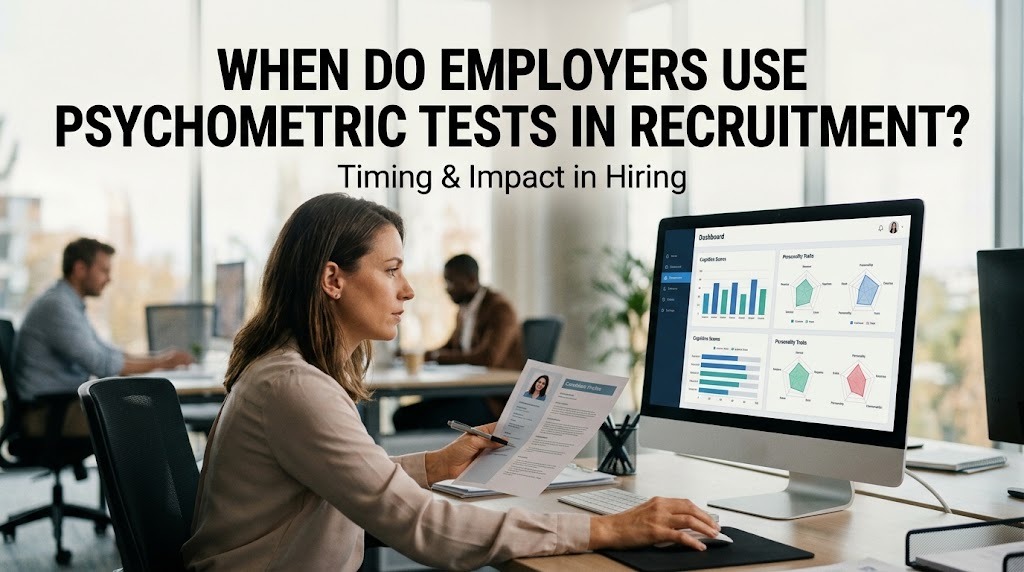
Employers use psychometric tests in recruitment at different stages of the hiring process to gather information about candidates' abilities, characteristics, and work-related preferences. These assessments can help recruiters evaluate applicants beyond the information provided in resumes and interviews. Depending on the position and recruitment strategy, a psychometric test may be administered early in the selection process or after an initial interview.
The timing of a psychometric assessment depends on the company's hiring objectives, the number of applicants, and the skills required for the role. Some employers use tests to screen a large applicant pool, while others introduce them later to support comparisons between shortlisted candidates. Understanding when these tests are used can help job applicants prepare for each stage of recruitment.
DURING THE INITIAL APPLICATION SCREENING
Employers may use psychometric tests during initial recruitment screening when they receive a large number of applications for a vacancy. At this stage, assessments can provide additional information about candidates' reasoning abilities or other job-related characteristics. The results may help recruiters determine which applicants should proceed to the next stage.
For example, a company recruiting for an analytical position may ask applicants to complete a numerical or logical reasoning test. This can help the employer assess skills relevant to the role before arranging individual interviews. However, not every company uses psychometric tests at the initial stage, and the decision to advance a candidate should not depend solely on one assessment result. Qualifications, relevant experience, and other application requirements may also be considered.
AFTER RESUME AND QUALIFICATION REVIEW
Some employers administer psychometric tests after reviewing resumes and checking whether applicants meet the basic requirements of a position. This approach allows recruiters to narrow the applicant pool before investing additional time in assessments. Candidates who meet the educational, professional, or experience requirements may then be invited to complete a test.
At this stage, the assessment can help employers compare applicants who have similar qualifications. For example, two candidates may have comparable degrees and work experience but demonstrate different approaches to numerical reasoning or problem-solving. Psychometric results can provide another perspective on their abilities, although they should be interpreted in the context of the job. This stage may also include online assessments that candidates complete remotely within a specified period.
BEFORE OR AFTER THE FIRST INTERVIEW
Employers may schedule psychometric testing before the first interview to identify candidates whose abilities align with the role. This can be useful when the company wants to prioritize applicants for interviews based on specific job-related criteria. The results may also help recruiters prepare questions that explore relevant skills and experiences in greater detail.
Other employers administer assessments after the first interview. By that point, recruiters may already have a preliminary understanding of the candidate's background, communication skills, and career interests. A subsequent test can provide additional information to support the evaluation. Neither approach is universally required; the timing depends on the employer's recruitment process, the type of assessment, and the practical needs of the organization.
DURING THE SHORTLISTING AND FINAL SELECTION STAGES
Psychometric tests during candidate shortlisting can help employers compare applicants who have already passed earlier recruitment stages. At this point, the applicant pool is usually smaller, allowing recruiters to examine assessment results alongside interview performance, qualifications, and other evidence. The tests may focus on abilities that are particularly important for the position.
In some recruitment processes, an assessment may also be used before the final hiring decision. For example, candidates applying for a management role might complete a relevant assessment alongside structured interviews or work-related exercises. Employers can use the combined information to evaluate how well each applicant meets the role's requirements. However, a test score should not automatically determine the final outcome because job performance also depends on experience, training, motivation, and workplace conditions.
WHEN A ROLE REQUIRES SPECIFIC ABILITIES OR CHARACTERISTICS
Employers are more likely to consider psychometric testing when a role requires particular cognitive abilities or other measurable characteristics. Positions involving numerical analysis, complex problem-solving, or detailed information processing may benefit from relevant ability assessments. Roles involving frequent collaboration or customer interaction may also use carefully selected personality or situational judgment assessments when these measures are appropriate for the job.
The choice of test should follow an analysis of the position's actual responsibilities. Employers should not administer assessments simply because they are available or commonly used by other organizations. A suitable test needs to measure characteristics relevant to the role and produce results that can be interpreted responsibly. This approach helps ensure that testing contributes meaningful information to recruitment rather than creating unnecessary barriers for applicants.
CONCLUSION
Employers may use psychometric tests in recruitment during initial screening, after reviewing resumes, before or after interviews, during shortlisting, or before making a final hiring decision. The timing depends on the company's recruitment strategy, the number of applicants, and the type of information needed to evaluate candidates.
For job applicants, understanding these stages can make the hiring process easier to anticipate. It is useful to review the employer's instructions, practice relevant question formats when appropriate, and prepare for the possibility of online or in-person assessments. When used alongside interviews, qualifications, and practical evidence, psychometric testing can support more structured and informed recruitment decisions.
Recent Posts

Bagaimana Sistem SKS pada Program Kuliah... 22.11.2026/61 View

How Does Technology Make Daily Evaluation... 21.11.2026/87 View

Apa Strategi Menghadapi Kesenjangan antara Kompetensi... 21.11.2026/85 View

Mengapa Inventaris Aset Penting bagi Kelancaran... 21.11.2026/83 View

When Should Musicians Join a Record... 21.11.2026/87 View
