

When Does Inflation Become a Serious Economic Problem?
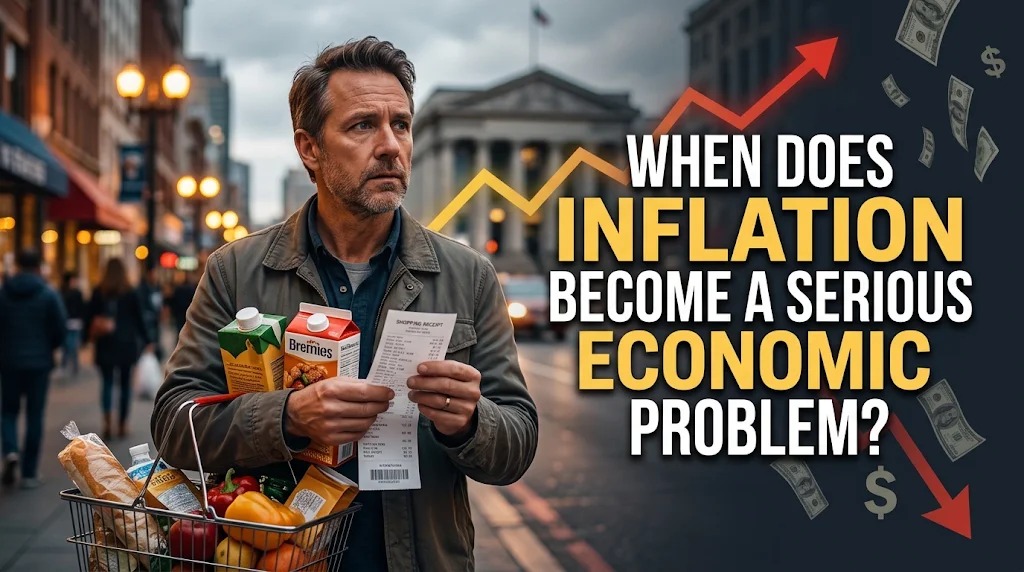
Inflation is a normal part of economic activity, but it can become a serious problem when prices increase too quickly, remain unstable, or grow faster than people's incomes. Moderate inflation may occur as an economy develops and consumer demand increases. However, excessive inflation can weaken purchasing power, disrupt business activities, and create uncertainty for households and investors. Understanding when inflation becomes dangerous is important for maintaining economic stability and protecting people's financial well-being.
WHEN PRICE INCREASES BECOME TOO RAPID
Inflation becomes a serious economic problem when the prices of goods and services rise rapidly over a relatively short period. Under these conditions, consumers may struggle to adjust their spending because essential products become more expensive before their incomes can increase. Food, transportation, housing, and healthcare costs can place significant pressure on household budgets.
One particularly concerning situation is high inflation, especially when it continues for an extended period. Businesses may also find it difficult to determine production costs and selling prices because market conditions change frequently. If inflation becomes extremely high and accelerates uncontrollably, it can develop into hyperinflation, a situation in which money loses purchasing power at an exceptionally rapid rate. This can severely disrupt normal economic activities.
WHEN INCOME GROWTH CANNOT KEEP UP WITH INFLATION
Inflation becomes more harmful when wages and household incomes increase more slowly than the prices of goods and services. In this situation, people's real income decreases even if their nominal salaries remain unchanged or increase slightly. They may need to spend a larger portion of their earnings on basic necessities.
This problem can affect low-income households, fixed-income workers, and pensioners more significantly. These groups often have limited financial flexibility and may find it difficult to reduce essential expenses. When purchasing power declines continuously, households may reduce consumption, postpone important purchases, or depend more heavily on personal savings. If this situation affects a large part of society, it can weaken overall consumer demand.
WHEN BUSINESSES AND INVESTORS FACE ECONOMIC UNCERTAINTY
Unstable inflation can create uncertainty for businesses because production expenses and consumer demand become harder to predict. Companies may struggle to prepare budgets, determine product prices, and make long-term investment decisions. When the cost of raw materials, labor, transportation, and energy changes frequently, business planning becomes more complicated.
Investors may also become more cautious when inflation remains high and unpredictable. They may delay investment decisions because future returns become harder to estimate. In response, central banks may increase interest rates to control inflation, which can make borrowing more expensive for businesses and consumers. If investment and business expansion slow down, economic growth may also be affected.
WHEN THE COST OF LIVING CREATES SOCIAL PRESSURE
Inflation can become a serious social problem when the increasing cost of living makes essential goods and services difficult to afford. Families may struggle to pay for food, housing, education, transportation, and healthcare. The pressure can be especially severe when wages remain stagnant or employment opportunities become limited.
Persistent increases in essential prices can also widen economic differences between households. People with higher incomes or valuable assets may have more resources to adjust, while financially vulnerable groups have fewer options. If the situation continues, dissatisfaction may grow because people feel that their income is no longer sufficient to meet basic needs. This makes inflation not only an economic issue but also a social concern.
WHEN INFLATION BECOMES DIFFICULT TO CONTROL
Inflation becomes particularly concerning when price increases continue despite efforts to stabilize the economy. Central banks may use monetary policy, such as adjusting interest rates, to reduce excessive demand and control inflationary pressure. Governments may also implement fiscal measures and policies that support product availability and improve distribution.
However, controlling inflation can be challenging when several factors occur simultaneously. Rising global energy prices, supply chain disruptions, currency depreciation, and shortages of essential goods may continue pushing prices upward. If economic policies are poorly coordinated or public confidence declines, inflation expectations may become harder to manage. Effective responses therefore require careful coordination between monetary policy, fiscal policy, and measures that strengthen domestic production.
CONCLUSION
Inflation becomes a serious economic problem when prices rise rapidly, incomes fail to keep pace, businesses face uncertainty, and essential goods become increasingly difficult to afford. It is also more challenging when inflation remains persistent and economic policies struggle to control it. Maintaining price stability requires effective monetary and fiscal policies, reliable product supplies, and economic conditions that support sustainable growth.
Recent Posts

Bagaimana Sistem SKS pada Program Kuliah... 22.11.2026/35 View

How Does Technology Make Daily Evaluation... 21.11.2026/69 View

Apa Strategi Menghadapi Kesenjangan antara Kompetensi... 21.11.2026/69 View

Mengapa Inventaris Aset Penting bagi Kelancaran... 21.11.2026/67 View

When Should Musicians Join a Record... 21.11.2026/68 View
