

Which Databases Are Commonly Used for Journal Indexing?
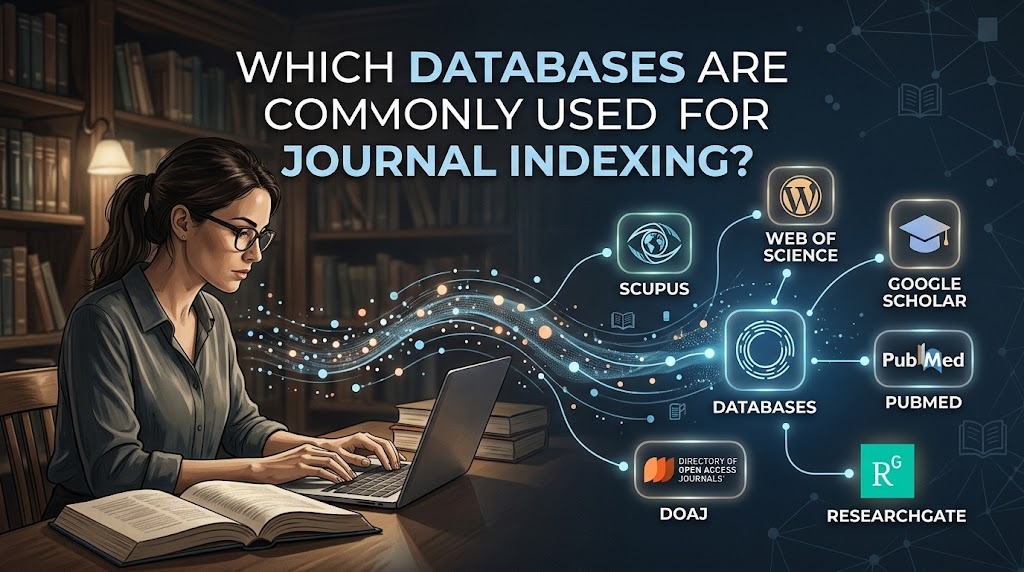
Journal indexing databases play an important role in academic publishing by helping researchers discover scholarly articles and evaluate publications relevant to their fields. These databases collect and organize information about journals, articles, authors, and citations, making academic literature easier to search and access. Different databases serve different purposes, ranging from broad academic discovery to specialized research coverage.
For students, lecturers, and researchers, understanding the databases commonly used for journal indexing can help when selecting references or preparing manuscripts for publication. However, each database has its own coverage and selection criteria, so researchers should identify which database best matches their academic needs.
SCOPUS FOR MULTIDISCIPLINARY RESEARCH
Scopus is a multidisciplinary abstract and citation database that covers scholarly publications across fields such as science, technology, medicine, social sciences, and the humanities. Researchers can use it to discover academic articles, examine citation information, and explore relationships between publications and authors.
Scopus is also used to evaluate journal coverage and research performance through various bibliometric indicators. However, researchers should distinguish between a journal's inclusion in Scopus and its performance according to citation metrics. To confirm whether a journal is currently covered, researchers should consult the official Scopus Sources directory and review its coverage information rather than relying solely on claims displayed on a journal's website.
WEB OF SCIENCE FOR SCHOLARLY LITERATURE AND CITATIONS
Web of Science is another widely used research platform that provides access to scholarly literature and citation information. Its coverage includes multiple academic disciplines, with different collections and indexes serving specific research needs. Researchers can use the platform to find publications, trace citations, and examine how research contributes to developments within a field.
The Web of Science Core Collection includes several indexes, and journal inclusion depends on the relevant collection and its selection criteria. Therefore, a statement that a journal is indexed in Web of Science should be checked carefully to determine which index covers it. Researchers can use the official Master Journal List to verify journal information and avoid confusing different levels or types of coverage.
SINTA FOR INDONESIAN ACADEMIC JOURNALS
SINTA (Science and Technology Index) is an Indonesian platform used to access information about scholarly publications and research performance. It is particularly relevant to students, lecturers, and researchers working within Indonesia's higher education and research environment.
SINTA provides information about Indonesian scholarly journals and their rankings within the national system. Researchers can use it to explore journals in different academic fields and review information relevant to local publication requirements. However, SINTA and international indexing databases serve different purposes, so a journal's SINTA ranking should not automatically be interpreted as proof that it is indexed in Scopus or Web of Science. Researchers should verify each status separately through the appropriate official platform.
SUBJECT-SPECIFIC INDEXING DATABASES
Some academic indexing databases focus on particular disciplines rather than covering research across many fields. For example, PubMed is widely used to search biomedical and life sciences literature, while ERIC focuses on education-related research. IEEE Xplore provides access to technical literature in areas such as electrical engineering, electronics, and computing.
These specialized platforms can help researchers find literature that is highly relevant to their topics. However, it is important to understand that a database's content may include different types of publications, and inclusion in a search platform does not always mean that every journal or article has undergone the same evaluation process. Researchers should review the platform's scope and inclusion policies before interpreting its records as evidence of journal indexing.
OTHER DATABASES AND ACADEMIC DISCOVERY TOOLS
Researchers may also use other databases and scholarly discovery tools to locate relevant publications. DOAJ (Directory of Open Access Journals) provides information about open-access journals that meet its inclusion criteria. Google Scholar helps users discover scholarly literature across a broad range of sources, while Crossref provides searchable metadata for publications registered with its services.
These resources can be valuable for literature reviews and publication searches, but their functions differ. For example, Google Scholar is primarily a scholarly search tool, and the presence of an article in its results should not automatically be treated as proof that its journal is indexed in a selective citation database. Similarly, the registration of a publication's metadata with Crossref is not equivalent to inclusion in Scopus or Web of Science. Understanding these distinctions helps researchers interpret database information accurately.
CONCLUSION
Commonly used journal indexing databases include Scopus, Web of Science, SINTA, and subject-specific resources such as PubMed, ERIC, and IEEE Xplore. Other tools, including DOAJ, Google Scholar, and Crossref, can also support scholarly discovery and publication research, although they do not all perform the same indexing function.
Researchers should choose databases according to their subject areas and academic objectives. Before relying on a journal's indexing claims, they should consult the relevant official source and confirm the journal's identity, coverage, and current status. This approach helps students and lecturers locate reliable academic information and make better-informed publication decisions.
Recent Posts

Bagaimana Sistem SKS pada Program Kuliah... 22.11.2026/44 View

How Does Technology Make Daily Evaluation... 21.11.2026/73 View

Apa Strategi Menghadapi Kesenjangan antara Kompetensi... 21.11.2026/75 View

Mengapa Inventaris Aset Penting bagi Kelancaran... 21.11.2026/70 View

When Should Musicians Join a Record... 21.11.2026/74 View
