

Which Gripper Designs Handle Irregularly Shaped Industrial Components?
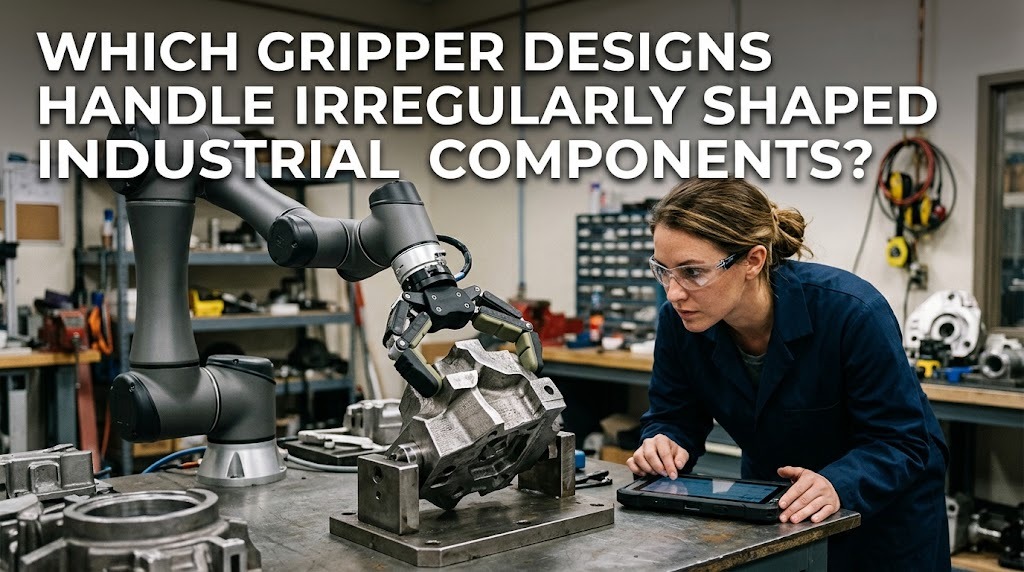
Industrial robots frequently handle components with different shapes, sizes, weights, and surface properties. Standard grippers may struggle with objects that have uneven surfaces, unusual contours, or fragile sections. Selecting the right gripper design helps manufacturers improve handling accuracy, reduce product damage, and maintain consistent production. Several gripper technologies are particularly suitable for manipulating irregularly shaped industrial components.
ADAPTIVE FINGER GRIPPERS
Adaptive finger grippers use movable fingers that adjust to the shape of an object. Unlike rigid grippers with fixed contact points, these designs can accommodate components with different contours and dimensions.
Some adaptive grippers use flexible joints, underactuated mechanisms, or compliant materials to distribute gripping forces more evenly. This makes them useful for handling cast metal parts, irregular plastic housings, and components with uneven surfaces. Their performance depends on finger geometry, gripping force, and the object's material.
SOFT ROBOTIC GRIPPERS
Soft robotic grippers use flexible materials such as silicone or other elastomers to conform to an object's surface. Their compliant structure allows them to grasp items with complex shapes without relying on precise contact points.
These grippers are especially useful when components are delicate, lightweight, or easily scratched. In industrial environments, they can handle products with uneven contours or varying dimensions. However, material durability, gripping force, and resistance to chemicals or heat must be considered before selecting a soft gripper.
VACUUM GRIPPERS WITH FLEXIBLE PADS
Vacuum grippers use suction to hold objects through a pressure difference between the suction pad and the surrounding atmosphere. Flexible suction pads can adapt to moderate surface variations, making them suitable for certain irregularly shaped components.
Multiple suction cups can improve stability when handling larger objects. Nevertheless, vacuum gripping works best when the contact surfaces are sufficiently airtight. Highly porous, rough, curved, or heavily textured components may require specialized pads, foam-based suction systems, or an alternative gripping method.
THREE-FINGER AND MULTIFINGER GRIPPERS
Three-finger grippers provide multiple contact points around an object, helping stabilize components that are difficult to hold with two parallel fingers. Their arrangement can support cylindrical, rounded, or asymmetrical workpieces, depending on the finger design.
Multifinger grippers offer additional contact points and can distribute forces across complex surfaces. Some designs use independently controlled fingers to accommodate different geometries. Although these systems provide flexibility, they may require more complex control software and careful calibration.
MAGNETIC GRIPPERS FOR METAL COMPONENTS
Magnetic grippers use permanent magnets or electromagnets to hold ferromagnetic objects. They can be effective for handling irregular metal components that lack convenient gripping surfaces.
These systems reduce the need for mechanical contact at multiple points and can simplify the handling of certain steel parts. However, they are unsuitable for nonmagnetic materials such as aluminum, copper, and most plastics. Engineers must also evaluate magnetic strength, component thickness, surface conditions, and the risk of residual magnetism.
MECHANICAL CONTOUR GRIPPERS
Mechanical contour grippers use specially shaped fingers or contact surfaces designed around a component's geometry. They can provide a stable grip for irregular parts when the shape remains consistent across production batches.
Manufacturers often use custom-machined fingers, replaceable inserts, or protective contact materials to improve positioning and prevent surface damage. These grippers can offer reliable performance in repetitive manufacturing processes, but they may be less versatile when product designs change frequently.
HYBRID GRIPPING SYSTEMS
Hybrid grippers combine two or more gripping technologies to handle components with different physical characteristics. For example, a robot may use mechanical fingers together with vacuum suction to stabilize a part that has both curved and flat surfaces.
Other hybrid designs combine compliant fingers with force sensors or tactile sensors. These systems can adjust gripping pressure based on contact information, improving stability when object dimensions vary. Although hybrid grippers can handle complex tasks, they usually require more integration, programming, and maintenance.
FACTORS FOR SELECTING THE RIGHT GRIPPER
Choosing a suitable gripper begins with examining the component's geometry, weight, material, surface texture, and fragility. Engineers should also consider the required cycle time, positioning accuracy, robot payload, and environmental conditions.
A practical selection process includes testing the gripper with representative components under realistic production conditions. Testing should measure grip stability, slippage, surface damage, repeatability, and performance across different orientations. Safety margins should also account for acceleration, vibration, and changes in component weight.
CONCLUSION
Adaptive finger grippers, soft robotic grippers, flexible vacuum systems, multifinger designs, magnetic grippers, and custom contour grippers can all handle certain irregularly shaped industrial components. The best option depends on the object's material, geometry, surface condition, and handling requirements. By evaluating these factors and conducting practical tests, manufacturers can select a gripping solution that improves automation efficiency, reliability, and product quality.
Recent Posts

Bagaimana Sistem SKS pada Program Kuliah... 22.11.2026/49 View

How Does Technology Make Daily Evaluation... 21.11.2026/77 View

Apa Strategi Menghadapi Kesenjangan antara Kompetensi... 21.11.2026/78 View

Mengapa Inventaris Aset Penting bagi Kelancaran... 21.11.2026/74 View

When Should Musicians Join a Record... 21.11.2026/79 View
