

Which Regional Languages Have the Largest Number of Speakers in Indonesia?
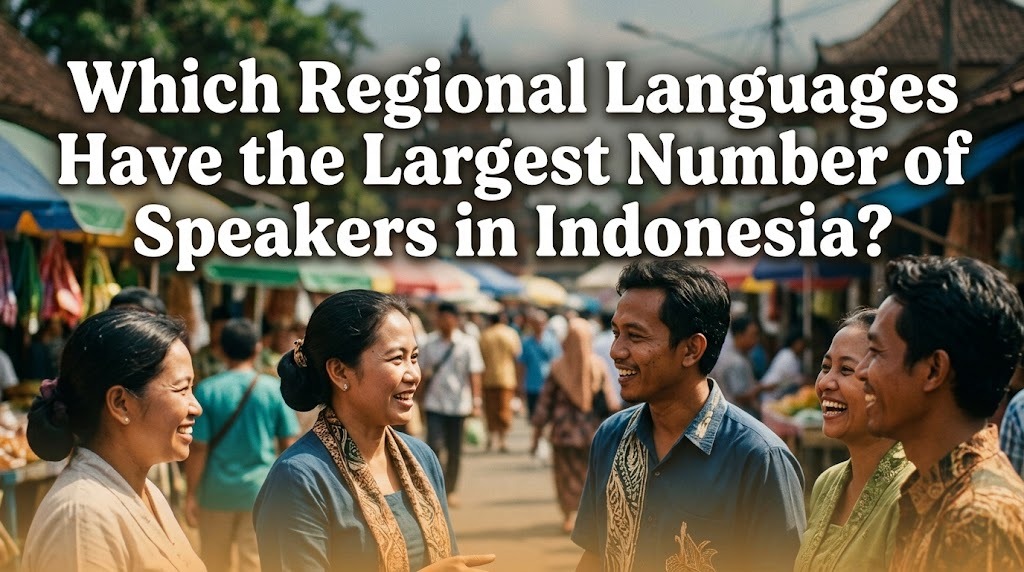
Indonesia is home to hundreds of regional languages that reflect the country’s rich cultural and linguistic diversity. These languages are used in daily conversations, family interactions, traditional ceremonies, and local communities across the archipelago. However, the number of speakers varies considerably from one language to another. Some regional languages have millions of speakers, while others are used by relatively small communities and face challenges in maintaining younger generations of speakers. Understanding which regional languages have the largest number of speakers helps explain Indonesia’s linguistic diversity and the importance of language preservation.
JAVANESE HAS ONE OF THE LARGEST SPEAKER COMMUNITIES
Javanese is widely recognized as one of the regional languages with the largest number of speakers in Indonesia. It is used by communities across Central Java, East Java, the Special Region of Yogyakarta, and areas where Javanese people have settled through migration. The language is also spoken by families living outside Java, including in several regions of Sumatra and Kalimantan. Its extensive use reflects the large population of Javanese people and the language’s long-standing role in everyday communication.
Javanese has distinctive speech levels that can express politeness and social relationships. Words and expressions may differ depending on whether someone is speaking to a friend, an older person, or someone they wish to address respectfully. The language also appears in traditional arts, literature, performances, and cultural ceremonies. Javanese demonstrates how a regional language can remain influential through family communication, community life, and cultural traditions. Although its speaker population is large, continued use among children and young people remains important for its long-term vitality.
SUNDANESE IS WIDELY SPOKEN IN WEST JAVA
Sundanese is another major regional language in Indonesia, especially in West Java and parts of Banten. It is used by millions of people in households, local communities, markets, schools, and cultural activities. Many Sundanese speakers use the language to maintain close relationships with family members and communicate within their communities. Migration has also brought Sundanese-speaking families to other parts of Indonesia.
Like Javanese, Sundanese has different ways of expressing politeness according to the situation and the relationship between speakers. The language is connected to traditional music, performing arts, literature, and local customs. It also helps transmit stories, expressions, and cultural values from older generations to younger people. Sundanese remains an important symbol of cultural identity for many communities in West Java and surrounding areas. Encouraging children to speak it at home and participate in local cultural activities can help maintain its use.
MADURESE HAS A STRONG SPEAKER BASE IN EAST JAVA
Madurese is spoken by communities originating from Madura Island and other areas of East Java. It is also used by Madurese families who have moved to different parts of Indonesia. The language plays an important role in everyday communication, family relationships, and community activities. Its continued use reflects the cultural connections maintained by Madurese people across different locations.
Madurese includes variations in vocabulary and pronunciation across communities, and speakers may adjust their language depending on the context. It is used in traditional expressions, local storytelling, and social interactions. Like other regional languages, Madurese can help younger generations understand their family backgrounds and cultural heritage. Its continued transmission depends on opportunities for children to hear and use the language regularly. Families, community organizations, and educational activities can all contribute to keeping Madurese active in daily life.
MINANGKABAU IS WIDELY USED IN WEST SUMATRA
Minangkabau is an important regional language spoken by communities in West Sumatra and by Minangkabau people who live elsewhere in Indonesia. Migration has contributed to the language’s presence in many cities and regions outside its traditional homeland. It is commonly used in family conversations, community gatherings, and cultural activities. The language also supports the transmission of Minangkabau traditions and social values.
Minangkabau is closely connected to oral traditions, proverbs, customary discussions, and cultural expressions. These forms of communication help convey lessons about relationships, responsibility, and community life. The language is also associated with the Minangkabau cultural system, which includes distinctive family and customary traditions. Minangkabau helps maintain cultural connections even when speakers live far from their ancestral region. Teaching the language to children and encouraging its use in family settings can support its continuity across generations.
BUGINESE AND BALINESE ALSO HAVE IMPORTANT SPEAKER COMMUNITIES
Buginese, also known as Bugis, is widely spoken by communities in South Sulawesi and by Bugis people who have settled in other parts of Indonesia. It is used in daily communication and plays a role in maintaining social relationships and cultural traditions. The language is also associated with a historical literary heritage, including the traditional Bugis writing system known as Lontara. These features make Buginese an important part of Indonesia’s linguistic and cultural history.
Balinese is widely used in Bali, where it has an important role in family life, local customs, and cultural ceremonies. The language has different speech styles that can reflect politeness and social context. It is used alongside Indonesian, particularly in situations involving family relationships and traditional cultural activities. Both Buginese and Balinese show how regional languages can preserve distinctive cultural knowledge and traditions. Their continued use depends on speakers having opportunities to learn and use them in everyday life as well as in cultural settings.
SPEAKER NUMBERS DEPEND ON CENSUS METHODS AND LANGUAGE VARIATIONS
Determining which regional languages have the largest number of speakers requires reliable data and clear definitions. Estimates may differ depending on the census year, the source, and whether the figures count native speakers, people who speak a language regularly, or everyone who has some ability in it. Some sources also group related varieties together, while others count them separately. These differences can affect how regional languages are ranked by speaker population.
Languages with large speaker populations often include Javanese, Sundanese, Madurese, Minangkabau, Buginese, and Balinese, although their exact rankings depend on the data being used. Other languages, including Batak varieties, Acehnese, and many languages in eastern Indonesia, also have important speaker communities. A large number of speakers does not automatically guarantee that a language will remain strong if children stop learning it. Language vitality depends not only on speaker numbers but also on whether a language continues to be passed down between generations. Accurate documentation and regular use at home, in communities, and through education are essential for long-term preservation.
CONCLUSION
Indonesia has several regional languages with large speaker populations, including Javanese, Sundanese, Madurese, Minangkabau, Buginese, and Balinese. Each language reflects a distinctive history, cultural identity, and way of life. Their speaker populations vary according to location, migration, language definitions, and the methods used to collect data. Although widely spoken languages may have advantages in maintaining their use, all regional languages deserve attention and preservation. Families, schools, communities, and cultural institutions can help protect Indonesia’s linguistic diversity by encouraging younger generations to learn and speak their regional languages.
Recent Posts

Bagaimana Sistem SKS pada Program Kuliah... 22.11.2026/49 View

How Does Technology Make Daily Evaluation... 21.11.2026/76 View

Apa Strategi Menghadapi Kesenjangan antara Kompetensi... 21.11.2026/78 View

Mengapa Inventaris Aset Penting bagi Kelancaran... 21.11.2026/74 View

When Should Musicians Join a Record... 21.11.2026/78 View
