

Which Regions Have the Highest Population Density in Indonesia?
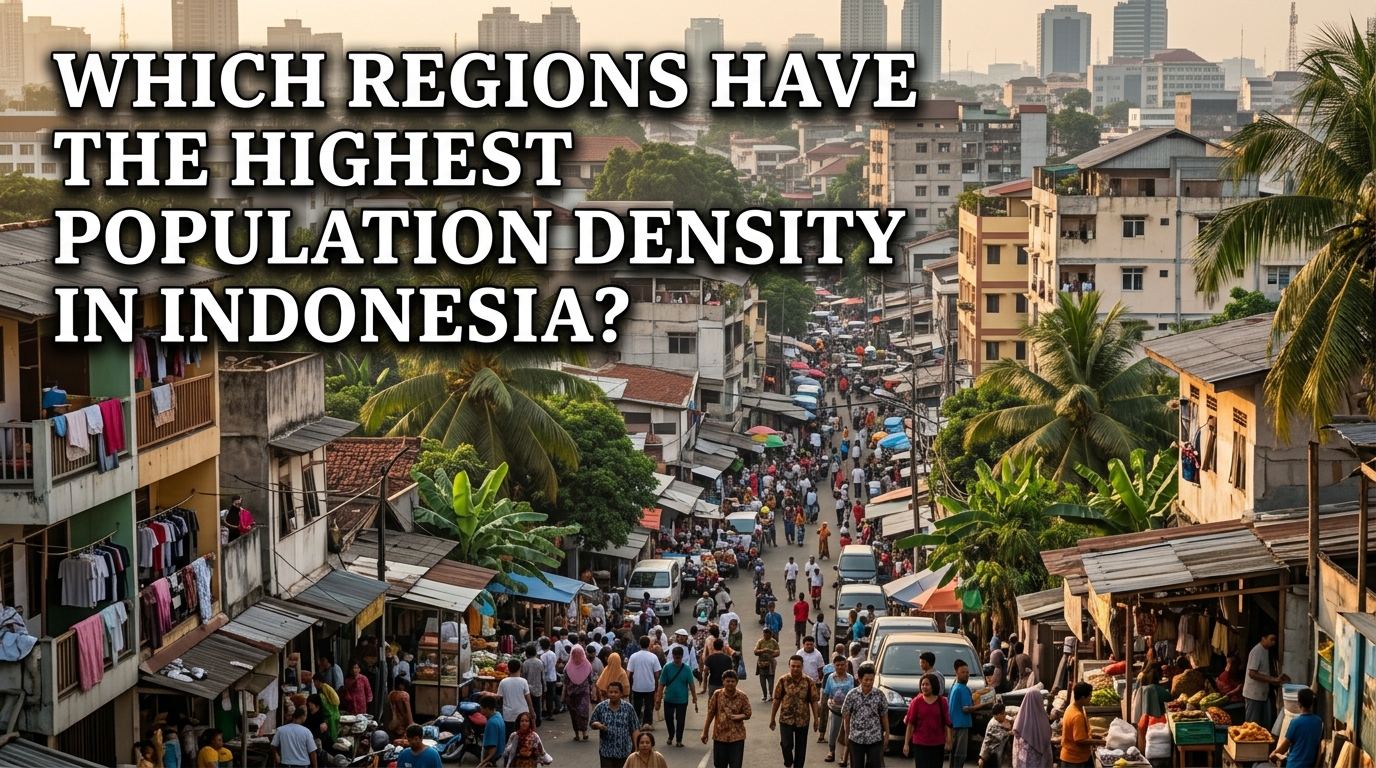
Indonesia is one of the most populous countries in the world, but its population is not distributed evenly across the archipelago. Some regions have millions of residents living within relatively small areas, while others have extensive land with comparatively few inhabitants. This difference creates significant variations in population density across Indonesian provinces. Understanding these patterns helps explain urbanization, economic development, housing demand, and regional planning.
According to Statistics Indonesia (BPS), Jakarta has the highest population density among Indonesian provinces, followed by several provinces on Java, including West Java, Banten, the Special Region of Yogyakarta, and Central Java. The concentration of people in these regions is influenced by economic opportunities, transportation networks, education, and access to public services. These factors have made Java particularly important in Indonesia's demographic and economic landscape.
UNDERSTANDING POPULATION DENSITY IN INDONESIA
Population density measures the average number of people living in one square kilometer of land. It is calculated by dividing the total population of an area by its land area. A region with 1,000,000 residents and 1,000 square kilometers of land has a population density of 1,000 people per square kilometer. This measurement helps researchers compare how concentrated populations are across different regions.
Indonesia consists of thousands of islands with different geographical conditions, economic activities, and settlement patterns. Some provinces contain major metropolitan areas, industrial centers, and extensive urban settlements, while others include large forests, mountains, and sparsely populated rural areas. Consequently, a province's population density depends on both its population size and its land area. A large population does not necessarily mean high population density if the region also covers an extensive territory.
JAKARTA HAS THE HIGHEST POPULATION DENSITY
Jakarta, officially the Special Capital Region of Jakarta in the 2024 statistical data, is the most densely populated province in Indonesia. BPS reported a population density of approximately 16,165 people per square kilometer in 2024. This figure is far higher than the density recorded in other Indonesian provinces. Jakarta's relatively small geographical area and concentration of residential, commercial, and administrative activities contribute to this condition.
Jakarta also attracts people because it offers employment, universities, healthcare facilities, shopping centers, and extensive transportation connections. Many residents travel between Jakarta and surrounding areas for work and education, contributing to the activity of the wider metropolitan region. However, the province's high population density creates challenges involving housing affordability, traffic congestion, waste management, and demand for public infrastructure. Effective urban planning is therefore essential to maintain residents' quality of life.
WEST JAVA HAS THE SECOND-HIGHEST POPULATION DENSITY
West Java is another major population center in Indonesia. In 2024, its population density was approximately 1,359 people per square kilometer, making it one of the country's most densely populated provinces after Jakarta. West Java is home to large urban and industrial areas, including Bandung, Bekasi, Bogor, and Depok. Its proximity to Jakarta also contributes to residential growth and commuting across the metropolitan region.
The province's economic diversity attracts workers and families seeking employment and educational opportunities. Manufacturing, trade, services, and tourism contribute to its economic activities. As more people settle in urban and suburban areas, demand for housing, roads, schools, and healthcare facilities increases. Nevertheless, population density varies considerably within West Java because some districts are much more urbanized than others.
BANTEN IS A MAJOR POPULATION CONCENTRATION AREA
Banten had a population density of approximately 1,329 people per square kilometer in 2024, placing it among Indonesia's most densely populated provinces. Located west of Jakarta, Banten benefits from its connections to the capital and the surrounding metropolitan economy. Areas such as Tangerang and South Tangerang have developed into important residential, commercial, and industrial centers. These locations attract people seeking jobs, business opportunities, and access to urban facilities.
Population concentration in Banten is particularly influenced by suburban expansion and industrial development. Many residents live in the province while working or studying in nearby metropolitan areas. This growth increases demand for public transportation, housing, clean water, and other essential services. Sustainable regional planning is important to ensure that urban development keeps pace with population growth.
THE SPECIAL REGION OF YOGYAKARTA HAS HIGH POPULATION DENSITY
The Special Region of Yogyakarta is another densely populated province, with approximately 1,186 people per square kilometer in 2024. Despite its relatively small geographical area, the province supports a substantial population. Yogyakarta is widely known as an educational and cultural center, attracting university students, domestic migrants, tourists, and business owners. Its universities and service industries contribute to population concentration in urban areas.
The presence of educational institutions creates demand for accommodation, restaurants, transportation, and other services. Tourism also supports employment and commercial activities throughout the region. However, population concentration can increase pressure on housing, roads, waste management, and public facilities. Careful planning can help preserve Yogyakarta's cultural heritage while supporting its growing communities.
CENTRAL JAVA ALSO HAS A HIGH POPULATION DENSITY
Central Java recorded a population density of approximately 1,104 people per square kilometer in 2024. The province has a large population distributed across cities, towns, agricultural areas, and industrial centers. Semarang, Surakarta, and other urban areas serve as important locations for commerce, education, manufacturing, and public services. These activities support employment and encourage people to settle in particular parts of the province.
Unlike Jakarta, Central Java covers a much larger geographical area and includes extensive rural settlements. Its population density therefore reflects a combination of urban concentration and a substantial population outside major cities. Agriculture remains important, while manufacturing, trade, and tourism also contribute to the regional economy. Improving transportation links and public services can help manage population needs across both urban and rural communities.
COMPARISON OF THE MOST DENSELY POPULATED PROVINCES IN INDONESIA
The following figures show the five provinces with the highest population density in Indonesia based on BPS data for 2024. The values are approximate and are expressed as people per square kilometer. They illustrate the substantial difference between Jakarta and the other densely populated provinces.
| Province | Population Density in 2024 |
|---|---|
| Jakarta | 16,165 people/km² |
| West Java | 1,359 people/km² |
| Banten | 1,329 people/km² |
| Special Region of Yogyakarta | 1,186 people/km² |
| Central Java | 1,104 people/km² |
The figures show that Jakarta's population density is much higher than that of any other province. The remaining four provinces have densities ranging from approximately 1,100 to 1,360 people per square kilometer. Their relatively high population densities reflect a combination of urbanization, economic opportunities, settlement patterns, and geographical size. These statistics describe provincial averages, so individual cities and districts may have substantially higher or lower densities.
WHY ARE THESE REGIONS SO DENSELY POPULATED?
Several factors explain why Jakarta and many provinces on Java have high population densities. First, economic opportunities attract people to areas with more jobs in manufacturing, trade, finance, tourism, and other services. Second, educational institutions and healthcare facilities encourage residents to settle near major cities. Third, developed transportation networks make it easier to travel between residential areas, workplaces, and commercial centers.
Historical settlement patterns and the distribution of infrastructure also influence population concentration. Java has long been a major center of agriculture, government, commerce, and industry, supporting the growth of large settlements over time. In addition, urban expansion has connected many previously separate towns and residential areas. Together, these factors explain why population density is particularly high in Jakarta and several neighboring or nearby provinces.
THE IMPACT OF HIGH POPULATION DENSITY ON LOCAL COMMUNITIES
High population density can provide economic advantages by bringing workers, consumers, and businesses closer together. Companies can reach larger markets, while residents may have better access to jobs, schools, hospitals, and public transportation. Dense settlements can also support more efficient public transport and infrastructure when cities are planned effectively. These benefits can contribute to economic productivity and improved access to essential services.
However, rapid urbanization and inadequate infrastructure can create significant challenges. Housing shortages, rising property prices, traffic congestion, air pollution, and pressure on water supplies may affect densely populated communities. Public facilities can become overcrowded if their capacity does not grow alongside the population. Governments therefore need to combine housing development, reliable transportation, environmental protection, and balanced regional investment to manage these challenges.
CONCLUSION
The regions with the highest population density in Indonesia are concentrated mainly on Java. Based on BPS data for 2024, Jakarta ranks first, followed by West Java, Banten, the Special Region of Yogyakarta, and Central Java. Their high population densities reflect the concentration of economic activities, educational institutions, transportation networks, and residential settlements.
Understanding population density in Indonesia is important for planning housing, transportation, public services, and regional development. Although densely populated areas can offer significant economic opportunities, they also require effective infrastructure and environmental management. By encouraging balanced development across different regions, Indonesia can reduce excessive pressure on major urban centers and improve living conditions for communities throughout the country.
Recent Posts

Bagaimana Sistem SKS pada Program Kuliah... 22.11.2026/33 View

How Does Technology Make Daily Evaluation... 21.11.2026/67 View

Apa Strategi Menghadapi Kesenjangan antara Kompetensi... 21.11.2026/67 View

Mengapa Inventaris Aset Penting bagi Kelancaran... 21.11.2026/65 View

When Should Musicians Join a Record... 21.11.2026/66 View
