

Which Robotic Grippers Work Best for Delicate Fruit Harvesting?
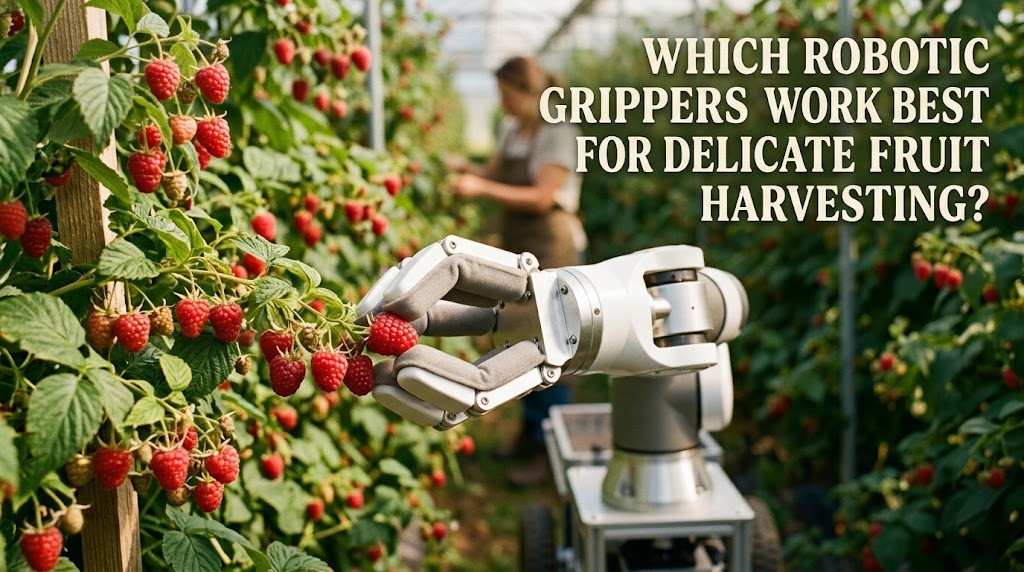
Harvesting delicate fruits with robots requires careful handling because excessive force can bruise, cut, or otherwise damage the produce. A robotic gripper must therefore combine secure handling with gentle contact and accurate movement. Different fruits also have different shapes, sizes, textures, and levels of firmness, so no single gripper is ideal for every crop. Soft robotic grippers, suction-based systems, and compliant mechanical grippers are among the technologies commonly considered for delicate harvesting. The best choice depends on the fruit characteristics, harvesting method, and operating environment.
SOFT ROBOTIC GRIPPERS
Soft robotic grippers are well suited to delicate fruits because they can deform around irregular shapes without applying excessive concentrated pressure. Instead of relying entirely on rigid mechanical fingers, these grippers may use flexible materials or pneumatic actuation to conform to the surface of the fruit. This can distribute contact forces more evenly and reduce the likelihood of bruising. Soft grippers can be particularly useful for fruits with fragile skins or varying shapes. Their design must still be carefully controlled because insufficient grip can cause fruit to fall or become damaged during movement.
SUCTION-BASED GRIPPERS
Suction grippers can provide gentle contact by using controlled vacuum pressure to hold fruit without requiring rigid fingers to squeeze it. They can work effectively with fruits that have relatively smooth and suitable surfaces for creating a vacuum seal. Suction systems may also simplify the gripping process because the robot can pick up an individual fruit without surrounding it with multiple mechanical fingers. However, their performance can decrease when surfaces are wet, dusty, irregular, or unsuitable for creating a stable seal. The vacuum level must also be carefully controlled to prevent unnecessary damage.
COMPLIANT MECHANICAL GRIPPERS
Compliant mechanical grippers use flexible elements or controlled mechanisms that allow the fingers to adapt to the shape of the fruit. Unlike rigid grippers that may apply pressure at specific points, compliant designs can distribute contact more evenly. Sensors can further help the robot detect contact and adjust gripping force. This makes the approach useful when fruit varies in size or shape within the same crop. Proper calibration remains important because excessive force can still cause bruising even when the gripper is designed to be compliant.
VISION-GUIDED GRIPPERS
A suitable gripper works best when it is combined with accurate perception and positioning. Cameras and other sensors can help a harvesting robot identify ripe fruit, estimate its location, and determine an appropriate grasping position. Vision systems may also help distinguish fruit from leaves, branches, and other objects. Accurate positioning reduces unnecessary contact with surrounding plant structures and helps the gripper approach the fruit from a suitable direction. This combination of perception and gentle gripping can improve harvesting efficiency while protecting produce quality.
FORCE AND PRESSURE CONTROL
The ability to control gripping force is critical when handling fragile fruit. Sensors can provide information about contact pressure or resistance, allowing the robotic system to adjust its grip according to the situation. A robot handling a firm fruit may require different force from one handling a softer or more mature fruit. Adaptive control can therefore reduce unnecessary pressure while maintaining a secure grasp. The appropriate force range should be established through testing because different crops and varieties have different mechanical properties.
GRIPPERS FOR DIFFERENT FRUIT TYPES
The best gripper depends heavily on the characteristics of the crop. Soft grippers may be advantageous for irregular or fragile fruits, while suction systems can be effective for suitable smooth surfaces. Compliant fingers may work well when fruit size varies and the robot needs adaptable mechanical contact. Crops that grow in dense foliage may also require a gripper that can approach fruit without damaging nearby leaves or stems. Researchers and manufacturers should evaluate gripping performance using factors such as bruising, fruit loss, harvesting speed, and reliability under actual field conditions.
TESTING GRIPPERS IN REAL FARM CONDITIONS
Laboratory demonstrations do not always represent the challenges encountered in agricultural environments. Outdoor harvesting robots must operate under changing lighting, humidity, temperature, plant structures, and fruit conditions. A gripper that performs well with clean laboratory samples may behave differently when fruit is wet or partially hidden by leaves. Field testing allows developers to evaluate durability, harvesting success, damage rates, and maintenance requirements. Repeated testing with different fruit sizes and maturity levels can help identify whether a gripper is suitable for commercial use.
CONCLUSION
Soft robotic grippers, suction systems, and compliant mechanical grippers can all be effective for delicate fruit harvesting when properly designed and controlled. Soft grippers are particularly useful for conforming to irregular shapes, while suction can provide gentle handling for fruits with suitable surfaces. Compliant mechanical designs offer another option when adaptability and controlled contact are important. Vision systems and force sensing can further improve performance by helping robots locate fruit and regulate their grip. Ultimately, the best gripper is determined by the specific fruit, plant structure, environmental conditions, and required harvesting performance.
Recent Posts

Bagaimana Sistem SKS pada Program Kuliah... 22.11.2026/48 View

How Does Technology Make Daily Evaluation... 21.11.2026/76 View

Apa Strategi Menghadapi Kesenjangan antara Kompetensi... 21.11.2026/78 View

Mengapa Inventaris Aset Penting bagi Kelancaran... 21.11.2026/73 View

When Should Musicians Join a Record... 21.11.2026/78 View
