

Who Is Authorized to Sign an Official Memo?
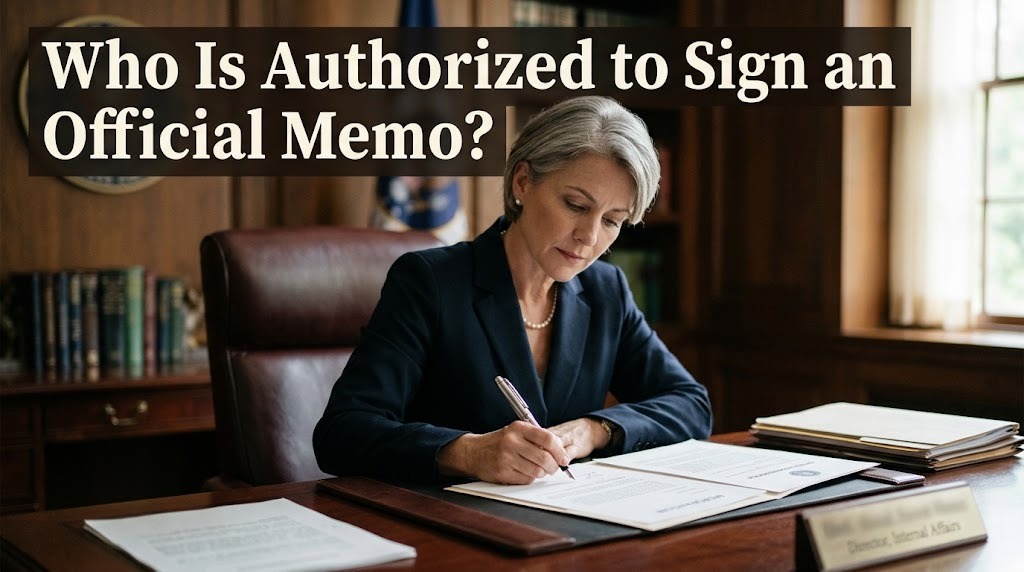
In modern corporate and governmental administrative frameworks, the validity and enforceability of an internal official memorandum depend fundamentally on the authority of the signatory. An official memo serves as a formal binding document that directs operational workflows, authorizes budget disbursements, announces policy adjustments, or establishes institutional directives across departments. Consequently, authority to sign an official memorandum is restricted to specific managerial tiers, designated acting officials, and personnel operating under legally recognized delegations of authority. Improperly authorized signatures can render an administrative memo legally void, cause severe operational disruptions, or trigger formal disciplinary reviews within an organization.
Understanding the precise boundaries of signing authority is vital for maintaining administrative discipline, ensuring accountability, and protecting organizational governance structures. This comprehensive guide details the primary categories of authorized signatories, legal delegation mechanisms, and the professional responsibilities associated with endorsing official internal correspondence.
EXECUTIVE LEADERS AND STRUCTURAL UNIT HEADS
The primary authority to sign an official memorandum rests with executive leaders and structural unit heads who hold formal administrative appointments within the organizational hierarchy. In private corporations, this includes board directors, department heads, division managers, and sectional supervisors who possess direct managerial jurisdiction over their respective operational units. In public sector institutions, signing authority is held by constitutional officers, departmental secretaries, bureau chiefs, and regional directors who possess statutory authority under governing administrative codes.
These structural officers hold inherent authority to issue directives, approve expenditure requests, and convey policy mandates within their defined scope of responsibility. Memos signed by structural leaders carry full administrative weight and obligate subordinate staff to execute the outlined directives. When an official signs a memorandum in their structural capacity, they assume complete administrative responsibility for the policy decisions, financial implications, and operational consequences contained within the document.
ACTING OFFICERS AND TEMPORARY DESIGNEES
Operational continuity often requires temporary adjustments to signing authority when a primary structural leader is absent due to official travel, leave, or unexpected medical incapacitation. To prevent administrative bottlenecks, organizations utilize formal temporary appointments, commonly designated as Acting Officers or Officers-in-Charge. An official appointed to an acting capacity receives full legal and administrative authorization to sign internal memoranda on behalf of the absent structural officer for the duration of the designated period.
When endorsing an official memorandum, an acting officer must explicitly indicate their temporary administrative status within the signature block using standard notation such as Acting Manager or Officer-in-Charge. This formal notation provides legal transparency, confirming that the signatory was exercising valid, temporary authority granted through an official administrative designation. Once the primary structural officer returns to active duty, the acting officer's signature authority automatically terminates, reverting exclusively to the permanent position holder.
DELEGATION OF SIGNING AUTHORITY AND FORMAL MANDATES
Beyond temporary acting appointments, senior executive leaders may formally delegate specific signing authorities to lower-tier managers through official administrative mandates or written delegations of authority. Organizations frequently utilize delegated authority to streamline routine operational approvals, such as low-value purchase requisitions, internal facility bookings, or standard training notifications. Delegations must be established in writing, clearly defining the exact scope, financial thresholds, and operational limits of the delegated signing power.
An official signing a memorandum under a delegated mandate must use specific administrative preambles in the signature block, such as For and On Behalf Of or By Authority Of, followed by their actual job title and name. This structural distinction clarifies that the signatory is acting as an authorized proxy rather than exercising inherent primary authority. Proper management of delegated signing authority ensures that administrative workflows remain efficient while maintaining strict organizational oversight and accountability.
FUNCTIONAL SPECIALISTS AND COMMITTEE CHAIRS
In specialized administrative environments, authority to sign specific types of memoranda is granted to functional specialists or appointed committee chairs based on technical expertise rather than traditional structural hierarchy. For instance, chief information security officers, internal audit leads, environmental compliance officers, or safety committee chairs may issue binding internal memos within their specialized operational domains. Their signing authority is derived from governing corporate policies, statutory compliance requirements, or specific board resolutions establishing their oversight jurisdiction.
However, the signing scope for functional specialists remains strictly confined to their technical subject matter and cannot cross into general management or unauthorized budgetary commitments. A memo signed by an internal audit chair regarding compliance protocols carries binding authority, but that same specialist cannot independently sign an internal memo approving general departmental capital expenditures. Maintaining clear boundaries around functional signing authority prevents jurisdictional conflicts and preserves structural management hierarchies.
LEGAL RESPONSIBILITIES AND CONSEQUENCES OF SIGNING
Affixing a signature to an official internal memorandum is a serious legal and administrative action that establishes personal and institutional accountability. The individual who signs a memo attests to the accuracy of the statements, the validity of the supporting data, and compliance with all applicable organizational policies and statutory regulations. If a signed memorandum contains fraudulent financial data, unauthorized policy changes, or instructions that violate employment laws, the signatory remains directly accountable to executive leadership and oversight bodies.
Because of these significant professional liabilities, authorized signatories must rigorously review, verify, and edit draft memoranda prior to formal endorsement. Unlawful or unauthorized signatures can result in severe institutional penalties, including document cancellation, formal administrative reprimands, or termination of employment. Rigorous adherence to signing protocols safeguards institutional integrity and ensures that all internal communications remain lawful, authoritative, and professionally sound.
CONCLUSION
Authority to sign an official memorandum is strictly governed by organizational hierarchies, formal acting designations, written delegations of authority, and specialized functional mandates. By ensuring that internal memos are executed exclusively by authorized signatories who understand their legal and administrative responsibilities, organizations can maintain operational discipline, prevent governance failures, and streamline office workflows. Understanding who is authorized to sign official correspondence is an essential competency for every administrative professional navigating the modern workplace.
Recent Posts

Bagaimana Sistem SKS pada Program Kuliah... 22.11.2026/53 View

How Does Technology Make Daily Evaluation... 21.11.2026/82 View

Apa Strategi Menghadapi Kesenjangan antara Kompetensi... 21.11.2026/81 View

Mengapa Inventaris Aset Penting bagi Kelancaran... 21.11.2026/77 View

When Should Musicians Join a Record... 21.11.2026/82 View
