

Who Were the Ancestors of Modern Humans and How Do Scientists Study Them?
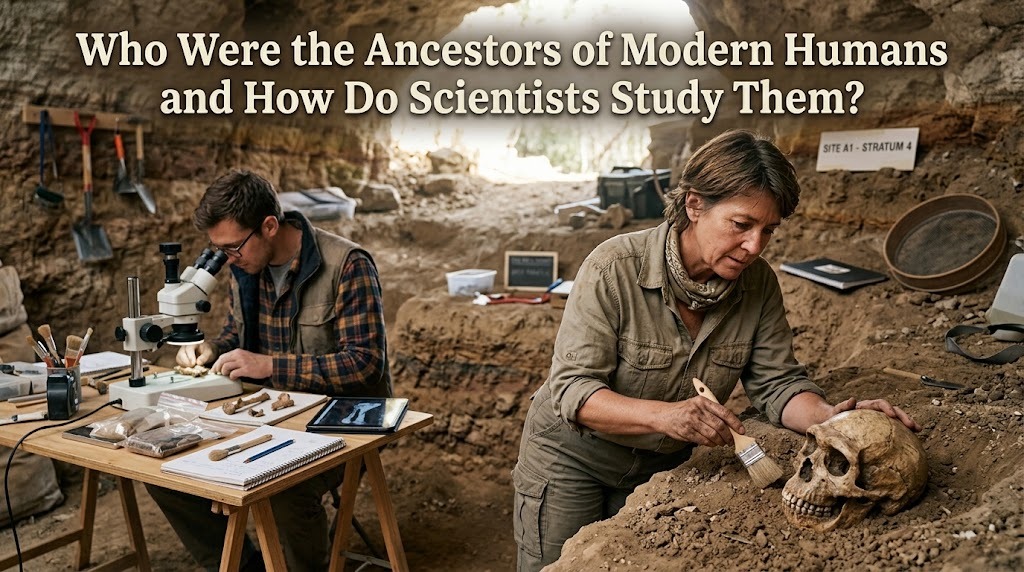
The ancestors of modern humans lived millions of years ago and gradually developed physical and behavioral characteristics that helped shape the human species. Through evolution, different groups of ancient humans adapted to changing environments, developed tools, and acquired new ways of finding food and cooperating with others. Modern humans, scientifically known as Homo sapiens, are part of a complex evolutionary history that includes several extinct human relatives.
Scientists study these ancient populations using fossils, archaeological discoveries, genetic evidence, and modern scientific technology. By combining these sources, researchers can reconstruct how early humans lived, how different species were related, and how modern humans eventually spread across the world. Understanding human ancestors provides valuable insights into human origins, biological diversity, and the evolutionary processes that shaped our species.
WHO WERE THE ANCESTORS OF MODERN HUMANS?
Modern humans belong to the primate family and share common ancestors with other great apes. Humans did not evolve from the chimpanzees or gorillas living today. Instead, humans and these other primates descended from earlier populations that lived millions of years ago.
The human evolutionary lineage includes several groups of ancient relatives. Some early hominins developed the ability to walk upright, while later species showed changes in brain size, tool use, and behavior. These groups did not form a simple, straight line leading directly to modern humans. Human evolution was a branching process in which different species sometimes lived at the same time, and many eventually became extinct.
THE ROLE OF AUSTRALOPITHECUS IN HUMAN EVOLUTION
Australopithecus was an important group of early hominins that lived in Africa millions of years ago. One famous example is Australopithecus afarensis, which lived approximately 3.9 to 2.9 million years ago. Fossils from this species show that its members could walk upright, although they retained adaptations useful for climbing.
The discovery of the fossil known as Lucy helped scientists understand the anatomy and movement of early hominins. Her remains, discovered in Ethiopia in 1974, provided important evidence about upright walking before the evolution of the much larger brains associated with later members of the human lineage. Australopithecus was not modern human, but members of this group or closely related populations may have contributed to the ancestry of later hominins. These discoveries demonstrate that important human characteristics developed at different times rather than appearing all at once.
HOW HOMO ERECTUS INFLUENCED HUMAN EVOLUTION
Homo erectus was an early human species that appeared around 1.9 million years ago and survived in some regions until much more recent periods. Its members had body proportions suited to walking long distances, making them well adapted to moving through different landscapes. Fossils and archaeological sites indicate that populations associated with this species spread beyond Africa into parts of Asia.
Homo erectus is also associated with important developments in stone tool technology. Some archaeological evidence suggests that members of this species or other early human populations used fire, although the timing and regularity of early fire use remain subjects of research. These developments helped ancient humans obtain food and respond to environmental challenges. Homo erectus was an important part of human evolutionary history, although scientists continue to investigate its precise relationships with later human species.
NEANDERTHALS AND DENISOVANS AS HUMAN RELATIVES
Neanderthals and Denisovans were ancient human groups that shared common ancestors with modern humans. Neanderthals lived mainly in Europe and parts of western and central Asia, while Denisovans are known primarily through genetic evidence and a limited number of fossil discoveries from Asia. Both groups adapted to their environments and developed behaviors that included tool use and other complex activities.
Genetic studies have shown that modern humans interbred with both Neanderthals and Denisovans. As a result, many people today carry small proportions of DNA inherited from these ancient populations, although the amounts vary among populations. This evidence shows that human evolution involved interactions between different groups rather than complete separation. Neanderthals and Denisovans were close human relatives, but neither should be described simply as an earlier version of modern humans.
WHEN DID MODERN HUMANS FIRST APPEAR?
Modern humans, or Homo sapiens, evolved in Africa approximately 300,000 years ago. Fossils from sites such as Jebel Irhoud in Morocco have provided important evidence of early members of our species. These discoveries suggest that the emergence of modern humans involved populations distributed across different parts of Africa rather than a single clearly defined location.
Over time, groups of Homo sapiens migrated beyond Africa and settled in other regions. These movements occurred in multiple stages, and genetic evidence indicates that major expansions contributed to the ancestry of most living populations outside Africa. During their migrations, modern humans encountered other human groups and sometimes interbred with them. The combination of fossil and genetic evidence continues to improve scientific understanding of when and how these movements occurred.
HOW SCIENTISTS STUDY HUMAN FOSSILS
Fossils are among the most important sources of information about ancient human ancestors. Scientists examine fossilized bones and teeth to identify physical characteristics, estimate body size, and compare anatomical features between species. These comparisons help researchers investigate how ancient populations moved, grew, and changed over time.
Scientists also determine the age of fossils using different dating techniques. Radiometric methods can estimate the age of suitable rocks or materials associated with fossil discoveries, while other approaches help establish the sequence of archaeological layers. Researchers must carefully consider the geological context because a fossil's location and relationship to surrounding materials influence how accurately it can be dated. Fossils provide valuable evidence, but incomplete remains sometimes make it difficult to identify a species or determine its exact evolutionary relationships.
HOW DNA HELPS SCIENTISTS UNDERSTAND HUMAN ANCESTORS
DNA analysis has transformed the study of human evolution. When scientists recover ancient DNA from preserved bones or teeth, they can compare it with genetic information from modern humans and other ancient populations. These comparisons help reveal evolutionary relationships, population movements, and evidence of interbreeding.
Ancient DNA research has been especially important for understanding Neanderthals and Denisovans. Even when fossil remains are limited, genetic evidence can reveal that a population existed and provide clues about its relationship with other human groups. However, ancient DNA is often damaged over time and can be contaminated by modern genetic material. Researchers therefore use careful laboratory procedures and independent checks to ensure that their findings are reliable.
THE IMPORTANCE OF ARCHAEOLOGICAL DISCOVERIES
Archaeology helps scientists understand how ancient humans lived by examining objects and traces left behind. Stone tools, animal bones, hearths, and other remains can reveal information about food gathering, hunting, technology, and daily activities. The location of these discoveries can also provide clues about the environments ancient populations occupied.
Scientists interpret archaeological evidence by studying how objects were made, used, and deposited. For example, changes in stone tool design may indicate new techniques or the transmission of knowledge between generations. However, researchers must avoid assuming that a particular tool or behavior belonged to only one human species unless the evidence supports that conclusion. By combining archaeological findings with fossils and genetic research, scientists can develop a more complete picture of human evolution.
HOW MODERN TECHNOLOGY SUPPORTS HUMAN EVOLUTION RESEARCH
Modern technology allows researchers to examine ancient remains in ways that were previously impossible. Three-dimensional scanning and digital reconstruction help scientists study fossil structures without repeatedly handling fragile specimens. Medical imaging techniques such as computed tomography can reveal internal features of bones and teeth, providing information about anatomy and development.
Computer models also help researchers compare fossils, estimate possible movements, and examine relationships between ancient populations. Statistical methods and genetic analysis can identify patterns that are difficult to detect through visual observation alone. These technologies do not replace direct scientific evidence, but they make it possible to analyze discoveries more precisely. As new methods improve, scientists can revisit older findings and develop more detailed explanations of human origins.
WHY STUDYING HUMAN ANCESTORS MATTERS
Studying human ancestors helps explain how modern humans developed their physical characteristics, cognitive abilities, and capacity for cultural learning. Fossil evidence reveals changes in walking, body structure, and brain development, while archaeology provides clues about tools and everyday behavior. Genetic research adds information about population history and relationships between ancient groups.
This research also helps scientists understand human diversity and the shared ancestry of living populations. It shows that migration, adaptation, and interbreeding contributed to the history of our species. Although many details remain uncertain, new discoveries continue to refine existing explanations. Studying human evolution therefore provides a stronger scientific foundation for understanding who we are and how our species developed.
CONCLUSION
The ancestors and ancient relatives of modern humans included early hominins such as Australopithecus, early members of the genus Homo, and groups such as Neanderthals and Denisovans. Human evolution was a complex branching process that took place over millions of years, with different populations developing distinct characteristics and sometimes interacting with one another.
Scientists investigate this history through fossils, archaeological discoveries, ancient DNA, dating methods, and modern imaging technology. Each source provides different information, and combining them helps researchers develop more reliable explanations of human origins. As scientific methods continue to improve, new discoveries will deepen our understanding of the evolutionary history that connects modern humans with their ancient relatives.
Recent Posts

Bagaimana Sistem SKS pada Program Kuliah... 22.11.2026/51 View

How Does Technology Make Daily Evaluation... 21.11.2026/81 View

Apa Strategi Menghadapi Kesenjangan antara Kompetensi... 21.11.2026/81 View

Mengapa Inventaris Aset Penting bagi Kelancaran... 21.11.2026/77 View

When Should Musicians Join a Record... 21.11.2026/82 View
