

Why Are Ancient Temples Important For Archaeological Research?
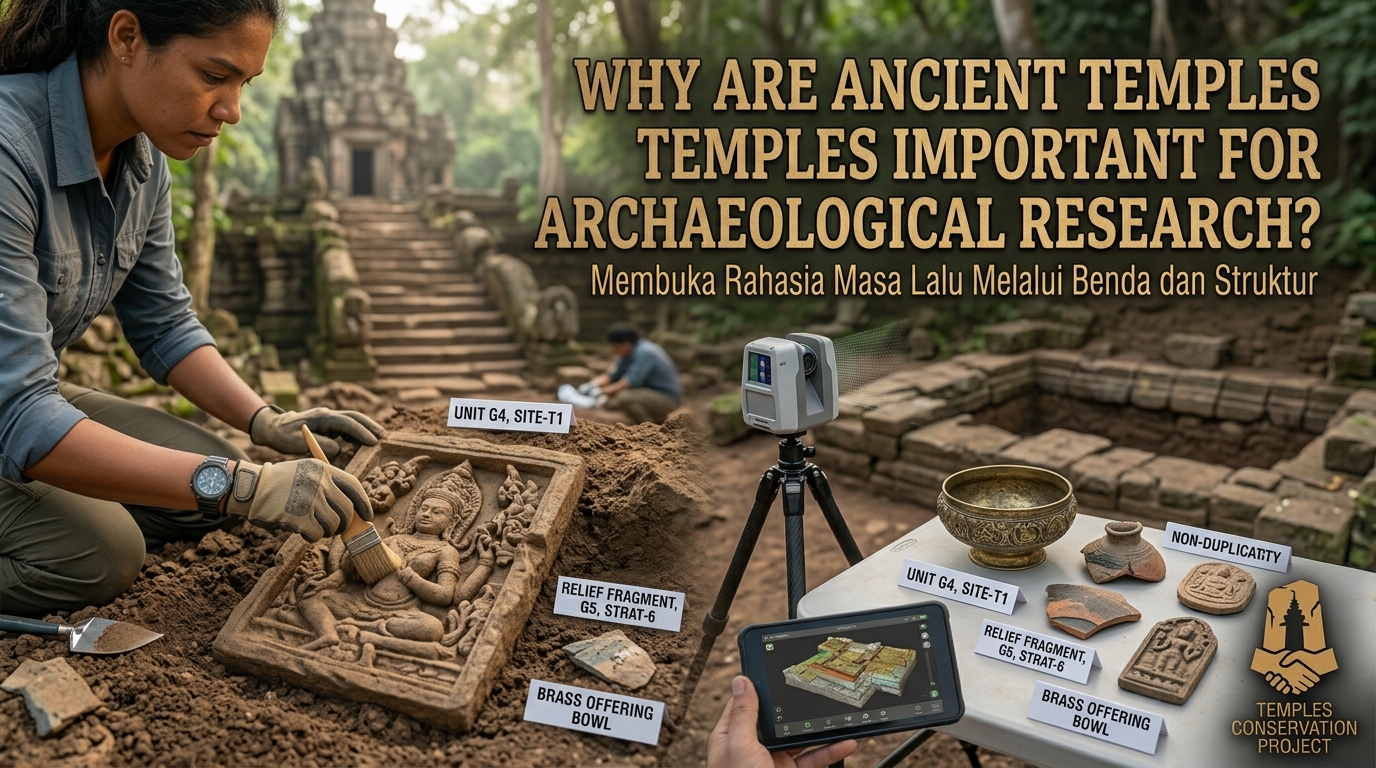
Ancient temples are among the most valuable sources of information about past civilizations. These historic structures reveal how people practiced religion, organized communities, developed architectural techniques, and expressed their cultural beliefs. Through careful examination of temple buildings, carvings, inscriptions, and surrounding artifacts, researchers can reconstruct important aspects of ancient life. Ancient temples are more than religious monuments because they preserve physical evidence of human history. Understanding why ancient temples are important for archaeological research helps explain how these structures contribute to our knowledge of past societies.
REVEALING ANCIENT RELIGIOUS BELIEFS AND PRACTICES
Ancient temples provide important evidence of religious beliefs and spiritual traditions. Their layouts, sculptures, carvings, and decorative symbols can reveal which deities people worshipped and how they expressed their faith. Researchers may examine altars, sacred rooms, statues, and ritual objects to understand religious activities. Inscriptions found on temple walls can also contain prayers, religious teachings, or references to ceremonies. Together, these discoveries help archaeologists investigate how religion influenced ancient communities.
Temple architecture can provide additional clues about spiritual ideas. Some temples were designed around specific directions, sacred spaces, or symbolic arrangements that reflected religious traditions. Archaeologists compare these features with historical records and similar structures to develop informed interpretations. However, the original meaning of every symbol is not always certain, especially when written explanations are missing. Careful analysis helps researchers distinguish supported conclusions from possible interpretations.
UNDERSTANDING ANCIENT ARCHITECTURE AND ENGINEERING
Ancient temples demonstrate the architectural knowledge and engineering skills of the societies that built them. Their foundations, columns, roofs, stairways, and stone carvings reveal how builders selected materials and constructed durable structures. Researchers examine these features to understand building techniques and the practical challenges ancient communities faced. Tool marks and unfinished sections can sometimes provide clues about how construction was carried out. These details help explain how architectural knowledge developed over time.
Studying temple construction can also reveal how ancient builders adapted to local environments. They may have selected particular stones based on availability, strength, or ease of carving. Some structures required advanced planning to support heavy roofs, manage rainwater, or remain stable on uneven ground. Archaeologists compare construction methods across regions to identify shared techniques and local innovations. Ancient temples demonstrate that complex engineering and specialized craftsmanship existed long before modern construction technology.
DISCOVERING ANCIENT SOCIETY AND SOCIAL STRUCTURE
Temples can reveal how ancient societies organized labor, resources, and social responsibilities. Large monuments often required workers, skilled craftspeople, material suppliers, and people responsible for planning and supervision. Their construction may therefore provide evidence of organized leadership and cooperation within a community. Inscriptions and associated objects can sometimes identify rulers, religious officials, donors, or other individuals connected with a temple. These findings help researchers investigate relationships between religious institutions and political authority.
The location and size of temples can also provide clues about the communities that supported them. A major temple complex may have been connected to nearby settlements, markets, agricultural areas, or administrative centers. Archaeologists examine these relationships to understand how religious buildings functioned within wider social systems. However, a large temple does not automatically reveal how wealth or power was distributed among all members of society. Combining architectural evidence with artifacts and historical records produces a more balanced understanding of ancient social life.
PRESERVING HISTORICAL INSCRIPTIONS AND CULTURAL KNOWLEDGE
Inscriptions are valuable archaeological sources because they can preserve names, dates, languages, titles, and descriptions of historical events. They may appear on temple walls, stone tablets, statues, or other architectural elements. Researchers study the writing systems and language used in these inscriptions to understand how people communicated and recorded information. Some inscriptions also provide evidence about rulers, donations, religious ceremonies, and construction activities. These records can help establish the historical context of a temple.
Inscriptions must be interpreted carefully because they may reflect the viewpoint or interests of the people who commissioned them. A royal inscription, for example, might emphasize a ruler's achievements rather than describe every aspect of everyday life. Archaeologists compare written evidence with architectural remains, artifacts, and other records to evaluate its reliability. Ancient temples can also preserve evidence of language changes and cultural contact between different communities. Protecting inscriptions is essential because damaged or lost writing may contain information that cannot be recovered elsewhere.
REVEALING TRADE AND CULTURAL EXCHANGE
Ancient temples can provide evidence of connections between distant communities. Their architectural styles, decorative patterns, religious images, and building materials may reflect influences from other regions. Archaeologists compare these features to investigate how ideas, technologies, and artistic traditions traveled through trade, migration, and religious contact. Objects discovered in or near temple complexes may also reveal links with distant production centers. These findings help researchers understand how ancient societies interacted beyond their local surroundings.
For example, temple architecture in Southeast Asia reflects a range of Hindu, Buddhist, and local cultural traditions. Borobudur and Prambanan in Indonesia illustrate the development of major Buddhist and Hindu architectural traditions in Java. Their designs, reliefs, and sculptures provide evidence of religious ideas and artistic practices that developed through regional connections. Researchers also study how these traditions were adapted to local environments and cultural settings. Such evidence shows that cultural exchange often involved both outside influences and local creativity.
DATING ARCHAEOLOGICAL SITES AND HISTORICAL EVENTS
Ancient temples help researchers establish timelines for the development of architecture, religion, and political institutions. Archaeologists examine construction methods, inscriptions, decorative styles, and artifacts found in secure archaeological contexts. Scientific dating techniques may also help determine the age of suitable materials associated with a temple. For example, radiocarbon dating can estimate the age of suitable organic remains found in relevant layers, while other methods may be used for different materials. Combining multiple forms of evidence generally produces a more reliable chronology than relying on architectural style alone.
Dating a temple requires care because a structure may have been modified many times. Later rulers or communities may have repaired walls, added new buildings, or reused older materials. An object found inside a temple does not necessarily date the original construction, especially if it was placed there much later. Researchers therefore distinguish between the dates of construction, renovation, use, and abandonment whenever the evidence allows. This approach helps create a more accurate account of a site's history.
SUPPORTING ARCHAEOLOGICAL CONSERVATION AND TOURISM
Ancient temples are important not only for research but also for cultural heritage preservation. Their structures and decorative features can deteriorate because of weathering, earthquakes, pollution, vegetation, and human activity. Archaeologists and conservation specialists document the condition of temples and identify areas that require protection. Techniques such as detailed photography, three-dimensional scanning, and structural monitoring can help record changes over time. These records support conservation planning and provide information for future research.
Well-preserved temples can also support education and responsible cultural tourism. Visitors can learn about architecture, religion, artistic traditions, and historical developments by exploring these sites. Tourism may create employment for local guides, craftspeople, and nearby businesses when it is managed responsibly. However, excessive visitor numbers and careless behavior can damage fragile structures and carvings. Sustainable tourism and careful conservation help balance public access with the long-term protection of archaeological heritage.
CONCLUSION
Ancient temples are essential for archaeological research because they preserve evidence of religious beliefs, architectural knowledge, social organization, historical events, and cultural exchange. Their structures, inscriptions, sculptures, and surrounding artifacts help researchers reconstruct how ancient societies developed and interacted. Scientific dating and comparative analysis make it possible to investigate when temples were built, how they changed, and what roles they played in their communities. Protecting these monuments ensures that valuable evidence remains available for future generations. By studying and preserving ancient temples, archaeologists can deepen our understanding of human history and cultural heritage.
Recent Posts

Bagaimana Sistem SKS pada Program Kuliah... 22.11.2026/50 View

How Does Technology Make Daily Evaluation... 21.11.2026/79 View

Apa Strategi Menghadapi Kesenjangan antara Kompetensi... 21.11.2026/79 View

Mengapa Inventaris Aset Penting bagi Kelancaran... 21.11.2026/75 View

When Should Musicians Join a Record... 21.11.2026/80 View
