

Why Are Gamma Rays Considered the Most Energetic Radiation in the Universe?
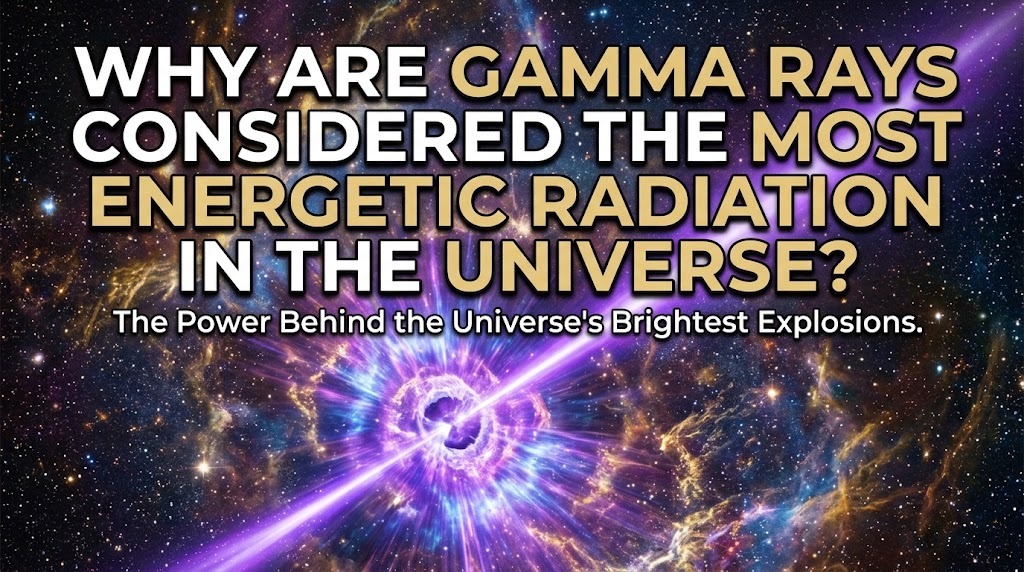
Gamma rays occupy the extreme high-energy end of the electromagnetic spectrum. Like visible light, radio waves, and X-rays, gamma rays travel in the form of photons, but they possess unmatched frequency and energy levels.
While radio waves have long wavelengths stretching across meters, gamma rays feature subatomic wavelengths smaller than an atom's nucleus. This extremely high frequency translates directly into massive photon energy, making gamma rays the most energetic form of light in the universe.
THE ORIGIN OF GAMMA RAYS
Gamma rays are produced only by the universe's most violent and powerful cosmic phenomena. Unlike lower-energy light emitted by thermal heating, gamma rays originate from intense subatomic interactions and massive astrophysical events.
- Supernova Explosions: The dramatic collapse and death of massive stars.
- Neutron Star Collisions: Mergers of ultra-dense cosmic bodies generating massive energy outputs.
- Black Hole Activity: Matter accelerating near supermassive black holes at nearly the speed of light.
These high-energy processes accelerate particles to extreme speeds, converting kinetic energy into intense gamma-ray emissions.
PENETRATING POWER AND ATOMIC INTERACTIONS
Because gamma-ray photons carry huge amounts of energy, they interact with matter with extraordinary penetrating force. Lower-energy rays interact mainly with outer electrons, but gamma rays pass through atomic electron clouds entirely.
When a gamma-ray photon strikes matter, it can break apart atomic nuclei, knock out deeply bound electrons, or create particle-antiparticle pairs. Stopping gamma rays requires extremely dense materials, such as thick lead or feet of concrete, to absorb their high kinetic energy.
COSMIC GAMMA-RAY BURSTS
The most energetic events ever recorded in space are Gamma-Ray Bursts (GRBs). These short, incredibly intense flashes of gamma radiation release more energy in a few seconds than our sun will emit throughout its entire 10-billion-year lifetime.
Astronomers classify these bursts into short-duration and long-duration events, which are linked to neutron star mergers and hypernova collapses. Detecting these cosmic bursts provides scientists with a unique window into the most energetic conditions in the cosmos.
EARTH'S PROTECTION AGAINST COSMIC GAMMA RAYS
Although gamma rays are constantly generated throughout deep space, life on Earth remains completely protected from cosmic gamma radiation. Earth's thick atmosphere acts as a natural shield, absorbing high-energy photons long before they reach the ground.
When cosmic gamma rays strike top layers of the atmosphere, they collide with air molecules and disperse into harmless secondary particle showers. To study cosmic gamma rays, astrophysicists use specialized space telescopes, such as NASA's Fermi Gamma-ray Space Telescope.
PRACTICAL USES OF HIGH-ENERGY GAMMA RAYS
Despite their extreme energy, controlled, low-dose gamma rays are harnessed on Earth for valuable scientific and medical applications.
- Medical Radiotherapy: Targeted gamma-ray beams treat deep-seated cancer tumors without open surgery.
- Industrial Sterilization: Gamma radiation sterilizes medical equipment and food products by destroying bacteria and pathogens.
- Industrial Imaging: Gamma rays inspect heavy metal welds and structural components for internal flaws.
Engineers and doctors use precise calibration to direct gamma energy safely and accurately.
CONCLUSION
In conclusion, gamma rays are the most energetic radiation in the universe because of their extreme frequencies and subatomic wavelengths. Born from cosmic events like supernovas and black holes, these photons carry unprecedented energy levels.
While Earth's atmosphere protects us from space radiation, understanding gamma rays allows scientists to unravel the physics of the cosmos. Through modern technology, this immense electromagnetic energy continues to serve vital medical and industrial purposes.
Recent Posts

Bagaimana Sistem SKS pada Program Kuliah... 22.11.2026/53 View

How Does Technology Make Daily Evaluation... 21.11.2026/82 View

Apa Strategi Menghadapi Kesenjangan antara Kompetensi... 21.11.2026/81 View

Mengapa Inventaris Aset Penting bagi Kelancaran... 21.11.2026/77 View

When Should Musicians Join a Record... 21.11.2026/82 View
