

Why Are Modular Robots Easier to Customize for Research?
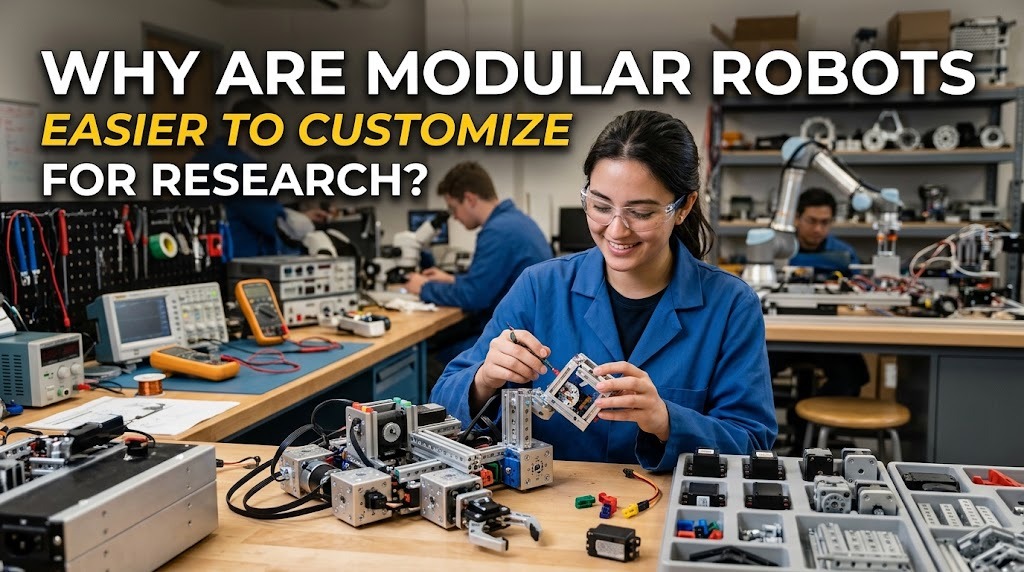
Robotics research often requires machines that can adapt to different experiments, environments, and technical objectives. Traditional robots may have fixed structures that limit how researchers modify their capabilities. Modular robots offer a more flexible alternative because they consist of separate components that can be connected, removed, or rearranged. This design allows researchers to build customized robotic systems without developing an entirely new machine for every experiment.
UNDERSTANDING MODULAR ROBOTS
Modular robots are robotic systems constructed from individual units that work together to perform specific tasks. Each module may provide a function such as movement, sensing, computing, power supply, or structural support. Researchers can combine these components into different configurations depending on the requirements of an experiment. Some modular systems use standardized connectors and communication protocols, making it easier to replace components and expand existing designs.
FLEXIBILITY IN ROBOT CONFIGURATION
One major advantage of modular robots is the ability to change their physical structure. Researchers can rearrange modules to create different shapes, sizes, and movement patterns without replacing the entire system. For example, a robot designed for laboratory experiments can be reconfigured to test locomotion, object manipulation, or navigation. This flexibility makes modular platforms useful for studying how mechanical structure influences robotic performance.
REDUCING DEVELOPMENT TIME AND COSTS
Building a new robot from scratch can require extensive mechanical design, electronic development, programming, and testing. Modular systems reduce some of this work by allowing researchers to reuse components from previous projects. If an experiment requires an additional sensor or a different actuator, the relevant module can often be added or replaced independently. This approach may reduce development time, material waste, and engineering costs, although specialized modules and integration work can still be expensive.
SIMPLIFYING EXPERIMENTAL TESTING
Modular robots allow researchers to change one component while keeping much of the remaining system unchanged. This supports controlled experiments in which the effects of a specific modification can be measured more clearly. For example, researchers can compare different wheel modules, grippers, or sensors to determine which design performs better under the same conditions. Standardized connections can also make it easier to repeat experiments and compare results across configurations.
SUPPORTING COLLABORATION AND KNOWLEDGE SHARING
Research teams often specialize in different areas, including mechanical engineering, electronics, artificial intelligence, and control systems. Modular architecture allows these teams to develop separate components that can later be integrated into a shared platform. Standardized interfaces help researchers exchange modules, reproduce experiments, and build upon previous work. This can encourage collaboration between laboratories and reduce the need for each team to develop every robotic component independently.
ENABLING ADVANCED ROBOTICS RESEARCH
Modular robots support research into adaptive systems, swarm robotics, autonomous reconfiguration, and bio-inspired movement. Researchers can investigate how individual modules coordinate, respond to environmental changes, or reorganize to complete different tasks. Some systems can even change their physical configuration automatically, allowing experiments on robots that adapt their structure to changing conditions. These capabilities are valuable for exploring robotic behavior that would be difficult to study using rigid, single-purpose machines.
CHALLENGES OF MODULAR ROBOT DESIGN
Despite their advantages, modular robots also present technical challenges. Every connection must provide sufficient mechanical strength and reliable communication between modules. Adding components can increase weight, energy consumption, and control complexity. Researchers must also ensure that different modules are compatible and that software can coordinate their functions correctly. Standardization can simplify integration, but it may limit design freedom when experiments require highly specialized components.
THE FUTURE OF MODULAR ROBOTICS RESEARCH
Advances in lightweight materials, wireless communication, artificial intelligence, and standardized interfaces are expanding modular robotics capabilities. Future systems may automatically identify connected modules and adjust their control programs to match the new configuration. Researchers may also use simulation tools to evaluate different arrangements before assembling physical prototypes. These developments could make experimental robotics more accessible, adaptable, and efficient across engineering, healthcare, manufacturing, and scientific exploration.
CONCLUSION
Modular robots are easier to customize for research because their components can be replaced, rearranged, and reused for different experiments. Their flexible architecture supports faster prototyping, controlled testing, collaboration, and exploration of advanced robotic concepts. Although compatibility and coordination remain important challenges, modular systems provide a practical foundation for researchers who need adaptable robotic platforms.
Recent Posts

Bagaimana Sistem SKS pada Program Kuliah... 22.11.2026/49 View

How Does Technology Make Daily Evaluation... 21.11.2026/77 View

Apa Strategi Menghadapi Kesenjangan antara Kompetensi... 21.11.2026/78 View

Mengapa Inventaris Aset Penting bagi Kelancaran... 21.11.2026/74 View

When Should Musicians Join a Record... 21.11.2026/79 View
