

Why Are Private Vehicles a Major Cause of Urban Traffic Congestion?
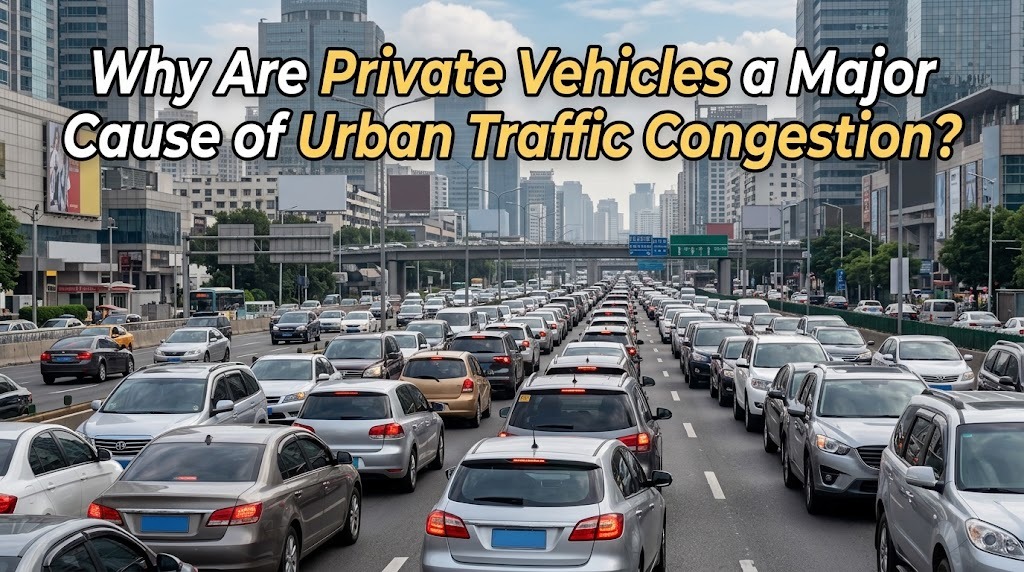
Private vehicles are one of the major contributors to traffic congestion in growing cities. Cars and motorcycles provide convenience, flexibility, and independence, allowing people to travel according to their own schedules. However, when too many people use private vehicles at the same time, roads can become overcrowded and travel times increase. Understanding why private vehicles contribute to urban traffic congestion can help governments and communities develop more effective transportation solutions.
INCREASING PRIVATE VEHICLE OWNERSHIP
One of the main reasons private vehicles contribute to traffic congestion is the continuous increase in vehicle ownership. As populations grow and household incomes improve, more people can afford to purchase cars and motorcycles. Many residents prefer private transportation because it offers greater flexibility than public transportation, especially in areas with limited routes or unreliable services. Consequently, the number of vehicles on urban roads can grow faster than the available road capacity.
The problem becomes more serious when multiple members of the same household use separate vehicles for work, school, and other activities. Even short journeys can add to congestion when thousands of people travel simultaneously. In densely populated cities, the accumulation of these individual trips places considerable pressure on major roads and intersections. Improving public transportation and encouraging shared mobility can help reduce excessive dependence on private vehicles.
INEFFICIENT USE OF ROAD SPACE
Private vehicles often occupy a considerable amount of road space relative to the number of passengers they carry. A car transporting only one person uses much of the same road space as a car carrying several passengers. When many vehicles operate with low occupancy, the transportation system moves fewer people using the available road capacity. This makes road space efficiency an important factor in understanding urban congestion.
Motorcycles generally occupy less physical space than cars, but large numbers of motorcycles can still create congestion, particularly at intersections and narrow roads. Vehicles may also slow traffic when drivers change lanes frequently, stop in unsuitable locations, or search for parking. These behaviors can reduce the effective capacity of roads even when the physical infrastructure remains unchanged. Carpooling, high-occupancy vehicles, and better parking management can help move more people without requiring additional road space.
LIMITED PUBLIC TRANSPORTATION ALTERNATIVES
Inadequate public transportation can encourage residents to rely heavily on private vehicles. When buses are infrequent, routes do not connect important destinations, or stations are difficult to reach, people may consider private transportation the more practical option. This is especially common in neighborhoods located far from employment centers and educational institutions. As private vehicle use increases, roads become more crowded and public transportation may become even less attractive if buses are delayed by the same traffic.
Cities can address this challenge by developing reliable and affordable public transportation networks. Frequent buses, integrated ticketing, convenient transfer points, and dedicated bus lanes can make public transport easier to use. Safe walking routes and cycling facilities can also help residents reach stations without needing a private vehicle for the entire journey. When public transportation becomes convenient and dependable, more people may choose it for their daily commutes.
TRAFFIC CONGESTION DURING PEAK HOURS
Private vehicle use often increases significantly during morning and evening rush hours. Employees travel to offices, students go to schools and universities, and business owners commute to commercial areas at similar times. Because many journeys follow the same routes, traffic demand can temporarily exceed the capacity of major roads. This creates long queues, slower vehicle movement, and delays at intersections.
The situation becomes worse when most commuters travel separately instead of sharing transportation. A minor incident, vehicle breakdown, or poorly managed intersection can further disrupt traffic flow. Cities can reduce peak-hour pressure by encouraging flexible working hours, staggered school schedules where practical, and carpooling programs. Better traffic signal coordination and real-time traffic information can also help manage congestion, although these measures work best when combined with broader transportation improvements.
ENVIRONMENTAL AND ECONOMIC CONSEQUENCES
Heavy dependence on private vehicles can create environmental and economic problems for urban communities. Cars and motorcycles that use petrol or diesel produce emissions that contribute to air pollution, while traffic noise can reduce comfort in residential and commercial areas. Congested driving may increase fuel consumption, particularly when vehicles idle frequently or repeatedly accelerate and brake. The precise environmental impact depends on vehicle efficiency, fuel type, driving behavior, and local traffic conditions.
Traffic congestion also wastes time that people could otherwise spend working, resting, studying, or participating in family activities. Businesses may experience delayed deliveries, higher transportation costs, and difficulties scheduling services. These consequences demonstrate that private vehicle dependence is not only a transportation issue but also a challenge for urban health and economic productivity. Encouraging cleaner transportation, improving public transit, and managing travel demand can help cities reduce these negative effects.
KESIMPULAN
Private vehicles are a major cause of urban traffic congestion because increasing ownership, inefficient use of road space, limited public transportation, and concentrated commuting hours place pressure on road networks. Although private vehicles provide convenience, excessive dependence on them can increase travel delays, pollution, fuel consumption, and economic losses.
A sustainable solution requires more than expanding roads. Governments should improve public transportation, support carpooling, develop safe walking and cycling facilities, and implement effective traffic management policies. Residents can also contribute by choosing shared or alternative transportation when practical. Through cooperation between governments, businesses, and communities, cities can improve mobility and create a more efficient and sustainable transportation system.
Recent Posts

Bagaimana Sistem SKS pada Program Kuliah... 22.11.2026/54 View

How Does Technology Make Daily Evaluation... 21.11.2026/83 View

Apa Strategi Menghadapi Kesenjangan antara Kompetensi... 21.11.2026/81 View

Mengapa Inventaris Aset Penting bagi Kelancaran... 21.11.2026/78 View

When Should Musicians Join a Record... 21.11.2026/83 View
