

Why Are Regional Languages Becoming Less Common Among Young People?
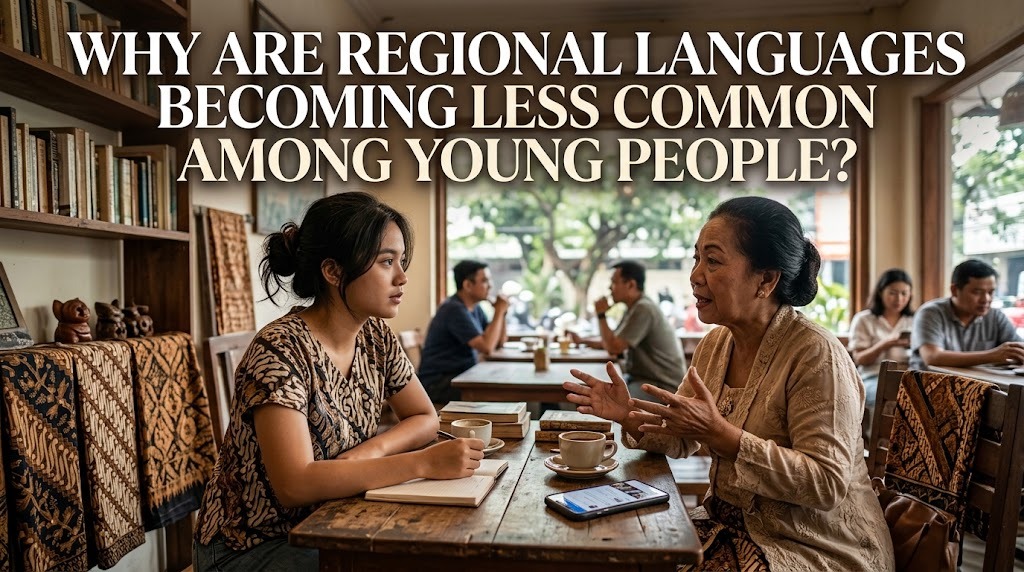
Regional languages are an important part of cultural identity in Indonesia because they carry local history, traditions, values, and ways of thinking. However, many young people today use Indonesian or foreign languages more frequently than the languages spoken by their parents and grandparents. This change can be seen in everyday conversations, social media, educational environments, and family interactions. Although Indonesian plays an essential role in national communication, the declining use of regional languages may create difficulties in passing local knowledge and cultural traditions to future generations. Understanding the causes of this trend is an important step toward finding practical solutions to preserve regional languages among young people.
THE INFLUENCE OF INDONESIAN AND FOREIGN LANGUAGES
One major reason regional languages are becoming less common among young people is the widespread use of Indonesian in daily communication. Indonesian serves as the national language and allows people from different regions to communicate easily. It is commonly used in schools, universities, workplaces, public services, and formal situations. As a result, many young people become more comfortable using Indonesian than speaking their regional languages, especially when communicating with friends from different cultural backgrounds.
Foreign languages, particularly English, also influence young people's communication habits. English is widely associated with international education, technology, entertainment, and career opportunities. Some young people therefore spend more time learning and using English through digital platforms, films, music, and online games. These languages are not inherently harmful to regional languages, but regional languages may receive less attention when young people rarely use them in everyday situations.
THE ROLE OF FAMILY AND PARENTAL HABITS
The family is one of the most important environments for learning a regional language. Children usually become familiar with their first language through conversations with parents, grandparents, siblings, and other relatives. When parents consistently use a regional language at home, children have more opportunities to understand its vocabulary, pronunciation, and expressions. However, some parents choose Indonesian because they believe it is more practical for education and future communication.
This habit can gradually reduce the number of young people who speak their regional language fluently. Children who understand a language but rarely speak it may struggle to use it naturally as they grow older. In some families, grandparents continue speaking the regional language while younger family members respond in Indonesian. Regular communication between generations is therefore essential for maintaining language skills and passing cultural knowledge to children. Parents can support this process by using regional languages during meals, storytelling, family activities, and everyday conversations.
THE INFLUENCE OF SOCIAL MEDIA AND DIGITAL TECHNOLOGY
Social media has significantly changed how young people communicate and consume information. Platforms such as TikTok, Instagram, YouTube, and other digital services expose users to content in Indonesian and international languages. Popular trends, entertainment videos, online discussions, and gaming communities often use Indonesian or English, making these languages more visible in young people's daily lives. Consequently, regional languages may appear less frequently in the digital spaces where young people spend much of their time.
Another challenge is the limited availability of digital content in some regional languages. Although creators increasingly produce local-language videos, songs, podcasts, and educational materials, the amount of content varies considerably between languages. Young people may find it easier to access information and entertainment in Indonesian or English than in their own regional language. Nevertheless, digital technology can also become a powerful tool for language preservation when communities use it creatively. Creating regional-language videos, online dictionaries, short stories, and educational content can encourage young people to use their languages in modern and engaging ways.
EDUCATIONAL ENVIRONMENTS AND SOCIAL ATTITUDES
Schools and universities influence the languages young people use because Indonesian is generally the main language of instruction. This is important for ensuring that students from different backgrounds can access education and understand learning materials. However, when regional languages receive limited attention in educational activities, students may have fewer opportunities to practice them outside their homes. Regional-language subjects and cultural activities can help students understand that local languages remain valuable in modern society.
Social attitudes also affect language choices. In some environments, young people may believe that speaking a regional language makes them appear less modern or less sophisticated. Others may avoid using it because they are afraid of making pronunciation or vocabulary mistakes. Such attitudes can weaken their confidence and reduce their willingness to communicate in their mother tongue. Positive attitudes toward linguistic diversity can help address this problem by showing that speaking a regional language is a valuable cultural skill rather than a barrier to progress. Teachers, parents, and communities can encourage students to appreciate regional languages while continuing to develop Indonesian and foreign-language skills.
THE IMPACT OF URBANIZATION AND CULTURAL CHANGE
Urbanization and migration also contribute to the declining use of regional languages. When families move to cities for education or employment, they often meet people from different linguistic backgrounds. In these environments, Indonesian may become the most convenient language for communication among neighbors, classmates, and coworkers. Children growing up in multilingual households may consequently have fewer opportunities to practice the regional language associated with their parents' hometown.
Cultural change can further influence language preferences. Young people are exposed to different lifestyles, values, and communication patterns through travel, education, entertainment, and international connections. These experiences can broaden their perspectives, but they may also change how often they participate in traditional activities where regional languages are commonly used. However, migration does not automatically cause language loss. Families can maintain their regional languages across generations by communicating with relatives, joining cultural communities, participating in traditional events, and creating opportunities for children to speak the language even when living far from their ancestral region.
HOW CAN YOUNG PEOPLE HELP PRESERVE REGIONAL LANGUAGES?
Young people can help preserve regional languages by using them regularly in meaningful situations. Speaking with parents, grandparents, relatives, and friends provides practical opportunities to develop vocabulary and improve fluency. They can also learn regional songs, traditional stories, proverbs, and expressions to understand the cultural meaning behind the language. Small habits, such as greeting family members in a regional language or using local expressions during conversations, can make language practice a natural part of daily life.
Digital platforms offer additional opportunities to make regional languages relevant to younger generations. Young creators can produce short videos, educational posts, podcasts, digital dictionaries, and stories using their local languages. Schools and community organizations can support these efforts through language competitions, storytelling events, cultural festivals, and local-language clubs. Governments, educators, families, and cultural institutions can also collaborate to document languages and develop learning resources, especially for languages with declining numbers of speakers. Preserving regional languages requires consistent use, intergenerational learning, and community participation, rather than relying only on formal lessons or occasional cultural celebrations.
CONCLUSION
Regional languages are becoming less common among young people because of several interconnected factors, including the dominance of Indonesian in public communication, the influence of foreign languages, changing family habits, social media, educational environments, urbanization, and shifting social attitudes. These factors can reduce opportunities for young people to learn and speak their local languages naturally. However, the decline is not inevitable because families, schools, communities, and digital creators can work together to strengthen language use. By speaking regional languages at home, developing engaging digital content, and encouraging positive attitudes toward local culture, young people can help protect their linguistic heritage. Maintaining regional languages alongside Indonesian and foreign languages allows future generations to benefit from broader communication skills while preserving the cultural identity and knowledge of their communities.
Recent Posts

Bagaimana Sistem SKS pada Program Kuliah... 22.11.2026/47 View

How Does Technology Make Daily Evaluation... 21.11.2026/75 View

Apa Strategi Menghadapi Kesenjangan antara Kompetensi... 21.11.2026/77 View

Mengapa Inventaris Aset Penting bagi Kelancaran... 21.11.2026/73 View

When Should Musicians Join a Record... 21.11.2026/77 View
