

Why Are Reliable Sources Important In Academic Citation?
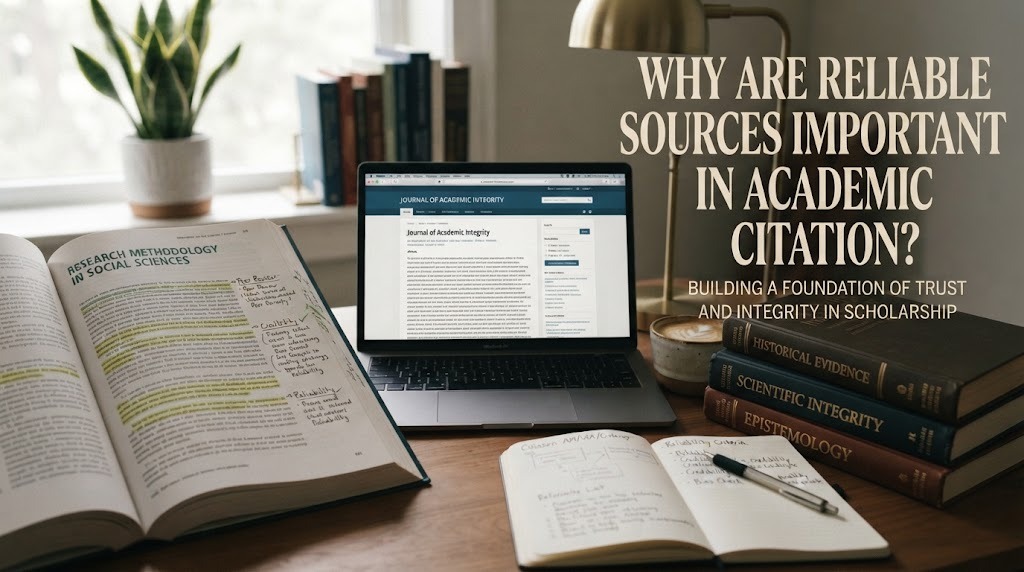
Academic writing depends on information that can be trusted and evaluated. When students and researchers use information from books, journal articles, websites, or research reports, they need to consider whether those sources are reliable and appropriate. Academic citation then identifies where the information comes from and allows readers to examine the original source. Using reliable sources therefore plays an important role in producing credible academic writing.
A citation is not automatically trustworthy simply because it is formatted correctly. The quality of the source behind the citation also matters. If a writer cites inaccurate, biased, outdated, or unsupported information, the citation may weaken rather than strengthen the argument. For this reason, source evaluation should be an important part of the academic writing process.
WHAT ARE RELIABLE SOURCES?
Reliable sources are sources that provide information supported by credible evidence and produced by identifiable and knowledgeable authors or organizations. Examples can include peer-reviewed journal articles, scholarly books, government publications, and reputable academic or professional institutions. The appropriate source depends on the topic and purpose of the research. A reliable source should provide enough information for readers to understand where its claims come from.
Reliability also involves accuracy, authority, relevance, and evidence. A source written by a qualified researcher and supported by references may be more suitable for an academic paper than an anonymous website with unsupported claims. However, no single source should be considered reliable for every topic. Writers should evaluate each source according to the requirements of their research.
WHY DOES SOURCE QUALITY MATTER?
Source quality directly affects the strength of an academic argument. When claims are supported by credible research, readers have stronger reasons to consider the discussion convincing. In contrast, weak sources may provide inaccurate or unsupported information. Even perfectly formatted citations cannot compensate for poor-quality evidence.
Using reliable sources also demonstrates that the writer has conducted careful research. Academic writing is expected to engage with established knowledge and relevant research rather than depend mainly on personal opinions. Selecting appropriate sources shows that the writer understands the topic and can distinguish stronger evidence from weaker information. This contributes to the overall quality of the paper.
HOW DO RELIABLE SOURCES INCREASE CREDIBILITY?
Reliable sources help increase the credibility of academic writing because they provide evidence that readers can examine. When a writer supports an important statement with a reputable journal article or scholarly book, readers can investigate the original research. This creates transparency and allows readers to evaluate the basis of the argument.
Credibility also depends on how the source is used. A reliable source should actually support the claim being made rather than being cited simply to make the paper appear academic. Writers should accurately represent the source's findings and avoid taking statements out of context. Responsible use of evidence makes citations more meaningful and trustworthy.
HOW CAN YOU IDENTIFY A RELIABLE SOURCE?
One way to identify a reliable source is to examine the author's qualifications and affiliation. Writers should consider whether the author has relevant expertise or whether the organization publishing the information has recognized authority in the field. The publication itself should also provide enough information about its purpose and evidence.
Writers should also check whether the source provides references or supporting evidence. Peer-reviewed journal articles can be particularly useful because they typically undergo evaluation by other experts before publication. However, peer review alone does not guarantee that every claim is correct. Students should still consider the source's relevance, methodology, date, and relationship to their research question.
WHY IS PEER REVIEW IMPORTANT?
Peer review is a process in which research is evaluated by other experts in the relevant academic field before publication in many scholarly journals. It can help identify weaknesses in research methods, reasoning, evidence, or presentation. This process provides an additional level of quality control compared with many sources that are published without expert review.
However, peer review should not be treated as an absolute guarantee of accuracy. Researchers should still examine the study's methods, evidence, limitations, and relevance to their topic. A high-quality academic paper benefits from evaluating sources critically rather than accepting every published claim automatically. Careful evaluation leads to stronger academic research.
WHY SHOULD YOU AVOID UNRELIABLE SOURCES?
Unreliable sources can introduce false information, unsupported claims, or misleading interpretations into an academic paper. If a writer uses such information, the weakness of the source can affect the entire argument. Readers may also question the writer's research process when the evidence comes from questionable publications.
This does not mean that every nonacademic website is automatically useless. Some websites operated by government agencies, universities, libraries, or professional organizations can provide valuable information. The key is to evaluate the authority, evidence, purpose, date, and relevance of the source before citing it.
HOW DOES SOURCE DATE AFFECT RELIABILITY?
The publication date can be important because some academic subjects change quickly. In fields such as technology, medicine, science, and current affairs, newer evidence may be necessary to reflect recent developments. In other subjects, older sources can remain valuable because they contain foundational theories or historical perspectives.
Therefore, a recent source is not automatically better than an older one. Writers should consider whether the information needs to be current for the specific research question. A balanced academic paper may use both recent research and important earlier publications when appropriate. What matters is whether each source remains relevant and suitable for the argument.
HOW SHOULD YOU EVALUATE ONLINE SOURCES?
The internet provides access to a large amount of information, but not everything online is suitable for academic citation. Writers should check the author, organization, publication date, evidence, references, and purpose of an online source. Websites that provide transparent information about their authorship and evidence are generally easier to evaluate.
Students should be especially careful with anonymous pages, unsupported blogs, social media posts, and websites that make strong claims without evidence. An online source can be useful, but its credibility should be established before it is cited. When possible, academic databases, university websites, government publications, and reputable professional organizations can provide stronger sources.
HOW DOES SOURCE EVALUATION SUPPORT ACADEMIC INTEGRITY?
Using reliable sources supports academic integrity because it demonstrates responsible handling of information. Writers have a responsibility not only to cite sources but also to choose evidence that is appropriate for their claims. Citing unreliable information without checking it can weaken the quality of an academic paper.
Academic integrity also involves representing sources accurately. Writers should not change the meaning of research to make it support an argument more strongly. They should acknowledge limitations and differences between sources when relevant. These practices show that the writer is committed to honest and responsible scholarship.
CONCLUSION
Reliable sources are important in academic citation because citation quality depends on source quality. A correctly formatted citation cannot make inaccurate or unsupported information reliable. Writers should therefore evaluate the authority, evidence, relevance, date, and purpose of a source before using it in academic writing.
Choosing credible sources helps strengthen arguments, improve transparency, and increase the credibility of academic work. Students should prioritize appropriate scholarly and institutional sources while evaluating online information carefully. By combining reliable evidence with accurate citation, writers can produce academic work that is more trustworthy, responsible, and persuasive.
Recent Posts

Bagaimana Sistem SKS pada Program Kuliah... 22.11.2026/38 View

How Does Technology Make Daily Evaluation... 21.11.2026/71 View

Apa Strategi Menghadapi Kesenjangan antara Kompetensi... 21.11.2026/73 View

Mengapa Inventaris Aset Penting bagi Kelancaran... 21.11.2026/69 View

When Should Musicians Join a Record... 21.11.2026/73 View
