

Why Are Research Skills Valuable for Science Olympiad Participants?
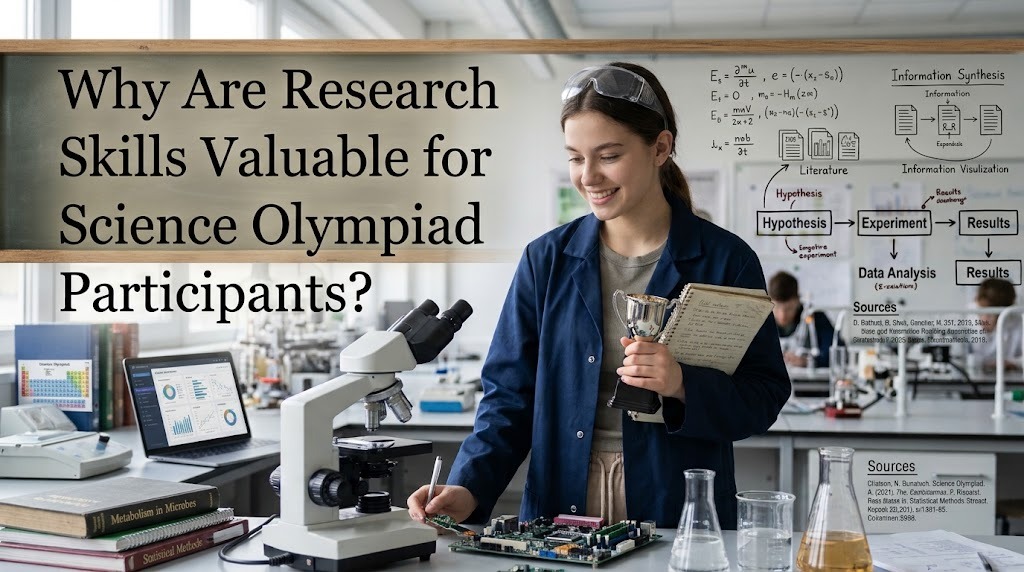
Science Olympiad competitions challenge students to understand scientific concepts, analyze information, and solve problems using logical reasoning. While strong subject knowledge is important, participants also need research skills to explore scientific topics more deeply and develop accurate conclusions.
Research skills help students find reliable information, understand scientific evidence, and investigate questions systematically. These abilities are valuable because many competition problems require more than memorizing formulas or definitions. Students must understand how scientific knowledge is developed and how it can be applied to different situations.
HELPING STUDENTS FIND RELIABLE INFORMATION
One important research skill is the ability to identify trustworthy sources. During Science Olympiad preparation, students often use textbooks, scientific journals, educational websites, and research publications to understand advanced topics.
However, not all information available online is accurate. Some sources contain outdated explanations, unsupported claims, or misleading interpretations of scientific findings.
Students need to evaluate the credibility of their references by considering the author's expertise, publication quality, supporting evidence, and relevance to the topic. This helps them build scientific knowledge based on accurate and dependable information.
STRENGTHENING SCIENTIFIC UNDERSTANDING
Research encourages students to explore scientific concepts beyond the explanations provided in regular classroom lessons. Instead of learning only basic definitions, they can investigate how scientific principles work and why certain phenomena occur.
For example, students studying biology can research genetic inheritance, cellular processes, or environmental changes. Those preparing for physics competitions can explore mechanics, electricity, and energy through additional scientific references.
This deeper exploration helps students connect different concepts and recognize relationships between scientific principles. As a result, they become better prepared to answer complex questions that require detailed understanding.
DEVELOPING CRITICAL THINKING ABILITIES
Critical thinking is essential when students need to evaluate scientific information and determine whether an explanation is supported by evidence. Research activities encourage them to question assumptions, compare findings, and examine different perspectives.
For example, students may discover that two scientific sources present different explanations of a particular phenomenon. Instead of immediately accepting one answer, they need to examine the methods, evidence, and context behind each explanation.
This process develops their ability to make logical judgments. It also prepares them to handle Science Olympiad questions that require careful analysis rather than simple memorization.
IMPROVING DATA ANALYSIS SKILLS
Scientific research often involves collecting, organizing, and interpreting data. These activities help students understand how numerical information can be used to explain scientific phenomena.
Participants may need to interpret tables, graphs, experimental measurements, or statistical results. Understanding these forms of information is particularly important in subjects such as physics, chemistry, biology, and environmental science.
By practicing data analysis, students become more familiar with identifying patterns, recognizing relationships, and drawing conclusions from evidence. These abilities can support their performance when solving data-based competition problems.
SUPPORTING EXPERIMENTAL INVESTIGATION
Research skills help students understand how scientific experiments are designed and conducted. Before performing an experiment, they need to identify a research question, understand relevant theories, and determine which variables should be examined.
They also need to consider appropriate procedures, measurement methods, and possible sources of error. These steps help ensure that experimental activities produce useful and meaningful results.
For Science Olympiad participants, understanding experimental investigation can improve their ability to interpret practical problems. It also teaches them that scientific conclusions should be based on systematic observation and evidence.
ENCOURAGING INDEPENDENT LEARNING
Students cannot always depend on teachers or mentors to explain every advanced topic they encounter during preparation. Research skills allow them to find answers independently and continue learning outside the classroom.
When students encounter unfamiliar concepts, they can search for relevant references, compare explanations, and organize important information into personal study notes. This makes their preparation more flexible and efficient.
Independent learning also encourages responsibility. Students become more aware of their knowledge gaps and can decide which subjects require additional attention.
IMPROVING PROBLEM-SOLVING STRATEGIES
Many Science Olympiad questions involve situations that require students to apply scientific knowledge in unfamiliar contexts. Research helps them develop a broader understanding of how theories can be used to explain real-world problems.
By examining scientific examples and previous investigations, students can recognize different approaches to solving similar challenges. They can also learn how to break complicated problems into smaller and more manageable parts.
This experience strengthens analytical reasoning and encourages students to consider several possible solutions before choosing an appropriate method.
DEVELOPING SCIENTIFIC COMMUNICATION
Research skills are also connected to the ability to communicate scientific ideas clearly. Students need to organize information, explain their findings, and support their arguments with relevant evidence.
These abilities are useful when presenting experimental results, discussing scientific questions with teammates, or explaining solutions to teachers and mentors.
Clear scientific communication requires accurate terminology and logical explanations. Practicing these skills helps students express their understanding more effectively and participate in academic discussions with greater confidence.
PREPARING STUDENTS FOR FUTURE ACADEMIC OPPORTUNITIES
The benefits of research skills extend beyond Science Olympiad competitions. Students who learn how to investigate questions, evaluate sources, and interpret evidence develop abilities that are useful in higher education and scientific careers.
At university, research activities are commonly part of academic assignments, laboratory projects, and final papers. Students with previous research experience may find it easier to understand academic procedures and organize scientific information.
These skills can also support future interests in fields such as medicine, engineering, biotechnology, environmental science, and other research-based professions.
HOW STUDENTS CAN IMPROVE THEIR RESEARCH SKILLS
Developing research skills requires regular practice and curiosity about scientific topics. Students can begin with simple activities before progressing to more advanced investigations.
Several practical methods can help strengthen these abilities:
- Read Scientific References: Use textbooks, educational publications, and credible scientific journals to expand subject knowledge.
- Compare Information: Examine several sources to understand different explanations and identify reliable evidence.
- Practice Data Interpretation: Study tables, graphs, and experimental results to improve analytical abilities.
- Conduct Simple Experiments: Observe scientific phenomena and document the results systematically.
- Create Research Notes: Summarize important findings using organized explanations and relevant examples.
- Discuss Scientific Topics: Exchange ideas with teachers, mentors, and fellow participants to develop deeper understanding.
Consistent practice helps students become more confident when investigating scientific questions and applying their knowledge.
CONCLUSION
Research skills are valuable for Science Olympiad participants because they strengthen scientific understanding, critical thinking, data analysis, and problem-solving abilities. They also help students identify reliable information, conduct investigations, and communicate scientific findings clearly.
More importantly, research encourages independent learning and prepares students for academic challenges beyond competitions. By developing these abilities, Science Olympiad participants can become more analytical, curious, and capable of understanding scientific problems through evidence-based reasoning.
Recent Posts

Bagaimana Sistem SKS pada Program Kuliah... 22.11.2026/48 View

How Does Technology Make Daily Evaluation... 21.11.2026/76 View

Apa Strategi Menghadapi Kesenjangan antara Kompetensi... 21.11.2026/78 View

Mengapa Inventaris Aset Penting bagi Kelancaran... 21.11.2026/73 View

When Should Musicians Join a Record... 21.11.2026/78 View
