

Why Are Rotary Encoders Essential for Precise Robot Positioning?
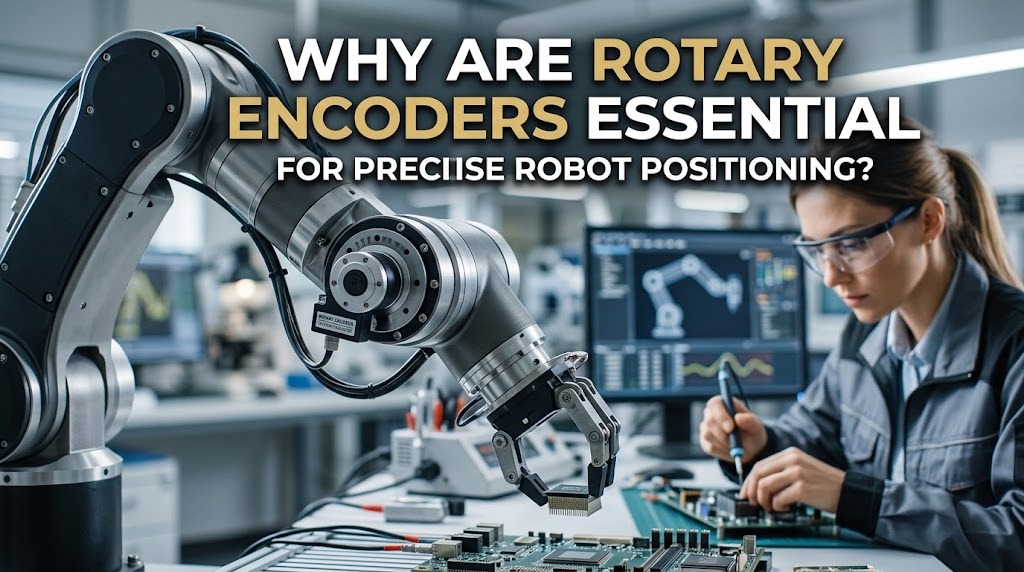
Robots must control the position and movement of their joints accurately to perform tasks such as assembling components, handling products, and operating machinery. Without reliable position measurements, even small movement errors can reduce productivity and cause equipment damage. Rotary encoders help solve this problem by measuring rotational movement and providing feedback to the robot's control system. These devices are essential for maintaining accuracy, improving motion control, and ensuring consistent robotic performance.
UNDERSTANDING ROTARY ENCODERS
A rotary encoder is a sensor that measures the angular position or rotation of a shaft. It converts mechanical movement into electrical signals that a controller can interpret. In robotics, encoders are commonly installed on motors, joints, or drive systems to monitor movement. The controller uses this information to determine how far a component has rotated and whether it has reached the intended position. Depending on their design, rotary encoders can provide incremental measurements or an absolute angular position.
HOW ROTARY ENCODERS MEASURE POSITION
Rotary encoders detect shaft movement through optical, magnetic, or other sensing mechanisms. Incremental encoders generate pulses as the shaft rotates, allowing the controller to calculate changes in position by counting those pulses. Absolute encoders provide a coded position value, enabling the system to identify the shaft's angular position directly. The controller can combine encoder readings with motor commands to estimate joint movement and correct deviations. This measurement process supports accurate positioning across different robotic applications.
IMPROVING ROBOT JOINT ACCURACY
Robotic arms contain multiple joints that must coordinate precisely to move an end effector to a target location. Rotary encoders measure the rotation of individual joints, allowing the controller to calculate the robot's configuration. If a joint moves too far or stops before reaching its target, feedback can help the controller adjust the motor command. Accurate joint measurements are particularly important for tasks such as precision assembly, welding, and component placement. Overall positioning accuracy also depends on mechanical tolerances, calibration, backlash, and the robot's control algorithms.
SUPPORTING CLOSED-LOOP CONTROL
Rotary encoders play an important role in closed-loop motion control. In this approach, the controller continuously compares the desired position with the measured position and calculates the difference, known as the position error. The control system then adjusts motor commands to reduce that error. This feedback process helps robots compensate for disturbances, changing loads, and variations in motor behavior. Without suitable feedback, an open-loop system may be unable to detect whether a commanded movement was completed accurately.
DIFFERENCES BETWEEN INCREMENTAL AND ABSOLUTE ENCODERS
Incremental and absolute encoders serve related purposes but operate differently. Incremental encoders track movement by counting pulses from a reference point, so the system may need to perform a homing procedure after startup if position information was lost. Absolute encoders provide a unique position value for each angular location within their measurement range. This can help a robot recover its joint position after a power interruption, depending on the encoder and system design. Engineers choose between these types based on accuracy requirements, cost, operating conditions, and the consequences of losing position information.
INCREASING SAFETY AND OPERATIONAL RELIABILITY
Reliable position feedback helps robots avoid unintended movement and reach commanded positions more consistently. In industrial automation, this can reduce positioning errors that might damage products, tools, or nearby equipment. Encoder signals can also help controllers identify abnormal movement or detect when a motor fails to follow its command. However, a standard rotary encoder is not automatically a safety-rated device. Applications requiring functional safety may need certified sensors, redundant feedback, and dedicated safety-control systems.
APPLICATIONS IN INDUSTRIAL AND SERVICE ROBOTS
Rotary encoders are widely used in industrial robotic arms, mobile robots, automated guided vehicles, and robotic grippers. In robotic arms, they measure joint rotation during assembly and material handling. In mobile robots, wheel encoders estimate wheel rotation and help calculate distance traveled, although wheel slip can reduce accuracy. In robotic grippers, encoders can support controlled opening and closing movements. These applications demonstrate how rotational feedback helps robots coordinate motion and perform repetitive tasks more reliably.
CHALLENGES AND MAINTENANCE REQUIREMENTS
Encoder performance can be affected by electrical noise, mechanical misalignment, contamination, vibration, and component wear. Incorrect installation may introduce measurement errors, while damaged wiring can interrupt feedback signals. Engineers must select encoders with suitable resolution, speed ratings, environmental protection, and communication interfaces. Regular inspection and calibration help maintain reliable measurements throughout the robot's operating life. The controller must also be configured correctly to interpret encoder signals and convert them into meaningful position values.
THE FUTURE OF ROTARY ENCODER TECHNOLOGY
Advances in magnetic sensing, optical measurement, compact electronics, and digital communication continue to improve encoder capabilities. Higher-resolution devices can provide more detailed movement information, while integrated diagnostic features can help identify potential faults. Modern robotic systems may combine rotary encoders with torque sensors, cameras, and inertial measurement units to obtain a more complete understanding of movement. These developments support more precise control and better fault detection in increasingly complex robotic applications.
CONCLUSION
Rotary encoders are essential for precise robot positioning because they measure rotational movement and provide feedback to motion controllers. They support accurate joint control, closed-loop operation, and consistent performance across industrial and mobile robotic systems. Although their effectiveness depends on correct installation, calibration, and system design, rotary encoders remain a fundamental component of reliable robotic motion control.
Recent Posts

Bagaimana Sistem SKS pada Program Kuliah... 22.11.2026/49 View

How Does Technology Make Daily Evaluation... 21.11.2026/77 View

Apa Strategi Menghadapi Kesenjangan antara Kompetensi... 21.11.2026/78 View

Mengapa Inventaris Aset Penting bagi Kelancaran... 21.11.2026/74 View

When Should Musicians Join a Record... 21.11.2026/79 View
