

Why Are the Colors of a Double Rainbow Reversed?
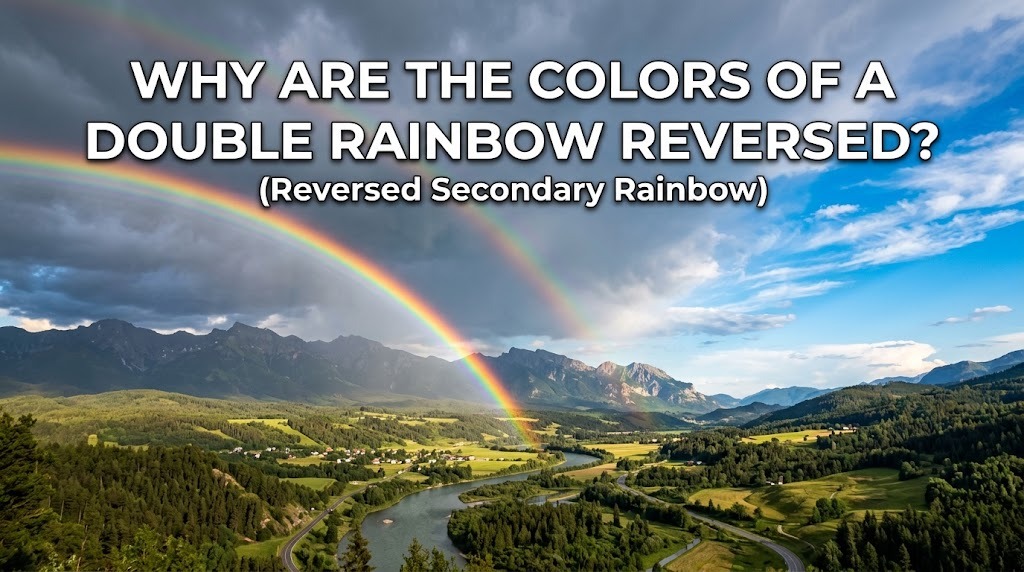
A double rainbow is a natural optical phenomenon in which two colorful arcs appear in the sky at the same time. One of its most distinctive features is that the secondary rainbow displays its colors in the opposite order from the primary rainbow. While the primary arc has red on the outer edge and violet on the inner edge, the secondary arc has violet on the outer edge and red on the inner edge.
This unusual arrangement is not caused by a change in sunlight or by the colors themselves switching places in the atmosphere. Instead, it results from the different paths that light follows inside water droplets. Through refraction, dispersion, and internal reflection, sunlight separates into colors and emerges from droplets at different angles. Understanding these processes explains why the colors of a double rainbow appear reversed.
HOW A REGULAR RAINBOW ARRANGES ITS COLORS
A primary rainbow forms when sunlight enters a water droplet, bends through refraction, reflects internally once, and bends again as it exits. During this process, different wavelengths of light are separated because they do not all bend by exactly the same amount. This separation is known as dispersion.
The emerging light reaches an observer at particular angles, creating the familiar sequence of rainbow colors. Red appears on the outer edge of the primary rainbow, while violet appears on the inner edge. Orange, yellow, green, blue, and other visible wavelengths occupy the region between them. This arrangement provides the reference for understanding the reversed color order of the secondary rainbow.
THE ROLE OF INTERNAL REFLECTION IN A DOUBLE RAINBOW
The secondary rainbow forms when sunlight follows a different path inside a water droplet. Instead of reflecting internally once, the light undergoes two internal reflections before exiting the droplet. Refraction still occurs as the light enters and leaves the water, and dispersion continues to separate the different wavelengths.
The additional reflection changes the direction in which the light emerges. Consequently, the secondary rainbow forms at a larger angular distance from the point in the sky directly opposite the Sun. Because the different wavelengths emerge in a different angular arrangement, the color sequence of the secondary arc appears reversed. This difference in the number of internal reflections is the central explanation for the phenomenon.
WHY VIOLET AND RED CHANGE THEIR POSITIONS
The colors of a rainbow do not physically change their identities or transform into different colors. Instead, their positions along the visible arc depend on the angles at which their wavelengths emerge from water droplets. In the primary rainbow, red light reaches the observer along the outer part of the arc, while violet light appears along the inner part.
In the secondary rainbow, the additional internal reflection changes the angular relationship between the emerging wavelengths. As a result, violet appears on the outer edge and red on the inner edge. The remaining colors are arranged between these two extremes in the opposite order. This reversal is a predictable result of the optical path rather than a random effect or an illusion created by the human eye.
WHY THE SECONDARY RAINBOW IS ALSO FAINTER
The secondary rainbow is usually fainter than the primary rainbow because its light undergoes an additional internal reflection. Each interaction with the droplet can reduce the amount of light that eventually emerges in the direction needed for an observer to see the arc. Therefore, less light contributes to the secondary rainbow, making its colors appear less intense.
Its visibility also depends on environmental conditions. A bright sky can make the secondary arc difficult to distinguish, while a darker background can improve the contrast between the rainbow and its surroundings. The wider shape and reversed colors may still be visible when conditions are favorable. These characteristics help observers identify the secondary rainbow and distinguish it from the brighter primary arc.
HOW TO RECOGNIZE THE REVERSED COLORS IN THE SKY
To identify a double rainbow, look for a second arc outside the brighter primary rainbow. The observer generally needs to stand with the Sun behind them and look toward water droplets in the opposite part of the sky. Rainfall, lingering droplets after a shower, or water spray can provide the conditions required for the phenomenon.
Once both arcs are visible, compare the color sequences. The primary rainbow has red on the outside and violet on the inside, while the secondary rainbow displays the opposite arrangement. The outer arc is generally wider and fainter, so it may require careful observation to see its colors clearly. Recognizing these patterns can help explain the optical processes taking place rather than treating the reversed colors as a mysterious occurrence.
CONCLUSION
The colors of a double rainbow are reversed because sunlight follows a different optical path inside water droplets. The primary rainbow forms when light undergoes one internal reflection, while the secondary rainbow forms when light undergoes two. This additional reflection changes the direction in which the separated wavelengths emerge, reversing the color sequence of the secondary arc.
The reversed colors are a direct consequence of the physics of light, particularly refraction, dispersion, and internal reflection. The secondary rainbow is also usually wider and fainter because it forms at a different angle and less light emerges along its optical path. By understanding these principles, observers can better recognize the distinctive features of a double rainbow and appreciate the science behind its appearance.
Recent Posts

Bagaimana Sistem SKS pada Program Kuliah... 22.11.2026/54 View

How Does Technology Make Daily Evaluation... 21.11.2026/83 View

Apa Strategi Menghadapi Kesenjangan antara Kompetensi... 21.11.2026/82 View

Mengapa Inventaris Aset Penting bagi Kelancaran... 21.11.2026/78 View

When Should Musicians Join a Record... 21.11.2026/84 View
