

Why Can an ATM PIN Be Declined During a Transaction?
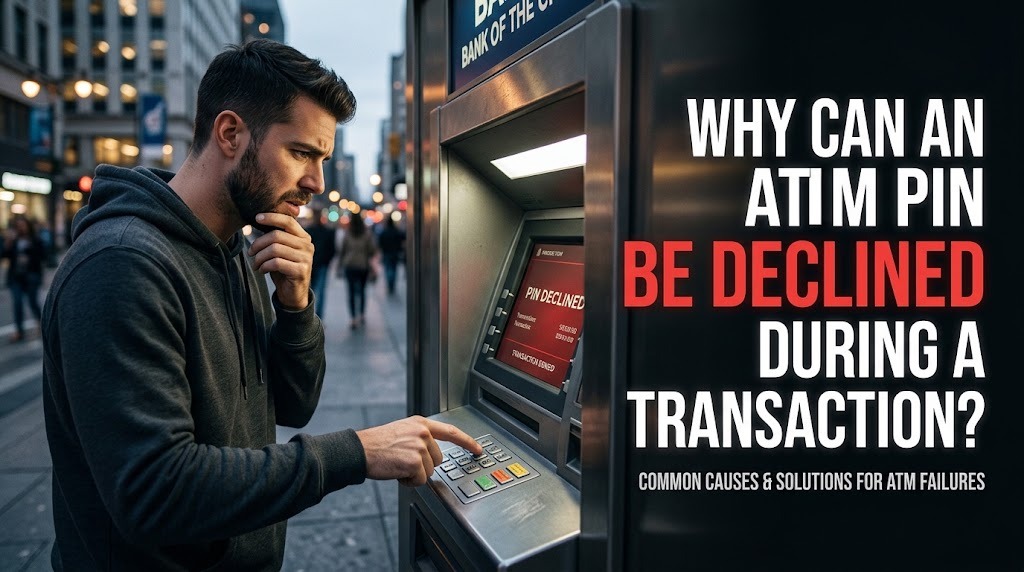
An ATM PIN can be declined during a transaction for several reasons. The most common possibility is that the PIN entered does not match the PIN associated with the card or account. However, other banking or security conditions may also prevent a transaction from being completed.
A declined PIN does not always mean that the account has a serious problem. The exact reason can depend on the bank, card, ATM, and security system being used. Understanding possible causes can help customers respond without repeatedly entering incorrect information.
THE ENTERED PIN MAY BE INCORRECT
One common reason an ATM PIN is declined is that the number entered does not match the correct PIN. This can happen because of a typing mistake, confusion between different PINs, or simply forgetting the correct number.
If you are certain about the correct PIN, check the numbers carefully before making another attempt. However, avoid repeatedly guessing different combinations because the bank may limit the number of incorrect attempts.
If you cannot remember your PIN, stop the transaction and use the bank's official PIN recovery procedure instead.
TOO MANY INCORRECT PIN ATTEMPTS
An ATM PIN may be declined after several unsuccessful attempts. Banks can apply security limits to reduce the risk of unauthorized people repeatedly trying to guess a customer's PIN.
The number of attempts allowed varies between financial institutions. Some banks may temporarily restrict the PIN or card after the permitted number of failed attempts has been reached.
If you suspect that your PIN has been restricted, do not continue trying different numbers. Contact your bank through an official banking channel for guidance.
THE CARD OR ACCOUNT MAY HAVE A SECURITY RESTRICTION
A declined ATM transaction may sometimes be related to a restriction on the card or account rather than the PIN itself. For example, a bank may temporarily restrict certain transactions because of a security concern or account status.
The reason cannot always be determined from the ATM message alone. Customers should check their banking application or contact the bank through an official channel if the problem continues.
Avoid sharing confidential information with anyone who offers to resolve the problem outside the bank's official support system.
THE ATM OR BANKING SYSTEM MAY HAVE A TECHNICAL ISSUE
Sometimes an ATM PIN transaction may fail because of a technical problem involving the ATM, network, or banking system. In this situation, the PIN itself may not be the actual problem.
If the machine displays an error or appears to be malfunctioning, avoid repeatedly attempting the same transaction. Consider using another official ATM or checking whether the bank has reported a service interruption.
If your account shows an unexpected transaction status after a failed attempt, contact the bank through its official customer service for clarification.
WHAT SHOULD YOU DO WHEN YOUR PIN IS DECLINED?
If your ATM PIN is declined, first avoid repeatedly entering different numbers. Check whether you may have made a simple typing error and consider whether you are certain that the PIN is correct.
If the problem continues, cancel the transaction and use an official banking channel to determine the cause. Your bank may be able to explain whether the issue relates to the PIN, card, account, ATM, or another security restriction.
Always protect your banking information during the process and never reveal your PIN to another person.
CONCLUSION
An ATM PIN can be declined during a transaction because the entered number is incorrect, too many failed attempts have occurred, the card or account has a restriction, or the ATM or banking system is experiencing a technical problem.
If the PIN is declined, avoid repeated guesses and follow your bank's official troubleshooting procedure. Maintaining good ATM security habits can help prevent unnecessary restrictions and protect your banking account.
Recent Posts

Bagaimana Sistem SKS pada Program Kuliah... 22.11.2026/35 View

How Does Technology Make Daily Evaluation... 21.11.2026/69 View

Apa Strategi Menghadapi Kesenjangan antara Kompetensi... 21.11.2026/69 View

Mengapa Inventaris Aset Penting bagi Kelancaran... 21.11.2026/67 View

When Should Musicians Join a Record... 21.11.2026/68 View
