

Why Can Reading Expand a Person’s Knowledge?
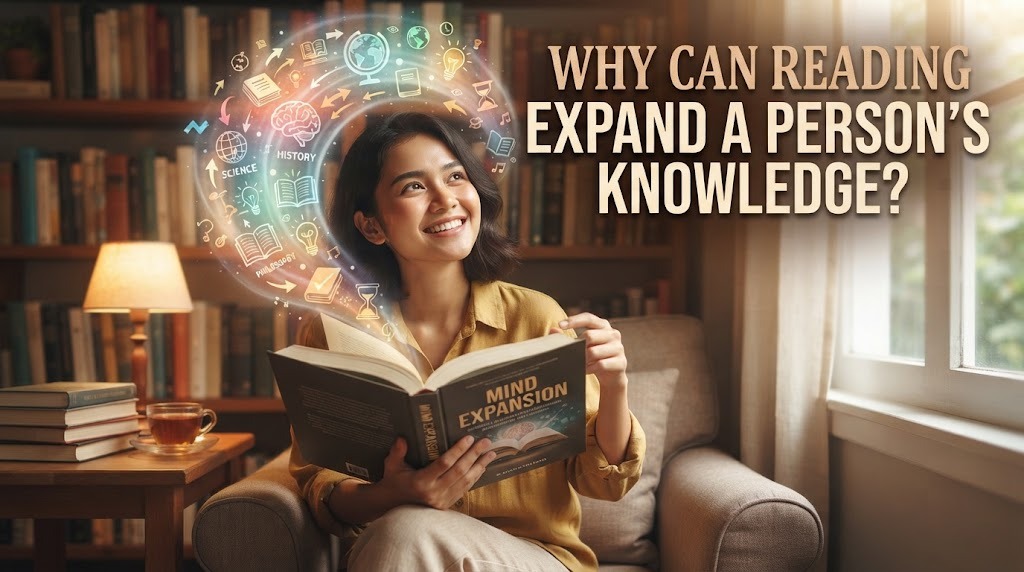
Reading is one of the most effective ways for people to gain and expand knowledge. Through books, articles, journals, and other reading materials, individuals can learn about subjects they may never experience directly. Reading provides information, ideas, experiences, and perspectives that can broaden a person's understanding of the world. It also allows people to learn at their own pace and revisit information whenever necessary. For this reason, developing regular reading habits can support continuous personal and intellectual growth.
INTRODUCES NEW INFORMATION
Reading exposes people to information that may not be available through their daily experiences. A person can learn about science, history, technology, culture, economics, and many other subjects through different types of texts. This allows readers to discover facts and concepts that they may not encounter in their immediate environment. The more varied the reading materials, the more opportunities people have to gain new information. Regular reading can therefore gradually increase the amount of knowledge a person has.
EXPANDS UNDERSTANDING OF DIFFERENT SUBJECTS
Reading allows individuals to explore subjects in greater depth. A short conversation may introduce an idea, but a book or detailed article can explain its background, causes, examples, and effects. Readers can choose materials based on their interests and gradually develop a deeper understanding of specific topics. They can also connect information from different sources to create a broader perspective. This makes reading valuable for both general knowledge and specialized learning.
PROVIDES DIFFERENT PERSPECTIVES
Books and other reading materials can present viewpoints that are different from a person's own experiences. Reading about other cultures, communities, professions, and historical periods can help people understand how others see the world. Exposure to different perspectives can challenge existing assumptions and encourage readers to think more openly. It can also help people understand why individuals may have different opinions about the same issue. As a result, reading can expand knowledge while also developing a more balanced way of thinking.
BUILDS VOCABULARY AND LANGUAGE KNOWLEDGE
Reading regularly introduces people to new words, expressions, and sentence structures. When readers encounter unfamiliar vocabulary in context, they can understand how words are used and gradually add them to their language knowledge. A wider vocabulary makes it easier to understand more complex texts and communicate ideas clearly. This creates a positive cycle in which better language skills make future reading easier. Over time, reading can strengthen both knowledge and communication abilities.
CONNECTS NEW INFORMATION WITH EXISTING KNOWLEDGE
Knowledge becomes more meaningful when new information can be connected with what a person already knows. Reading provides opportunities to make these connections by presenting related facts, examples, and explanations. For example, someone who has learned basic environmental concepts may understand climate-related articles more deeply when they encounter new information about conservation. These connections help readers organize information in their minds. They also make it easier to remember and apply what has been learned.
ENCOURAGES CURIOSITY AND QUESTIONS
Reading often creates curiosity about topics that readers have never considered before. A person may begin with a simple question and discover several new questions while exploring an article or book. This encourages active learning because readers become motivated to search for additional information. Curiosity can lead people to explore new subjects beyond their original interests. In this way, reading can turn a single piece of information into a continuous learning process.
DEVELOPS CRITICAL THINKING
Reading does more than provide information because it also encourages people to evaluate and analyze what they encounter. Readers can compare different sources, identify arguments, examine evidence, and consider whether a claim is reliable. These activities help people understand information more carefully instead of simply accepting everything they read. Critical thinking also allows readers to recognize differences between facts, opinions, and assumptions. As this skill improves, people can use their knowledge more effectively in everyday decisions.
SUPPORTS LIFELONG LEARNING
Reading makes it possible to continue learning even outside formal education. People can read about new technologies, professional skills, current developments, hobbies, or personal interests at any stage of life. This flexibility allows individuals to update their knowledge as their needs and environments change. Reading can therefore become a simple but powerful lifelong learning habit. People who continue reading are more likely to remain curious and open to new information.
HELPS PEOPLE LEARN FROM OTHER EXPERIENCES
Reading can provide access to experiences that readers have never personally encountered. Biographies, memoirs, novels, case studies, and historical accounts can show how people respond to different situations. Readers can learn from successes, mistakes, challenges, and decisions without having to experience every situation themselves. This can provide practical and emotional knowledge that goes beyond basic facts. As a result, reading can help people understand both information and human experiences.
CONCLUSION
Reading can expand a person's knowledge by introducing new information, explaining subjects in depth, and providing different perspectives. It also strengthens vocabulary, encourages curiosity, develops critical thinking, and helps readers connect new ideas with existing knowledge. Because reading can be done throughout life, it provides a flexible way to continue learning beyond school or formal education. Developing a regular reading habit can therefore contribute to broader knowledge and a deeper understanding of the world.
Recent Posts

Bagaimana Sistem SKS pada Program Kuliah... 22.11.2026/35 View

How Does Technology Make Daily Evaluation... 21.11.2026/69 View

Apa Strategi Menghadapi Kesenjangan antara Kompetensi... 21.11.2026/70 View

Mengapa Inventaris Aset Penting bagi Kelancaran... 21.11.2026/67 View

When Should Musicians Join a Record... 21.11.2026/69 View
