

Why Did Human Physical Characteristics Change Over Time?
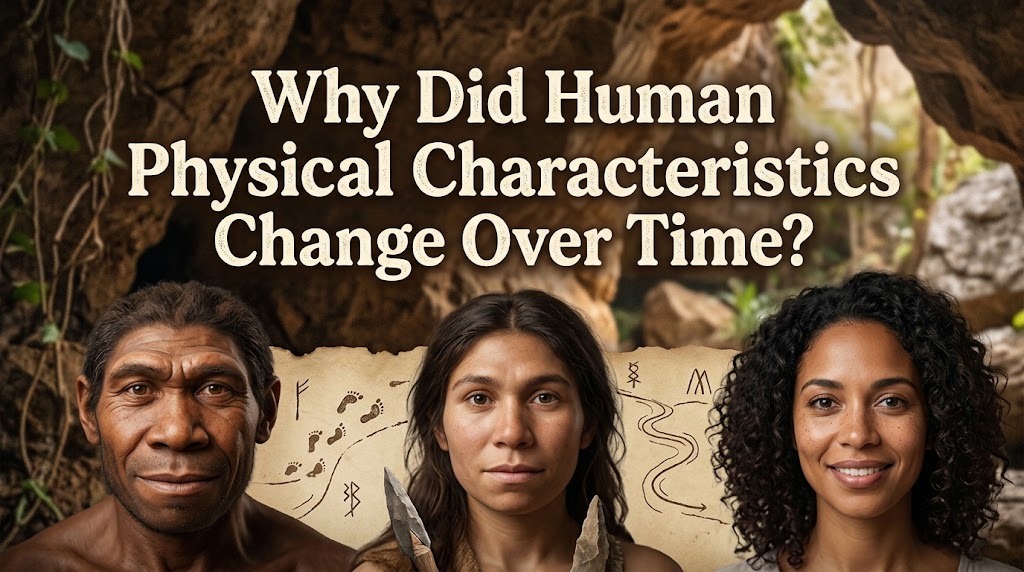
Human physical characteristics have changed over millions of years through a process known as human evolution. Early human ancestors looked different from modern humans because they lived in different environments and faced different survival challenges. Over many generations, inherited traits that helped individuals survive and reproduce became more common in populations. These changes affected body size, skull shape, skin color, walking ability, and other physical features. Understanding why human physical characteristics changed over time helps explain how humans adapted to different environments and developed into the diverse populations we see today.
THE ROLE OF NATURAL SELECTION IN HUMAN EVOLUTION
Natural selection is one of the main reasons human physical characteristics changed over time. It occurs when individuals with certain inherited traits are more likely to survive and reproduce in a particular environment. For example, early humans who could walk efficiently on two legs had advantages when traveling across open landscapes and carrying food or tools. Over many generations, these useful characteristics became more common within their populations. Natural selection did not happen because humans deliberately chose to change their bodies, but because some inherited variations provided advantages under specific conditions.
However, natural selection does not always produce a perfect adaptation. A characteristic that is beneficial in one environment may be less useful in another. Changes in climate, food availability, predators, and diseases can influence which traits provide advantages. Human evolution therefore reflects the interaction between inherited variation and changing environmental conditions. This process continues today, although many modern environments are very different from those experienced by early humans.
HOW CLIMATE AND ENVIRONMENT INFLUENCED PHYSICAL FEATURES
Climate played an important role in shaping human physical characteristics. Early human populations lived in environments that ranged from hot tropical regions to cold areas with seasonal changes. Over many generations, natural selection influenced traits that helped populations cope with these conditions. For example, body proportions can affect how efficiently the body retains or releases heat. Populations living in colder environments often developed body proportions that helped conserve heat, while relatively slender body forms can help release heat in hot environments.
Skin color also changed in response to environmental conditions, particularly differences in ultraviolet radiation from sunlight. Darker skin contains more melanin, which helps protect against ultraviolet radiation and reduces the breakdown of folate in the body. In regions with lower ultraviolet radiation, lighter skin evolved in some populations, helping the body produce vitamin D more efficiently under those conditions. These changes occurred over many generations and were influenced by migration, diet, and other factors. Skin color variation is therefore an example of human adaptation to different environments rather than evidence of separate human species.
CHANGES IN THE HUMAN BRAIN AND SKULL
The human brain and skull changed significantly throughout human evolutionary history. Some early human relatives had smaller brains than modern humans, while later members of the genus Homo developed larger average brain sizes. These changes were associated with several factors, including more complex behavior, social interaction, environmental challenges, and changes in diet. However, brain size alone does not determine intelligence, and scientists continue to investigate the relationships between brain structure, cognition, and behavior. Human evolution involved changes in both the size and organization of the brain.
The shape of the skull also changed as the face, teeth, and jaws evolved. Compared with many early human ancestors, modern humans generally have smaller jaws, reduced teeth, and a flatter face. These differences are connected to changes in diet, food processing, and the overall development of the skull. Cooking and using tools made it possible to process foods in ways that reduced the effort required for chewing. Nevertheless, these changes did not occur in a single step, and different human species displayed different combinations of physical characteristics.
WHY WALKING ON TWO LEGS BECAME IMPORTANT
Walking on two legs, known as bipedalism, was one of the most important developments in human evolution. Early members of the human evolutionary lineage developed adaptations that allowed them to move on two legs more efficiently. These adaptations included changes in the pelvis, spine, legs, feet, and the position of the head. Walking upright helped early humans travel across different landscapes while using their hands for carrying food, handling objects, and using tools. It also changed the way their bodies distributed weight and maintained balance.
Scientists believe that bipedalism evolved before the major expansion of the human brain. This means that upright walking was not simply a result of becoming more intelligent. Instead, it developed through a long evolutionary process influenced by movement, habitat, and survival needs. Walking on two legs may have provided several advantages, but it also involved trade-offs, including greater stress on certain parts of the skeleton. The human body today still reflects the anatomical changes associated with millions of years of adaptation to upright walking.
THE INFLUENCE OF FOOD AND DIET ON HUMAN PHYSICAL CHARACTERISTICS
Changes in diet contributed to the development of human physical characteristics. Early human ancestors relied on different combinations of fruits, leaves, roots, seeds, meat, and other available foods. As environments changed, human populations developed different ways of obtaining and processing food. The use of tools and the controlled use of fire allowed people to prepare food more effectively, making some foods easier to chew and digest. Over time, these behavioral changes interacted with biological evolution.
Diet also influenced the development of teeth, jaws, and digestive adaptations. For example, modern humans generally have smaller teeth and jaws than some earlier human ancestors. The ability to obtain energy from varied food sources also supported the demands of human growth and brain function. In more recent history, some populations developed genetic adaptations that helped them digest milk into adulthood, particularly in communities with long traditions of herding animals and consuming dairy products. This demonstrates how cultural practices can create new selective pressures that influence human biology.
HOW MIGRATION AND GENETIC VARIATION SHAPED HUMAN DIVERSITY
Human physical characteristics changed partly because populations migrated to different regions of the world. As humans moved into new environments, they encountered different climates, food sources, diseases, and living conditions. These circumstances influenced the traits that became more common in particular populations. Migration also brought different groups into contact, allowing them to exchange genes through reproduction. As a result, human populations developed diverse physical characteristics while remaining members of the same species, Homo sapiens.
Genetic variation provides the foundation for many evolutionary changes. Mutations introduce new genetic variations, while genetic recombination creates different combinations of existing genes. Natural selection, genetic drift, and gene flow can then change the frequency of these variations within populations. Some physical traits evolved through natural selection, while others became more common partly by chance. Human diversity therefore cannot be explained by climate or adaptation alone, because population history and genetic processes also play important roles.
THE RELATIONSHIP BETWEEN CULTURE AND HUMAN EVOLUTION
Human culture has influenced physical evolution by changing how people live and interact with their surroundings. Clothing, shelters, cooking, agriculture, and technology allowed humans to survive in environments that might otherwise have been difficult to inhabit. These cultural developments sometimes reduced the need for certain biological adaptations while creating new evolutionary pressures. For example, cooking made a wider range of foods easier to eat, while farming changed the types of food available to many populations. Culture and biology have therefore influenced each other throughout human history.
One important example is the ability to digest lactose, the sugar found in milk. In some populations with a long history of dairy farming, genetic variants that allow adults to digest lactose became more common. This is known as lactase persistence and demonstrates how cultural behavior can influence natural selection. Other examples include genetic adaptations associated with high-altitude living and resistance to certain infectious diseases. These examples show that human physical characteristics can continue to change when lifestyles and environments create different survival challenges.
CONCLUSION
Human physical characteristics changed over time because of natural selection, genetic variation, climate, diet, migration, and cultural development. These factors influenced important features such as skin color, body proportions, skull shape, brain development, teeth, and the ability to walk upright. Most evolutionary changes occurred gradually across many generations, rather than within the lifetime of an individual. Different human populations developed certain adaptations in response to their environments, while migration and genetic exchange continued to connect them. Ultimately, human evolution is an ongoing process that explains both the shared biological features and the physical diversity of modern humans.
Recent Posts

Bagaimana Sistem SKS pada Program Kuliah... 22.11.2026/51 View

How Does Technology Make Daily Evaluation... 21.11.2026/81 View

Apa Strategi Menghadapi Kesenjangan antara Kompetensi... 21.11.2026/81 View

Mengapa Inventaris Aset Penting bagi Kelancaran... 21.11.2026/77 View

When Should Musicians Join a Record... 21.11.2026/82 View
