

Why Did Port Cities Become Major Trading Centers?
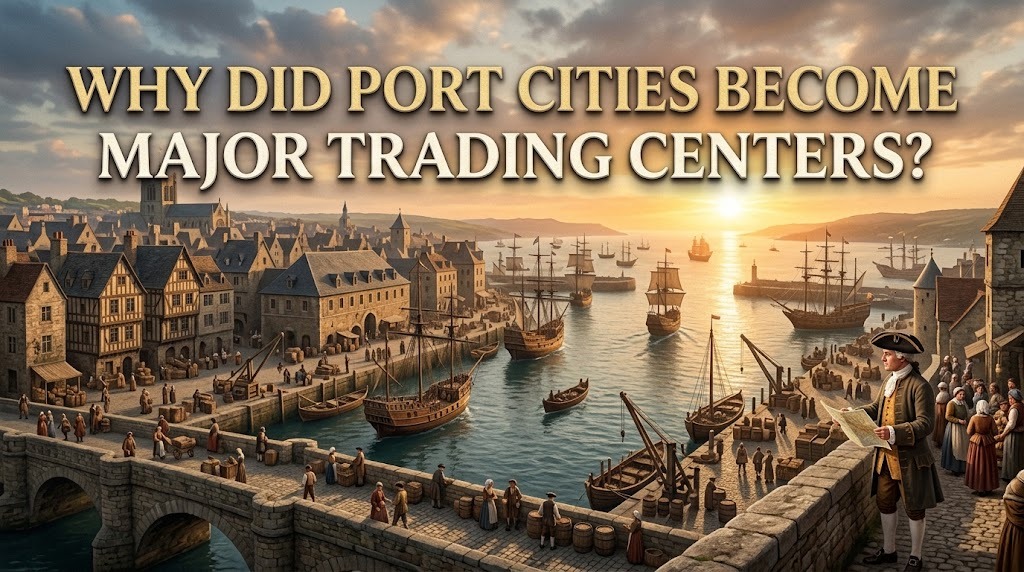
Port cities have played an important role in the development of regional and international trade. Their locations near seas, oceans, or navigable rivers allowed ships to transport large quantities of goods between different regions. As maritime trade expanded, these cities attracted merchants, workers, industries, and financial services. Their economic importance often grew alongside improvements in transportation, infrastructure, and commercial institutions.
ACCESS TO MARITIME TRANSPORTATION
The main advantage of a port city is its direct connection to maritime transportation. Ships can carry large and heavy quantities of goods over long distances, often making water transport more efficient for bulk cargo.
A city with a suitable harbor could become a stopping point for ships traveling between different markets. Merchants could load and unload products, arrange further transportation, and establish businesses near the port. This made ports important links between coastal and inland economies.
FACILITATING INTERNATIONAL TRADE
Port cities often connect domestic markets with international trading networks. Ships can transport products such as agricultural commodities, textiles, minerals, manufactured goods, and other merchandise across countries and regions.
As international trade increases, port cities may become places where goods from different parts of the world are exchanged. This creates opportunities for merchants and businesses while increasing the city's economic significance. Successful ports can therefore develop into major commercial gateways.
DEVELOPING MARKETS AND WAREHOUSES
Large volumes of cargo require places for storage, distribution, and exchange. Warehouses, markets, cargo terminals, and logistics facilities commonly develop around busy ports.
These facilities allow goods to remain in the city temporarily before being transported to their final destinations. Commercial districts may grow around these activities, creating demand for shops, offices, transportation services, and other businesses.
ATTRACTING MERCHANTS AND WORKERS
Growing port activity creates employment opportunities for many different occupations. Dock workers, sailors, traders, shipbuilders, warehouse employees, transport operators, and administrative workers may all depend on the port economy.
Merchants are also attracted by access to suppliers and customers. As more people move to the city for economic opportunities, the population grows and creates additional demand for housing, food, services, and infrastructure.
SUPPORTING SHIPBUILDING AND INDUSTRIES
Ports can encourage industries that depend on maritime transportation. Shipbuilding, fishing, food processing, manufacturing, repair services, and logistics may develop close to the waterfront.
Industries benefit from being near shipping facilities because raw materials can arrive by sea and finished products can be exported efficiently. This relationship between ports and industry can strengthen the city's overall economy.
CONNECTING PORTS WITH INLAND AREAS
A successful port needs transportation connections beyond the waterfront. Roads, railways, canals, and rivers can move imported goods into inland markets and bring domestic products to the port for export.
When these connections are efficient, the port can serve a much larger economic region. This makes the city more than simply a place where ships stop; it becomes a major distribution center connecting producers, consumers, and international markets.
ENCOURAGING CULTURAL EXCHANGE
Port cities have historically brought together people from different regions and cultures. Merchants, sailors, migrants, and travelers introduce new languages, foods, religions, technologies, and cultural practices.
Repeated interaction between different communities can create diverse urban societies. Cultural exchange may influence architecture, cuisine, arts, traditions, and everyday life. As a result, the commercial importance of port cities can also shape their cultural identities.
GOVERNMENT AND INFRASTRUCTURE INVESTMENT
Governments often recognize the economic importance of major ports and invest in infrastructure to support them. Docks, breakwaters, roads, customs facilities, warehouses, and navigation systems can improve the movement of ships and goods.
Governments may also establish customs regulations, taxes, and trade policies to manage commercial activity. Stable institutions and effective administration can make a port more attractive to merchants and investors.
STRATEGIC AND GEOGRAPHICAL ADVANTAGES
Not every coastal settlement becomes a major trading center. Successful port cities often have additional geographical advantages, such as naturally sheltered harbors, access to major sea routes, or proximity to productive hinterlands.
Their strategic locations may also make them important for naval activities and regional political power. However, these advantages can change when shipping technology, trade routes, or political conditions change.
CHALLENGES FACED BY PORT CITIES
Port cities also face challenges such as congestion, pollution, coastal flooding, storms, and dependence on international trade. Changes in shipping routes or global economic conditions can reduce the importance of a port.
Modern ports must therefore adapt by improving infrastructure, adopting efficient logistics technologies, and managing environmental impacts. Successful adaptation allows port cities to remain competitive as transportation and trade systems evolve.
CONCLUSION
Port cities became major trading centers because they provided direct access to maritime transportation and connected different markets. Their ports encouraged the development of warehouses, industries, transportation networks, and commercial services while attracting merchants and workers. They also became important places for cultural exchange and political investment. Their success ultimately depended on geography, infrastructure, economic connections, and the ability to adapt to changing trade conditions.
Recent Posts

Bagaimana Sistem SKS pada Program Kuliah... 22.11.2026/50 View

How Does Technology Make Daily Evaluation... 21.11.2026/79 View

Apa Strategi Menghadapi Kesenjangan antara Kompetensi... 21.11.2026/79 View

Mengapa Inventaris Aset Penting bagi Kelancaran... 21.11.2026/75 View

When Should Musicians Join a Record... 21.11.2026/80 View
