

Why Do Ancient Artifacts Have Cultural And Historical Value?
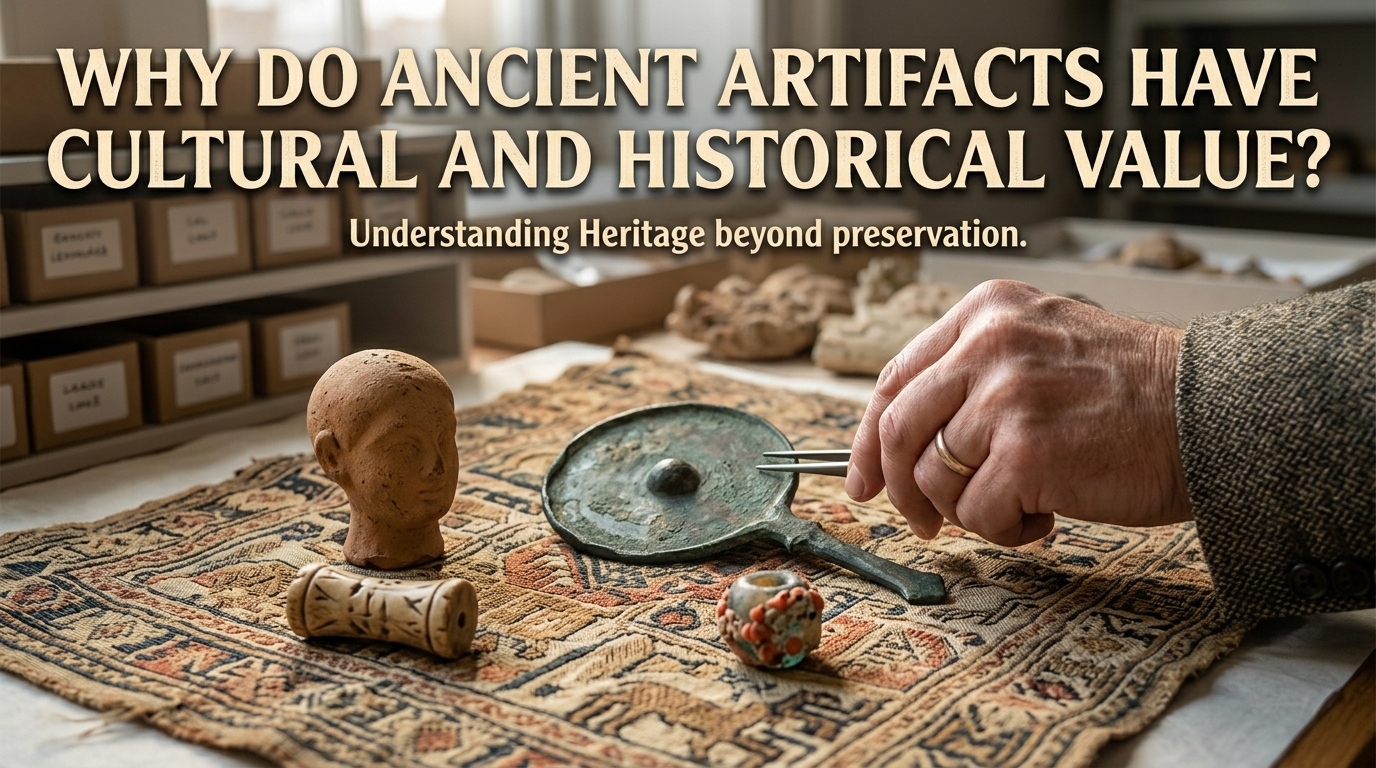
Ancient artifacts are more than objects left behind by earlier civilizations. They provide valuable evidence of how people lived, worked, traded, created art, and practiced their beliefs. Items such as pottery, coins, tools, jewelry, and religious objects help researchers understand societies that existed hundreds or thousands of years ago.
These discoveries are important because they preserve details that written records may overlook or never mention. By studying their materials, designs, locations, and uses, archaeologists can uncover information about human development and cultural traditions. Ancient artifacts have cultural and historical value because they connect modern society with the experiences, achievements, and identities of people from the past.
WHAT ARE ANCIENT ARTIFACTS?
Ancient artifacts are objects made, modified, or used by humans in the past that provide evidence of earlier societies. They include stone tools, pottery, weapons, coins, sculptures, jewelry, and household items. Archaeologists examine these objects to understand how people obtained food, built communities, developed technologies, and interacted with their surroundings.
Artifacts can be discovered at archaeological sites, including ancient settlements, temples, burial grounds, and shipwrecks. Their significance depends not only on their appearance or age but also on their condition, origin, and archaeological context. For example, a simple cooking pot may reveal information about food preparation, trade, and everyday life. Even ordinary objects can provide extraordinary historical insights when researchers study them carefully.
HOW ANCIENT ARTIFACTS REVEAL HISTORY
Artifacts help researchers reconstruct events and lifestyles that may not be fully documented in written sources. Coins can reveal information about rulers, economic systems, and political changes, while tools can show how people developed agricultural practices and manufacturing techniques. Inscriptions on objects may also provide names, dates, languages, and details about historical events.
By comparing artifacts from different periods and locations, archaeologists can identify changes in technology, trade, and social organization. For example, imported pottery or glassware may indicate connections between communities separated by long distances. However, researchers must consider the object's archaeological context and other available evidence before drawing conclusions. Physical evidence helps make historical interpretations more reliable by providing information that can be examined and tested.
WHY ARTIFACTS ARE IMPORTANT FOR CULTURAL IDENTITY
Ancient artifacts help communities understand their cultural roots and the traditions that have shaped their identities. Traditional ornaments, religious objects, musical instruments, and ceremonial items can reflect beliefs, artistic styles, social customs, and community values. They provide tangible connections to the people who created and used them.
For many communities, these objects represent more than historical evidence because they may also hold spiritual, emotional, or ancestral significance. Museums and cultural institutions can help explain their importance while encouraging respect for different traditions. Preserving cultural artifacts helps protect collective memory and strengthen connections between generations. Their interpretation should also consider the perspectives of communities whose heritage is represented.
WHAT ARTIFACTS TELL US ABOUT DAILY LIFE
Many artifacts reveal how ordinary people lived beyond the activities of kings, rulers, and military leaders. Cooking pots, farming tools, fishing equipment, clothing accessories, and household objects can provide clues about food, work, housing, and family life. These discoveries help archaeologists understand the practical challenges people faced in different environments.
Scientific analysis can reveal even more details. Residues inside pottery may provide evidence of foods or other substances that containers once held, while wear marks on tools can suggest how they were used. The materials and craftsmanship of an object may also indicate the resources and skills available to its makers. Everyday artifacts bring ancient lives into clearer focus by revealing experiences that formal historical records often leave out.
HOW ARTIFACTS SHOW TRADE AND CULTURAL EXCHANGE
Ancient artifacts provide evidence of connections between distant societies. Objects made from materials that were unavailable locally may indicate trade, travel, or the movement of people. Similar designs, manufacturing methods, or artistic styles found in different regions can also suggest cultural contact.
For example, imported ceramics, beads, metals, and glassware can help researchers investigate historical trading networks. Their distribution may reveal how goods moved between ports, settlements, and regional markets. However, similar objects do not automatically prove direct contact because ideas and designs can spread through several communities. Careful comparison of materials, styles, and archaeological contexts helps researchers build a more accurate understanding of cultural exchange.
THE ROLE OF ARTIFACTS IN UNDERSTANDING ANCIENT TECHNOLOGY
Ancient artifacts demonstrate how human technology developed over time. Stone tools, metal weapons, agricultural equipment, and construction materials reveal the methods people used to solve practical problems. Their designs can show how knowledge was improved and adapted to different needs.
Researchers examine manufacturing marks, material composition, and tool shapes to understand how objects were produced. Scientific techniques can identify the metals, minerals, or other raw materials used in their construction. In some cases, researchers can trace materials to their geological sources, providing clues about resource use and trade. Artifacts preserve evidence of human innovation and help explain how earlier technological achievements influenced later societies.
WHY ANCIENT ARTIFACTS MUST BE PRESERVED
Ancient artifacts are often fragile and can be damaged by moisture, temperature changes, pollution, improper handling, and exposure to light. Natural disasters, construction, illegal excavation, and looting can also destroy objects or remove them from their original archaeological settings. Once an artifact loses its context, researchers may lose important information about its age, purpose, and relationship to other discoveries.
Artifact preservation involves suitable storage, careful handling, conservation treatment, and accurate documentation. Museums and archaeological institutions use different methods depending on an object's material and condition. Digital photography and three-dimensional scanning can also record an artifact's appearance for research and education. However, digital records cannot fully replace the original object, making physical conservation essential.
HOW MUSEUMS HELP PROTECT CULTURAL AND HISTORICAL VALUE
Museums play an important role in preserving artifacts and making historical knowledge accessible to the public. They provide controlled environments for storing and displaying objects while supporting research by archaeologists, historians, and conservation specialists. Exhibitions can explain how artifacts were used and what they reveal about ancient societies.
Educational programs also help visitors understand why historical objects deserve protection. Responsible museum practices include documenting an object's origin, providing accurate historical information, and addressing ethical questions about ownership and cultural significance. Some artifacts may have been removed from their original communities during colonial periods or through illegal trade. Museums increasingly face the responsibility of consulting source communities and considering appropriate ways to share, return, or care for cultural objects.
THE CHALLENGES OF PROTECTING ANCIENT ARTIFACTS
Despite their importance, ancient artifacts face many threats. Illegal trafficking, looting, environmental damage, and insufficient conservation funding can put valuable objects at risk. When artifacts are removed from archaeological sites without proper records, their scientific value may be greatly reduced, even if the objects themselves survive.
Protecting these resources requires cooperation between governments, researchers, museums, local communities, and international heritage organizations. Stronger legal protections, public education, responsible collecting practices, and careful site management can reduce damage and discourage illegal trade. Communities also play a vital role by sharing knowledge about local heritage and supporting preservation efforts. Protecting artifacts is a shared responsibility because these objects contribute to our understanding of human history and cultural diversity.
CONCLUSION
Ancient artifacts have cultural and historical value because they provide physical evidence of how earlier societies lived, developed technology, traded goods, and expressed their beliefs. They help researchers reconstruct the past while allowing communities to maintain connections with their cultural identities. From everyday tools to valuable ceremonial objects, each discovery can reveal important details about human experience.
However, artifacts must be studied responsibly and preserved with care. Scientific research, ethical conservation, and public education are essential for protecting their historical meaning and cultural significance. By safeguarding ancient artifacts today, we help ensure that future generations can continue learning from the achievements, traditions, and experiences of people who came before us.
Recent Posts

Bagaimana Sistem SKS pada Program Kuliah... 22.11.2026/50 View

How Does Technology Make Daily Evaluation... 21.11.2026/79 View

Apa Strategi Menghadapi Kesenjangan antara Kompetensi... 21.11.2026/79 View

Mengapa Inventaris Aset Penting bagi Kelancaran... 21.11.2026/75 View

When Should Musicians Join a Record... 21.11.2026/80 View
