

Why Do City Centers Change Throughout History?
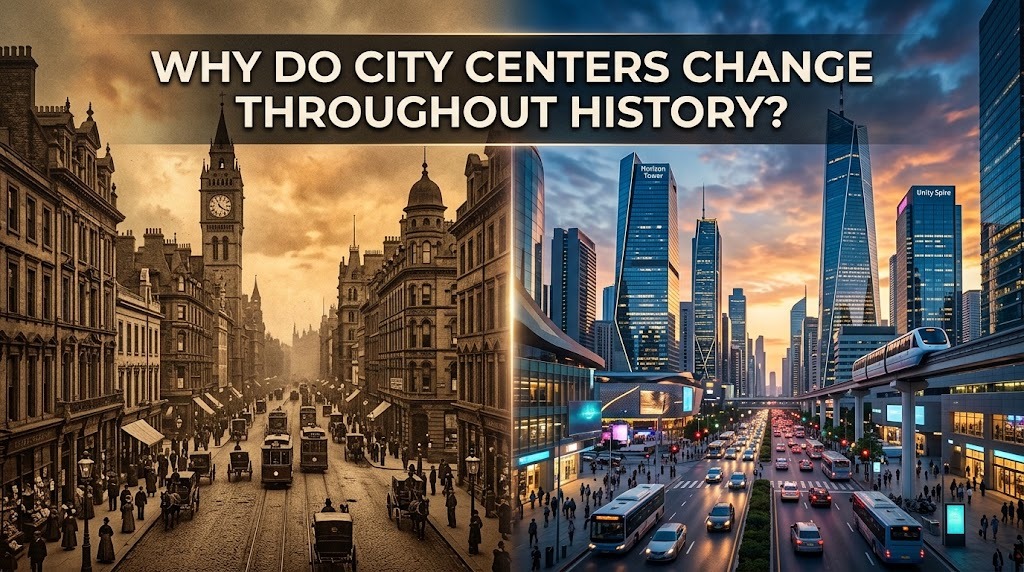
City centers change throughout history because of shifts in economic activity, population growth, transportation, political power, and urban planning. A location that once served as a major trading hub or government center may eventually lose its importance as new industries, roads, and residential areas develop elsewhere. These changes influence where people work, shop, live, and gather for public activities. Understanding why city centers move or transform helps explain how urban environments respond to changing social and economic needs.
ECONOMIC ACTIVITIES SHIFT OVER TIME
Economic development is one of the main reasons city centers change. In earlier periods, central areas often developed around traditional markets, ports, workshops, and trading routes. As industrialization and commercial activities expanded, factories, shopping districts, office buildings, and business complexes emerged in different locations. Businesses frequently move toward areas that offer better infrastructure, more customers, or lower operating costs. Consequently, former commercial centers may lose some of their importance while new economic districts become increasingly influential.
POPULATION GROWTH EXPANDS URBAN AREAS
Population growth can gradually transform the location and function of city centers. As more people move into a city, demand increases for housing, employment, education, healthcare, and public services. The original urban core may become crowded, encouraging residents and businesses to settle in surrounding areas. New residential neighborhoods and commercial developments can eventually form secondary centers outside the historic downtown. This process creates a more complex urban structure in which several districts share important economic and social functions.
TRANSPORTATION CHANGES URBAN ACCESSIBILITY
Transportation systems strongly influence the development of city centers. Historically, many cities grew around rivers, ports, railway stations, or major roads because these locations made trade and travel easier. The introduction of highways, public transportation networks, and modern rail systems can change which areas are most accessible. Businesses may relocate near transport hubs, while residential and commercial growth follows newly connected routes. As accessibility changes, the traditional city center may compete with newer districts that offer more convenient transportation.
POLITICAL POWER AND GOVERNMENT RELOCATION
Changes in political authority can reshape the role of a city center. Governments may establish new administrative districts to improve public services, accommodate growing institutions, or support regional development. When major government offices relocate, nearby businesses and services may follow. Historical government centers can lose some administrative functions but retain their cultural, architectural, and symbolic importance. In other cases, political changes lead to the restoration or redevelopment of central districts as places for public gatherings and civic activities.
TECHNOLOGY TRANSFORMS BUSINESS DISTRICTS
Technological development has changed how people conduct business and use urban spaces. Digital communication allows some companies to operate without maintaining large central offices, while online shopping has altered the role of traditional retail streets. At the same time, technology-related industries may create new business districts around universities, research institutions, or specialized infrastructure. Modern construction methods also make it possible to develop larger buildings and mixed-use complexes in previously underused areas. These changes influence the types of activities that city centers support.
URBAN PLANNING SHAPES CITY CENTERS
Urban planning decisions can determine how city centers develop over time. Governments may improve public transportation, create pedestrian zones, build public parks, or redevelop neglected commercial districts. Zoning regulations influence where housing, offices, shops, and industrial activities can operate. Investment in public facilities can attract residents and businesses to areas that previously received little attention. However, poorly coordinated development may contribute to congestion, unequal access to services, or the displacement of existing communities.
HISTORIC CITY CENTERS ADAPT TO MODERN NEEDS
Many historic city centers change their functions rather than disappear completely. Former warehouses, government offices, markets, and colonial buildings may be converted into museums, restaurants, galleries, hotels, or cultural venues. These adaptations allow historic districts to remain active while preserving important architectural features. Tourism and heritage conservation can also encourage investment in older urban areas. Successful revitalization requires balancing commercial development with the protection of historic buildings and the needs of local residents.
ECONOMIC INEQUALITY AFFECTS URBAN DEVELOPMENT
Differences in land prices, investment, and access to public services can influence which districts become new centers of activity. Businesses may move away from expensive downtown locations toward areas with more affordable land or greater development opportunities. Meanwhile, investment in prestigious commercial districts can increase property values and living costs. These changes may push lower-income residents and small businesses toward less expensive neighborhoods. As a result, city centers can reflect broader patterns of economic inequality and changing access to urban opportunities.
CITY CENTERS IN INDONESIA
Indonesian cities illustrate how historical and modern forces transform urban centers. In Semarang, the historic Kota Lama district reflects the city's past as an important trading and colonial-era urban center, while contemporary commercial activities extend across other parts of the city. Jakarta has also developed multiple business and administrative districts as its population and economy have expanded. In many Indonesian cities, traditional markets, historic government areas, modern shopping centers, and transportation hubs operate alongside one another. These patterns show that urban development often creates several important centers rather than replacing one center with another entirely.
CONCLUSION
City centers change throughout history because economic priorities, population patterns, transportation systems, technology, and political decisions continue to evolve. Some districts lose their original functions, while others develop into new commercial, administrative, or cultural hubs. Historic centers may also adapt to modern needs while preserving their architectural and social significance. Understanding these changes helps urban planners and communities create cities that support economic growth, accessibility, cultural heritage, and a better quality of life.
Recent Posts

Bagaimana Sistem SKS pada Program Kuliah... 22.11.2026/50 View

How Does Technology Make Daily Evaluation... 21.11.2026/80 View

Apa Strategi Menghadapi Kesenjangan antara Kompetensi... 21.11.2026/79 View

Mengapa Inventaris Aset Penting bagi Kelancaran... 21.11.2026/75 View

When Should Musicians Join a Record... 21.11.2026/80 View
