

Why Do Companies Use Psychometric Tests in Recruitment?
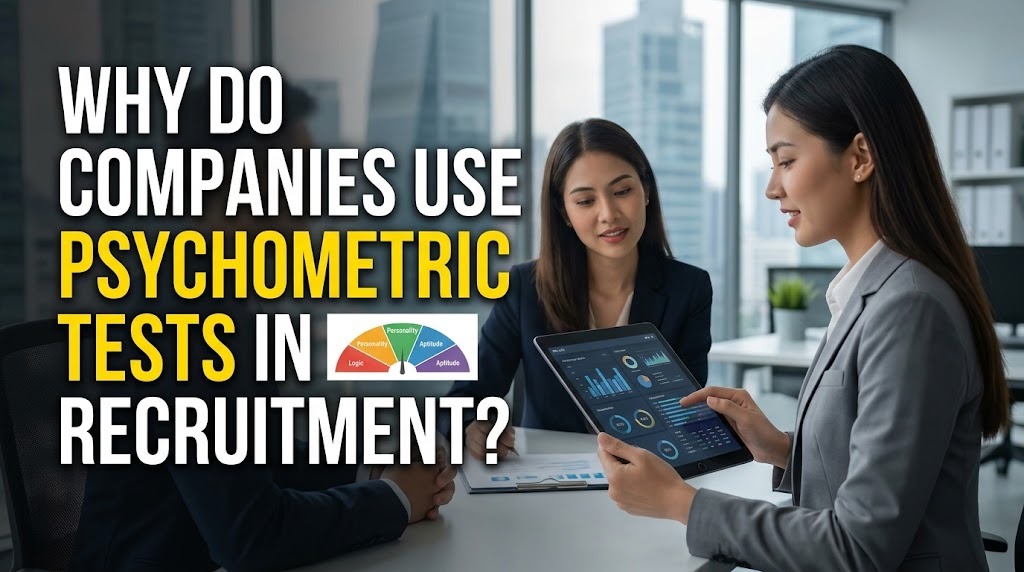
Companies use psychometric tests in recruitment to gain a better understanding of job applicants beyond their resumes and interview answers. While a resume provides information about education and work experience, psychometric assessments can offer additional insights into a candidate’s reasoning abilities, personality traits, and work-related preferences. These insights may help employers make more informed hiring decisions.
The use of psychometric testing in recruitment can also support a more structured selection process. By assessing candidates against relevant criteria, companies can compare applicants more consistently and identify individuals whose abilities align with the requirements of a position. However, these tests should be used alongside interviews, qualifications, experience, and other relevant evidence rather than as the sole basis for hiring decisions.
TO ASSESS CANDIDATES’ SKILLS AND REASONING ABILITIES
One major reason companies use psychometric tests is to evaluate candidates’ cognitive abilities. Depending on the position, these assessments may measure numerical reasoning, verbal reasoning, logical thinking, or problem-solving skills. Such abilities can be relevant to jobs that require employees to analyze information, interpret data, or make decisions based on evidence.
For example, a financial analyst may need strong numerical reasoning skills, while an administrative employee may need to interpret written instructions accurately. A logical reasoning assessment can also help employers understand how candidates approach unfamiliar problems. Although these tests can provide useful information, their results should be interpreted in relation to the actual responsibilities and requirements of the job.
TO UNDERSTAND PERSONALITY AND WORKING PREFERENCES
Companies may use personality assessments to explore characteristics and working preferences that could be relevant to a role. These assessments may examine tendencies such as communication style, organization, cooperation, adaptability, or preferences for working independently. The purpose is not necessarily to identify a perfect personality but to understand how an applicant may approach different workplace situations.
For instance, a position involving frequent teamwork may require regular communication and collaboration, while another role may involve more independent tasks. Personality assessment results can provide additional information about a candidate’s preferences, but they cannot fully predict future workplace behavior. Employers should avoid labeling applicants as suitable or unsuitable based on a single personality score and should consider other evidence during the selection process.
TO MAKE THE RECRUITMENT PROCESS MORE STRUCTURED
Another reason employers use psychometric testing in hiring is to create a more consistent method of evaluating applicants. When candidates complete the same assessment under comparable conditions, recruiters can review their results using established scoring criteria. This approach may reduce reliance on informal impressions and help employers organize information about candidates more systematically.
A structured assessment process can be particularly useful when a company receives a large number of applications. Instead of relying entirely on initial interviews, recruiters can use relevant test results as one part of the selection process. Nevertheless, consistency alone does not guarantee fairness. Employers should ensure that assessments are appropriate for the role, accessible to candidates who need reasonable adjustments, and evaluated with awareness of possible limitations or bias.
TO IDENTIFY CANDIDATES WHO MATCH JOB REQUIREMENTS
Psychometric tests for recruitment can help employers examine whether applicants demonstrate abilities relevant to a particular position. Before using an assessment, companies should identify the skills and characteristics that matter for successful job performance. The assessment can then be selected according to those requirements rather than using the same test for every role without a clear purpose.
For example, a customer service position may place importance on communication and problem-solving, while a technical role may require analytical reasoning. By connecting assessment results to job requirements, employers can gather information that supports more relevant comparisons between applicants. However, a strong match on a test does not guarantee success, because performance also depends on training, motivation, experience, workplace conditions, and other factors.
TO SUPPORT BETTER HIRING DECISIONS
Companies may also use psychometric test results to support decisions when several candidates have similar qualifications or experience. The assessments can provide another source of information that helps recruiters evaluate applicants from different perspectives. When combined with interviews, work samples, references, and relevant experience, these results can contribute to a more comprehensive view of each candidate.
Responsible interpretation is essential because no test can measure every quality required for a job. Results may be influenced by test conditions, familiarity with the format, language demands, or factors unrelated to job performance. Employers should therefore use assessments that are reliable, valid for their intended purpose, and appropriate for the candidates being evaluated. The final decision should consider the full range of relevant evidence rather than relying on a single score.
CONCLUSION
Companies use psychometric tests in recruitment to assess reasoning abilities, understand personality-related preferences, structure candidate evaluations, examine job-related suitability, and support hiring decisions. These assessments can provide useful information that may not be fully captured by resumes or interviews alone.
However, psychometric testing works best as one component of a broader recruitment process. Employers should choose assessments that match job requirements, interpret results carefully, and consider each candidate’s qualifications, experience, and practical abilities. When used responsibly, psychometric tests can help organizations make more informed and consistent hiring decisions.
Recent Posts

Bagaimana Sistem SKS pada Program Kuliah... 22.11.2026/61 View

How Does Technology Make Daily Evaluation... 21.11.2026/87 View

Apa Strategi Menghadapi Kesenjangan antara Kompetensi... 21.11.2026/85 View

Mengapa Inventaris Aset Penting bagi Kelancaran... 21.11.2026/83 View

When Should Musicians Join a Record... 21.11.2026/87 View
