

Why Do Impermeable Surfaces Increase Urban Flooding?
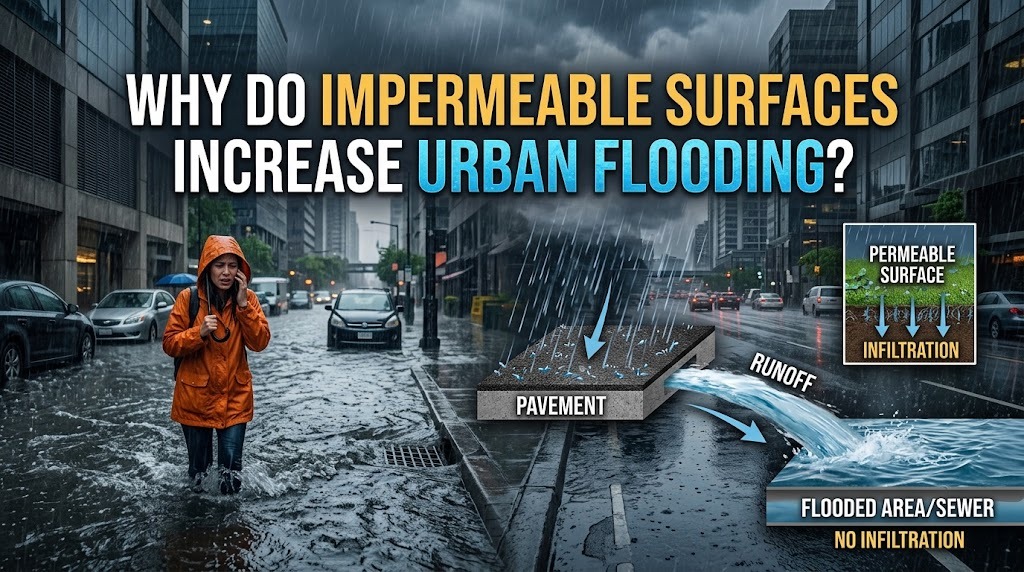
Impermeable surfaces are materials that prevent or significantly limit water from soaking into the ground. Common examples include concrete roads, asphalt parking lots, paved sidewalks, rooftops, and building foundations. These surfaces are widely used in modern cities because they support transportation, construction, and urban development. However, when impermeable surfaces cover large areas, they can increase the risk of flooding by changing how rainwater moves through the environment.
WHAT ARE IMPERMEABLE SURFACES?
Impermeable surfaces are surfaces through which water cannot easily pass into the soil. In urban environments, they are commonly found on roads, driveways, sidewalks, rooftops, and commercial parking areas. Unlike natural ground covered with vegetation, these materials provide few opportunities for rainwater to infiltrate the soil beneath them.
The expansion of impermeable surfaces is often associated with population growth and urban development. As cities build more houses, offices, shopping centers, and transportation infrastructure, natural landscapes may be replaced by concrete and asphalt. Although these developments provide important benefits, excessive surface coverage can interfere with natural water movement and increase pressure on urban drainage systems.
REDUCED WATER INFILTRATION INTO THE GROUND
Water infiltration occurs when rainwater enters the soil instead of remaining on the surface. In natural environments, soil and vegetation help absorb rainfall, allowing water to move through the ground and replenish groundwater supplies. This process can reduce the amount of water that flows directly into streets, drains, and rivers.
Impermeable surfaces interrupt this process by covering the soil with materials that restrict infiltration. As a result, a larger proportion of rainfall remains on the surface and becomes runoff. When heavy rain occurs, this additional runoff can increase the amount of water that urban drainage systems must handle within a short period.
INCREASED SURFACE RUNOFF
Surface runoff is rainwater that flows over the ground rather than soaking into the soil. In areas with extensive concrete, asphalt, and rooftops, runoff can develop rapidly because water has fewer opportunities to infiltrate. Sloped roads and paved surfaces can also direct water toward lower areas, where it may accumulate.
When runoff from multiple streets and buildings reaches the same drainage channel, the volume of water can rise quickly. If the drainage system cannot carry the water away fast enough, streets, parking areas, and nearby buildings may become flooded. This explains why some urban neighborhoods experience sudden flooding even during relatively short periods of intense rainfall.
OVERLOADED URBAN DRAINAGE SYSTEMS
Urban drainage systems are designed to collect and transport rainwater away from developed areas. Their capacity depends on factors such as channel size, pipe dimensions, terrain, rainfall intensity, and maintenance conditions. When a city contains many impermeable surfaces, drainage networks may receive much more water than they were originally designed to handle.
If the incoming water exceeds the system's capacity, drains can overflow and water may back up onto streets. Blockages caused by rubbish, sediment, or fallen leaves can make the problem worse. Upgrading drainage infrastructure, maintaining existing channels, and reducing runoff at its source can help limit these risks.
THE LOSS OF NATURAL GREEN SPACES
Green spaces such as parks, gardens, forests, and grass-covered areas help regulate the movement of rainwater. Vegetation can intercept rainfall, slow water movement, and support infiltration through the soil. These areas may also provide temporary storage for rainwater before it enters drainage networks.
When green spaces are replaced with paved surfaces, cities lose part of their natural capacity to manage rainfall. The effects can be especially significant in densely populated neighborhoods where open land is already limited. Preserving existing vegetation and creating additional green spaces can help reduce runoff while improving urban environmental quality.
WHY IMPERMEABLE SURFACES CAUSE FLASH FLOODS
Flash floods can occur when water accumulates rapidly after intense rainfall. Impermeable surfaces contribute to this risk by allowing rainwater to move quickly across the landscape instead of entering the soil gradually. This can cause drainage channels and rivers to receive sudden increases in water volume.
Low-lying streets, underpasses, and densely developed neighborhoods may be particularly vulnerable when runoff converges in these locations. Flash flooding can disrupt transportation, damage vehicles and buildings, and create dangerous conditions for pedestrians. Although impermeable surfaces are not the only cause of flash floods, extensive paving can increase their likelihood and severity under certain conditions.
ENVIRONMENTAL AND ECONOMIC CONSEQUENCES
Flooding associated with impermeable surfaces can have significant consequences for urban communities. Water entering homes, offices, and shops may damage furniture, electrical equipment, inventory, and essential documents. Flooded roads can delay emergency services, disrupt public transportation, and reduce access to schools and workplaces.
There are also environmental consequences. Rapid runoff can carry oil, dust, chemicals, litter, and other pollutants from paved surfaces into rivers and lakes. Reduced infiltration may limit groundwater recharge, while the loss of vegetation can affect urban biodiversity and local temperatures. These connected effects make stormwater management an important part of sustainable city planning.
USING PERMEABLE MATERIALS TO REDUCE FLOODING
One effective way to reduce runoff is to use permeable materials where suitable. Permeable pavement allows water to pass through gaps or porous materials into a prepared base layer, where it can be stored temporarily and infiltrate the underlying soil. It can be used in selected parking areas, footpaths, driveways, and low-traffic spaces.
However, permeable pavement is not appropriate for every location. Its performance depends on soil conditions, groundwater levels, rainfall patterns, installation quality, and regular maintenance. In areas with unsuitable soil or high groundwater, additional storage or drainage measures may be necessary to manage the water effectively.
INCREASING GREEN INFRASTRUCTURE IN CITIES
Green infrastructure uses natural processes to manage stormwater. Examples include rain gardens, green roofs, vegetated drainage channels, urban trees, and landscaped areas designed to collect rainwater. These features can slow runoff, encourage infiltration, and temporarily store water before it enters conventional drainage systems.
Governments, developers, and residents can incorporate green infrastructure into new construction and existing neighborhoods. For example, a parking area may include landscaped sections that collect runoff, while a building may use a green roof to retain some rainfall. When these measures are combined with properly maintained drainage networks, they can help reduce flood risks more effectively than relying on drainage infrastructure alone.
CONCLUSION
Impermeable surfaces increase urban flooding by restricting water infiltration, accelerating surface runoff, and placing additional pressure on drainage systems. As concrete, asphalt, and rooftops replace natural landscapes, cities lose some of their ability to absorb and store rainwater. The resulting runoff can contribute to flash floods, property damage, and environmental pollution. By preserving green spaces, using suitable permeable materials, and investing in green infrastructure, cities can manage rainwater more effectively and reduce the risk of urban flooding.
Recent Posts

Bagaimana Sistem SKS pada Program Kuliah... 22.11.2026/54 View

How Does Technology Make Daily Evaluation... 21.11.2026/83 View

Apa Strategi Menghadapi Kesenjangan antara Kompetensi... 21.11.2026/81 View

Mengapa Inventaris Aset Penting bagi Kelancaran... 21.11.2026/78 View

When Should Musicians Join a Record... 21.11.2026/82 View
