

Why Do Interdisciplinary Subjects Matter in Science Olympiads?
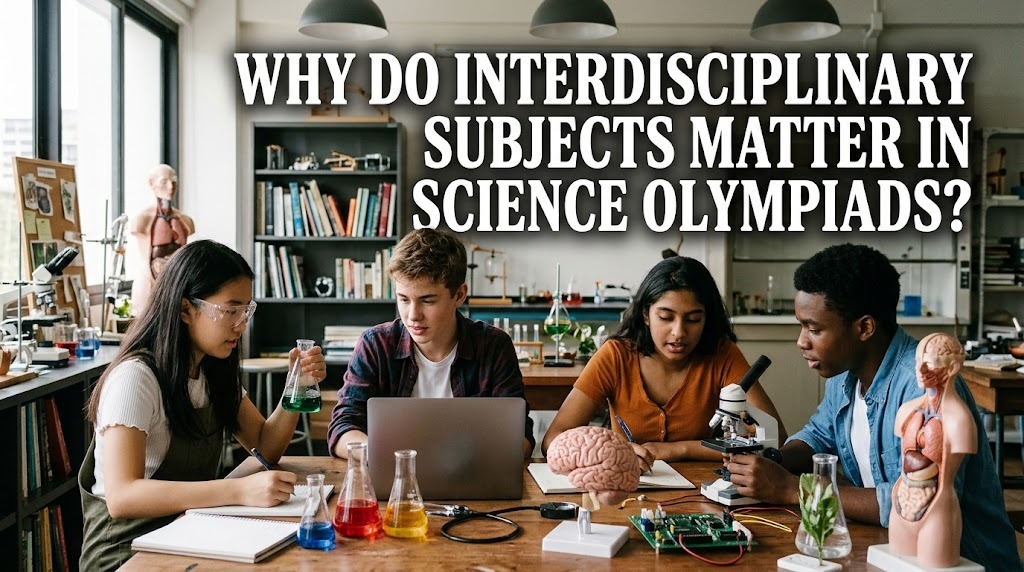
Science Olympiad competitions challenge students to understand scientific concepts and apply their knowledge to complex problems. Although subjects such as physics, chemistry, biology, and mathematics are often studied separately, many scientific problems involve connections between several disciplines. This makes interdisciplinary learning an important part of Science Olympiad preparation.
Interdisciplinary subjects combine knowledge and methods from different academic fields to explain scientific phenomena more comprehensively. Students who understand these connections can approach unfamiliar questions from multiple perspectives and develop more complete solutions. This ability is valuable not only for competitions but also for understanding how science is applied in everyday life.
CONNECTING DIFFERENT SCIENTIFIC CONCEPTS
One important reason interdisciplinary subjects matter is that scientific disciplines are closely connected. A single problem may involve principles from physics, chemistry, biology, or mathematics.
For example, understanding how plants grow requires knowledge of biology and chemistry. Students need to recognize biological processes while understanding how chemical substances such as water, minerals, and carbon dioxide contribute to plant development.
Recognizing these connections helps students build a more complete understanding of scientific topics. Instead of treating every subject as an isolated area, they can see how different concepts work together to explain a particular phenomenon.
IMPROVING CRITICAL THINKING ABILITIES
Interdisciplinary learning encourages students to examine problems from different academic perspectives. This approach develops critical thinking because participants must determine which concepts are relevant and how those concepts relate to one another.
For instance, a question about climate change may require students to understand atmospheric chemistry, physical energy transfer, and biological effects on ecosystems. They must evaluate information from several fields before developing a logical explanation.
This process encourages students to question assumptions and consider different possibilities. It also helps them avoid relying on a single explanation when a problem requires a broader scientific understanding.
STRENGTHENING PROBLEM-SOLVING SKILLS
Science Olympiad questions sometimes involve multiple stages of reasoning and require students to combine different scientific principles. Interdisciplinary knowledge helps participants identify suitable methods for approaching these challenges.
A problem involving electricity in biological systems, for example, may require an understanding of electrical principles and the functioning of the human nervous system. Students need to connect these areas before they can explain the situation accurately.
By practicing interdisciplinary questions, participants become more flexible in their problem-solving approaches. They learn to break complex problems into smaller parts and apply relevant knowledge from different subjects.
SUPPORTING REAL-WORLD SCIENTIFIC APPLICATIONS
Many real-world challenges cannot be solved through one scientific discipline alone. Issues such as environmental pollution, public health, renewable energy, and food security involve several interconnected factors.
For example, reducing water pollution may require chemistry to identify contaminants, biology to understand their effects on organisms, and environmental science to evaluate ecosystem conditions. Mathematics can also support the analysis of pollution measurements and trends.
Studying these connections helps students understand why interdisciplinary knowledge is important outside the classroom. It also makes Science Olympiad preparation more relevant to practical scientific challenges.
ENHANCING MATHEMATICAL AND DATA ANALYSIS SKILLS
Mathematics plays an important role in many scientific disciplines. Students frequently need mathematical reasoning to calculate measurements, interpret graphs, analyze experimental results, and identify relationships between variables.
Physics problems may involve equations related to motion, force, and energy. Chemistry can require calculations involving concentration, chemical reactions, and quantities of substances. Biology may also involve statistics and population data.
Understanding the relationship between mathematics and science helps students interpret numerical information more accurately. These abilities are particularly valuable when solving Olympiad questions that combine scientific theories with calculations.
ENCOURAGING SCIENTIFIC CURIOSITY
Interdisciplinary subjects expose students to a wider range of scientific questions. When they discover connections between different fields, they may become interested in exploring topics beyond their main area of study.
For example, a student interested in biology may become curious about biotechnology, which combines biological knowledge with chemistry, engineering, and technology. A student studying physics may develop an interest in astronomy, which also uses mathematics and computational methods.
This curiosity encourages independent learning and exploration. Students become more willing to investigate unfamiliar topics and expand their scientific knowledge.
PREPARING STUDENTS FOR COMPLEX COMPETITION QUESTIONS
Science Olympiad competitions may include questions that test more than one area of knowledge. These questions are designed to evaluate whether participants can apply scientific principles in unfamiliar situations.
Students with interdisciplinary understanding can recognize connections between concepts more effectively. They are also better prepared to interpret questions that involve several variables or scientific processes.
This preparation does not mean students must master every scientific discipline equally. Instead, they should develop strong foundational knowledge and understand the relationships between relevant subjects.
DEVELOPING COLLABORATION AND COMMUNICATION
Interdisciplinary learning can also encourage students to work together and exchange different perspectives. Each student may have particular strengths in mathematics, biology, chemistry, or physics.
When they discuss scientific problems, participants can combine their knowledge to develop more complete explanations. They also learn how to communicate complex ideas in ways that others can understand.
These experiences strengthen teamwork and academic communication. Such abilities are useful during group training, scientific projects, and other educational activities.
SUPPORTING FUTURE ACADEMIC AND CAREER DEVELOPMENT
The benefits of interdisciplinary learning extend beyond Science Olympiad competitions. Many modern academic programs and professional fields combine knowledge from several disciplines.
For example, biotechnology connects biology with chemistry and engineering, while environmental engineering applies scientific principles to environmental problems. Medical research may involve biology, chemistry, statistics, and advanced technology.
Students who become familiar with interdisciplinary learning can develop a broader understanding of these opportunities. This knowledge may help them explore future educational interests and choose academic fields that match their abilities.
HOW STUDENTS CAN DEVELOP INTERDISCIPLINARY KNOWLEDGE
Students can strengthen interdisciplinary understanding by connecting concepts during their regular study activities. They do not need to wait for advanced competition questions to begin exploring relationships between scientific subjects.
Several practical methods can support this learning process:
- Explore Related Topics: Study how concepts from physics, chemistry, biology, and mathematics influence one another.
- Solve Integrated Problems: Practice questions that require knowledge from multiple scientific disciplines.
- Analyze Real-World Issues: Examine environmental, technological, and health-related problems through different scientific perspectives.
- Conduct Experiments: Observe how several scientific principles can operate within one investigation.
- Use Visual Learning Tools: Create diagrams and concept maps to identify relationships between different subjects.
- Discuss Scientific Questions: Exchange ideas with teachers and classmates to discover alternative explanations.
Consistent practice helps students develop a more connected understanding of science and prepare for questions that require interdisciplinary reasoning.
CONCLUSION
Interdisciplinary subjects matter in Science Olympiads because they help students connect scientific concepts, strengthen critical thinking, and solve complex problems. They also demonstrate how different disciplines contribute to understanding real-world phenomena.
By developing knowledge across related subjects, students can become more flexible, curious, and analytical learners. These abilities support Science Olympiad preparation while providing a valuable foundation for future academic opportunities and scientific careers.
Recent Posts

Bagaimana Sistem SKS pada Program Kuliah... 22.11.2026/48 View

How Does Technology Make Daily Evaluation... 21.11.2026/76 View

Apa Strategi Menghadapi Kesenjangan antara Kompetensi... 21.11.2026/78 View

Mengapa Inventaris Aset Penting bagi Kelancaran... 21.11.2026/73 View

When Should Musicians Join a Record... 21.11.2026/78 View
