

Why Do Long-Haul Flights Increase Passengers' Radiation Exposure?
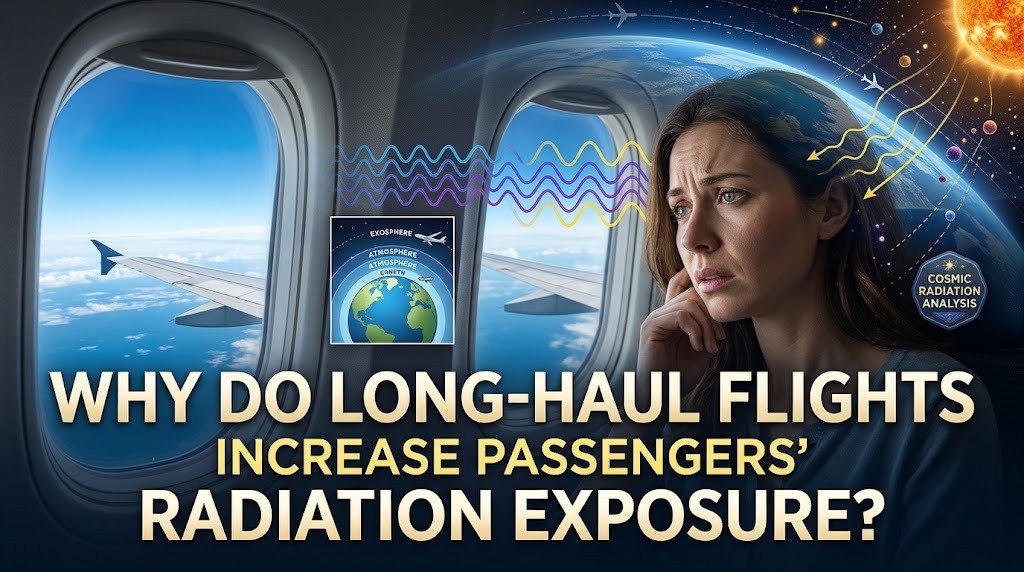
When traveling on a commercial airliner, passengers are exposed to slightly higher levels of cosmic radiation than people on the ground. Cosmic radiation consists of high-energy subatomic particles that constantly travel through deep space toward Earth.
At ground level, Earth's thick atmosphere acts as a protective blanket, absorbing and deflecting the vast majority of these incoming cosmic rays. However, at cruising altitudes of 30,000 to 40,000 feet, the atmosphere is considerably thinner, offering less physical shielding against high-energy particles.
THE ROLE OF FLIGHT DURATION AND LATITUDE
The total amount of radiation a passenger receives during a flight depends on three main factors: flight altitude, flight duration, and geographic latitude.
- Flight Duration: Long-haul flights keep passengers at high altitudes for 8 to 15 hours or more, increasing the cumulative time spent in a less shielded atmospheric zone.
- Geographic Latitude: Earth's magnetic field directs incoming charged particles toward the magnetic poles. Flights traveling near the polar regions experience higher cosmic radiation levels than flights traveling over the equator.
PUTTING AIRLINE RADIATION INTO PERSPECTIVE
While cosmic radiation exposure increases during long flights, the actual dose absorbed remains extremely low and safe for occasional travelers.
A typical long-haul flight across the ocean results in a radiation dose of approximately 0.03 to 0.05 millisieverts (mSv). To put this in perspective:
- A single chest X-ray delivers about 0.1 mSv.
- Average natural background radiation on the ground is roughly 2 to 3 mSv per year.
For frequent flyers and commercial aircrews who spend hundreds of hours at high altitudes annually, regulatory bodies monitor cumulative occupational exposure to ensure it stays well within established safety guidelines.
CONCLUSION
In conclusion, long-haul flights increase radiation exposure because aircraft fly high above the dense layers of Earth's atmosphere that normally absorb cosmic rays. Long flight times and polar flight routes further increase total particle exposure.
However, for the vast majority of passengers, the amount of cosmic radiation absorbed during air travel is minimal and poses no health concern. Understanding atmospheric physics helps travelers stay informed about everyday environmental radiation.
Recent Posts

Bagaimana Sistem SKS pada Program Kuliah... 22.11.2026/53 View

How Does Technology Make Daily Evaluation... 21.11.2026/82 View

Apa Strategi Menghadapi Kesenjangan antara Kompetensi... 21.11.2026/81 View

Mengapa Inventaris Aset Penting bagi Kelancaran... 21.11.2026/77 View

When Should Musicians Join a Record... 21.11.2026/82 View
