

Why Do Regional Accents Differ Across Different Areas of Indonesia?
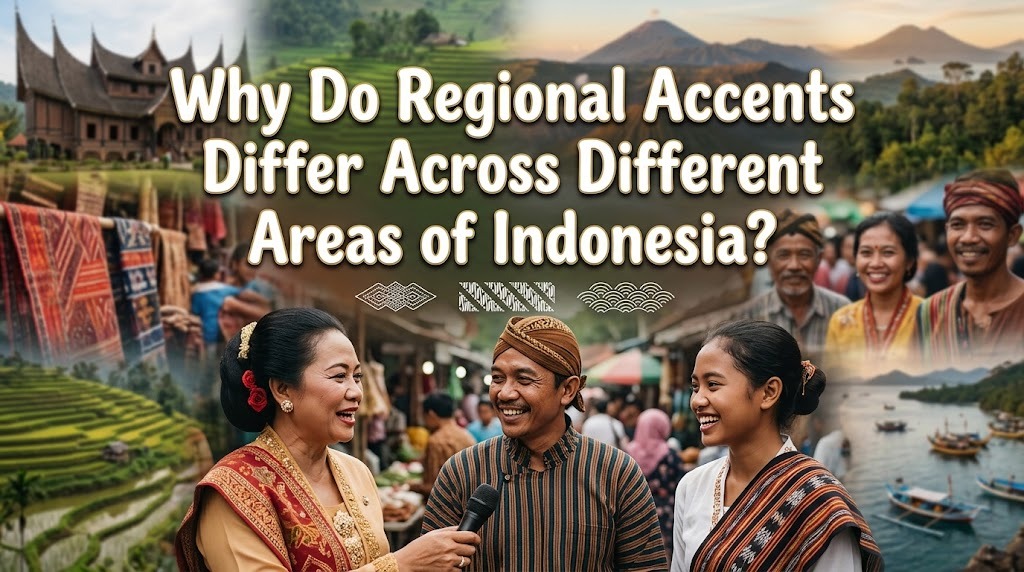
indonesia is a country with remarkable linguistic and cultural diversity. People from different regions often speak Indonesian with distinct accents, even when they use the same national language. For example, someone from Java may pronounce certain words differently from someone from Sumatra, Bali, Sulawesi, or eastern Indonesia. These differences can be heard in pronunciation, intonation, speaking rhythm, and the way certain sounds are produced.
Regional accents in Indonesia develop through a combination of local languages, cultural traditions, geographical conditions, and social interactions. Understanding these factors helps explain why Indonesian sounds different from one region to another. It also shows how regional accents reflect the country's rich cultural identity and linguistic heritage.
THE INFLUENCE OF LOCAL LANGUAGES ON REGIONAL ACCENTS
One of the main reasons regional accents differ across Indonesia is the influence of local languages. Indonesia has hundreds of regional languages, including Javanese, Sundanese, Minangkabau, Balinese, Bugis, and many others. People often learn their local language before learning Indonesian at school or through everyday communication. As a result, the pronunciation habits they develop in their first language can influence how they speak Indonesian.
For example, some Javanese speakers may pronounce Indonesian words with characteristic vowel patterns or softer intonation. Sundanese speakers may have different pronunciation habits, while speakers from eastern Indonesia may use distinctive speech rhythms influenced by their local languages. These differences do not mean that one accent is better than another. Instead, they demonstrate how the languages people grow up with shape their speech patterns throughout their lives.
GEOGRAPHICAL CONDITIONS AND HISTORICAL DEVELOPMENT
Indonesia's geographical structure also contributes to the development of regional accents. The country consists of thousands of islands, and communities have historically developed their own languages and communication practices. Mountains, seas, forests, and long distances sometimes limited direct contact between communities, allowing local speech patterns to develop independently over generations. As these patterns became established, they contributed to the distinctive accents heard in different areas.
Historical migration and trade also played important roles in shaping regional speech. For centuries, Indonesian communities interacted with traders and migrants from other parts of the archipelago and beyond. These interactions introduced new words, pronunciation habits, and linguistic influences into local communities. Over time, the combination of geographical separation and cultural exchange helped create the wide variety of regional accents found in modern Indonesia.
CULTURAL TRADITIONS AND COMMUNITY IDENTITY
Culture influences the way people speak because language is closely connected to traditions, social values, and everyday interactions. In many Indonesian communities, people use particular speaking styles to express politeness, respect, familiarity, or social relationships. These communication habits can influence intonation, word choice, and the rhythm of conversation. When people speak Indonesian, some of these patterns may remain noticeable even when they are not using their regional language.
Regional accents can also become an important part of cultural identity. People may feel a strong connection to their hometown because their accent reminds them of their family, community, and personal experiences. Even after moving to another city, some individuals maintain their original accents as a way of preserving their connection to their cultural background. Therefore, regional accents are not simply differences in pronunciation but also expressions of belonging and shared history.
THE ROLE OF EDUCATION AND DAILY COMMUNICATION
Education helps people learn Indonesian as the national language, but it does not necessarily eliminate their regional accents. Students may learn standard Indonesian pronunciation through teachers, textbooks, presentations, and formal speaking activities. However, the language patterns they use at home and in their communities can continue to influence their speech. This is why two people who have received similar education may still sound different when speaking Indonesian.
Daily communication also reinforces regional pronunciation habits. People usually interact frequently with family members, friends, coworkers, and neighbors who share similar speech patterns. Through repeated conversations, individuals maintain and strengthen familiar ways of pronouncing words. At the same time, people who regularly communicate with speakers from other regions may gradually adopt new pronunciation patterns or adjust their accents depending on the situation.
HOW MIGRATION AND URBANIZATION CHANGE REGIONAL ACCENTS
Migration allows people from different parts of Indonesia to meet, work, study, and live together. Large cities such as Jakarta, Surabaya, and other urban centers bring together speakers with different regional languages and accents. When these individuals communicate regularly, they may adjust their pronunciation to make conversations easier. This process can gradually influence the way people speak, especially in communities where several regional groups interact.
Urbanization can also encourage the development of mixed speech patterns. Some people retain strong regional accents, while others develop more neutral-sounding Indonesian after years of communicating with people from different backgrounds. Younger generations may combine features from their parents' regional speech with expressions and pronunciation patterns learned from school, work, and social environments. Nevertheless, accent changes vary from person to person and do not necessarily mean that someone has lost their regional identity.
THE INFLUENCE OF MEDIA AND DIGITAL COMMUNICATION
Television, radio, films, online videos, and social media expose Indonesians to speakers from many different regions. Through these platforms, people can hear a wide range of accents and become more familiar with different pronunciation styles. National news programs and formal educational content often use relatively standardized Indonesian, while entertainment content may feature strong regional accents. This exposure can influence how people pronounce certain words and how they perceive speakers from other areas.
Digital communication also helps regional accents remain visible in modern society. Content creators often use their natural accents to express their personalities and connect with audiences who share similar backgrounds. Some accents become widely recognized because of popular comedians, actors, musicians, or social media personalities. However, exposure to media does not automatically change a person's accent, because pronunciation is also shaped by family, community, and individual speaking habits.
WHY REGIONAL ACCENTS DIFFER IN PRONUNCIATION AND INTONATION
Regional accents can differ in several aspects of speech, including vowel pronunciation, consonant sounds, stress, intonation, and speaking speed. Some speakers may pronounce certain vowels more clearly, while others may use different patterns when ending words or connecting syllables. Intonation refers to the rise and fall of the voice during speech, which can make a sentence sound different even when the words are identical. Speaking rhythm and speed can also contribute to the distinctive sound of a regional accent.
These differences usually develop naturally through language acquisition and repeated social interaction. People learn how sounds are produced by listening to others and practicing speech from an early age. Because different communities have different linguistic backgrounds, they may develop different pronunciation habits when speaking Indonesian. It is important to distinguish accents from dialects: an accent mainly concerns pronunciation, while a dialect can also include differences in vocabulary and grammar.
THE IMPORTANCE OF RESPECTING INDONESIAN REGIONAL ACCENTS
Respecting regional accents is important for maintaining positive relationships in Indonesia's multicultural society. An accent does not determine a person's intelligence, education, professionalism, or ability to communicate effectively. However, people sometimes judge others based on how they speak, which can lead to stereotypes or unfair treatment. Recognizing that accents develop through language and cultural experiences can help reduce these misunderstandings.
Regional accents also contribute to Indonesia's linguistic diversity. Rather than forcing everyone to speak in exactly the same way, communities can appreciate different accents while continuing to develop clear communication skills. In formal situations, speakers may choose a more standardized pronunciation when necessary, but they can still retain their natural accents in everyday conversations. By respecting these differences, Indonesians can strengthen mutual understanding and preserve the cultural heritage represented by their languages.
CONCLUSION
Regional accents differ across Indonesia because of the combined influence of local languages, geography, history, cultural traditions, education, migration, and media exposure. These factors shape the way people pronounce words, use intonation, and develop their speaking rhythms. Although Indonesian serves as the national language, regional linguistic backgrounds continue to influence how it is spoken in everyday life.
Regional accents are an important part of Indonesia's cultural and linguistic diversity. They reflect the experiences and identities of communities across the archipelago. By understanding and respecting these differences, people can communicate more effectively, avoid unfair stereotypes, and appreciate the unique characteristics that make Indonesian society diverse.
Recent Posts

Bagaimana Sistem SKS pada Program Kuliah... 22.11.2026/54 View

How Does Technology Make Daily Evaluation... 21.11.2026/83 View

Apa Strategi Menghadapi Kesenjangan antara Kompetensi... 21.11.2026/82 View

Mengapa Inventaris Aset Penting bagi Kelancaran... 21.11.2026/78 View

When Should Musicians Join a Record... 21.11.2026/84 View
