

Why Does Data Analysis Matter in Science Olympiad Challenges?
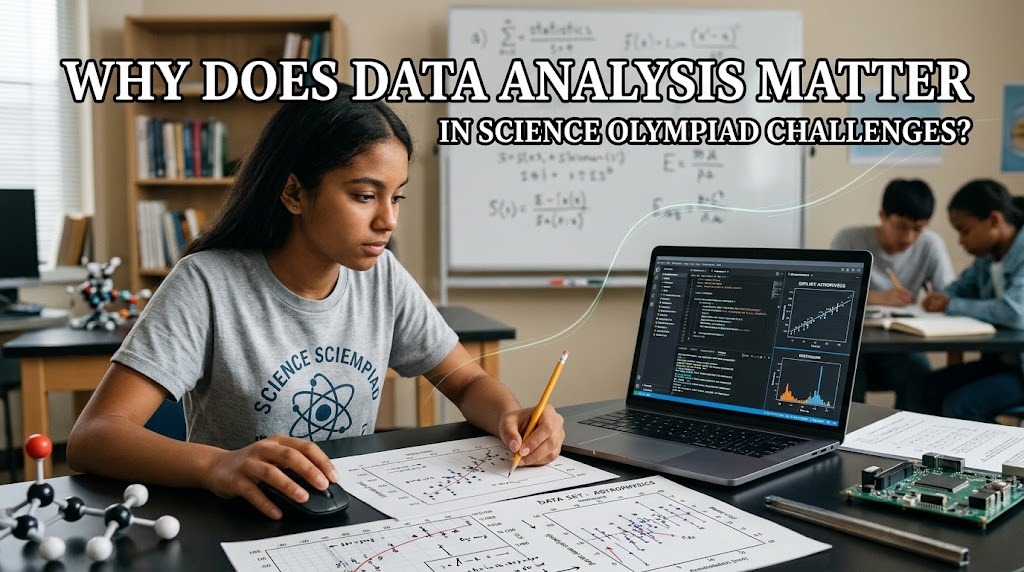
Science Olympiad competitions require students to understand scientific concepts, solve complex problems, and interpret information accurately. Many challenges involve numerical data, experimental results, graphs, tables, and scientific observations. To answer these questions correctly, students need more than theoretical knowledge. They must also understand how to examine information, identify patterns, and draw logical conclusions. This is why data analysis plays an important role in Science Olympiad preparation and competition performance.
UNDERSTANDING DATA ANALYSIS IN SCIENCE
Data analysis is the process of examining, organizing, and interpreting information to discover meaningful patterns or relationships. In science, data can come from experiments, observations, measurements, or research activities. Students use analytical methods to understand what the collected information represents and how it relates to a scientific question. For example, they may compare temperature measurements to determine how heat affects a particular process. Understanding data analysis helps participants move beyond memorizing scientific facts and develop evidence-based explanations.
HELPING STUDENTS INTERPRET SCIENTIFIC INFORMATION
Science Olympiad questions often present information in different formats, including tables, diagrams, charts, and written descriptions. Students must identify important details and understand what the information reveals. Data analysis helps them distinguish relevant values from unnecessary details and recognize relationships between different variables. This ability is particularly useful when questions contain large amounts of information that must be examined carefully. Accurate interpretation can help students avoid misunderstandings and choose more appropriate answers.
IDENTIFYING PATTERNS AND RELATIONSHIPS
Recognizing patterns is an important part of scientific investigation. Through data analysis, students can identify trends, similarities, differences, and relationships between variables. For example, they may examine how changes in light intensity influence plant growth or how temperature affects the speed of a chemical reaction. These observations can help participants understand scientific principles more deeply. The ability to recognize patterns also makes it easier to solve unfamiliar problems that require logical connections between different concepts.
DEVELOPING CRITICAL THINKING SKILLS
Data analysis encourages students to evaluate information before accepting a conclusion. They must consider whether the available evidence supports a particular explanation and whether other factors could influence the results. This process teaches them to question assumptions, examine possible errors, and compare alternative interpretations. Instead of choosing answers based on guesses, students learn to use evidence and logical reasoning. These critical thinking skills are essential when facing complex Science Olympiad challenges.
IMPROVING PROBLEM-SOLVING ABILITIES
Many Science Olympiad problems require students to combine mathematical calculations with scientific understanding. Data analysis helps them organize the available information, identify what needs to be determined, and select suitable methods for solving the problem. They may need to calculate averages, compare measurements, identify rates of change, or interpret numerical relationships. Breaking a complicated problem into smaller analytical steps can make it easier to manage. Regular practice helps students become more systematic and confident when answering difficult questions.
SUPPORTING ACCURATE EXPERIMENTAL CONCLUSIONS
Experimental activities generate data that students must interpret before reaching conclusions. Participants need to compare their observations with initial predictions and determine whether the results support their hypotheses. They should also consider measurement errors, unusual results, and possible limitations in the experimental procedure. A conclusion should be based on the available evidence rather than personal expectations. This approach helps students understand how scientific investigations produce reliable knowledge.
STRENGTHENING MATHEMATICAL AND STATISTICAL SKILLS
Data analysis often involves mathematical and statistical methods that are useful in different scientific subjects. Students may need to calculate percentages, averages, ratios, probabilities, or other numerical values. They can also learn to interpret statistical information and understand how measurements vary. These skills are important in subjects such as physics, chemistry, biology, and mathematics. A strong understanding of mathematical relationships allows students to approach quantitative Olympiad questions more effectively.
IMPROVING GRAPH AND TABLE INTERPRETATION
Graphs and tables are commonly used to present scientific information in a clear and organized format. Students need to understand titles, labels, units, scales, and the relationships represented by the data. For example, a line graph may show how an object's speed changes over time, while a table may compare the results of several experiments. Practicing these skills helps students identify trends and understand numerical information without overlooking important details. It also prepares them for questions that require conclusions based on visual data.
ENCOURAGING EVIDENCE-BASED DECISION-MAKING
Scientific conclusions should be supported by reliable evidence. Data analysis helps students compare available information and determine which explanation is most consistent with the results. They learn to distinguish between observations, interpretations, and assumptions. This skill is important when multiple answers appear reasonable but only one is supported by the evidence. Evidence-based decision-making also encourages students to explain why they choose a particular answer instead of relying on intuition alone.
HOW STUDENTS CAN IMPROVE THEIR DATA ANALYSIS SKILLS
Students can strengthen their analytical abilities through regular practice and scientific investigation. They should become familiar with different types of data, learn basic statistical methods, and practice interpreting graphs and tables. Several activities can support this development:
- Analyze experimental results: Examine measurements and identify patterns in collected information.
- Practice graph interpretation: Study different graph types and understand the relationships they represent.
- Solve numerical problems: Improve calculation skills through scientific exercises and Olympiad questions.
- Compare different findings: Identify similarities, differences, and possible explanations.
- Review incorrect conclusions: Understand why an interpretation is inaccurate and how to improve the reasoning.
Consistent practice helps students become more comfortable working with scientific information and applying analytical methods to challenging questions.
CONCLUSION
Data analysis matters in Science Olympiad challenges because it helps students interpret information, recognize patterns, solve problems, and develop evidence-based conclusions. It also strengthens critical thinking, mathematical understanding, and experimental reasoning. These abilities allow participants to approach scientific questions more systematically instead of depending only on memorized knowledge. By practicing data interpretation and analytical methods regularly, students can improve their scientific understanding and become better prepared for demanding Olympiad competitions.
Recent Posts

Bagaimana Sistem SKS pada Program Kuliah... 22.11.2026/48 View

How Does Technology Make Daily Evaluation... 21.11.2026/76 View

Apa Strategi Menghadapi Kesenjangan antara Kompetensi... 21.11.2026/78 View

Mengapa Inventaris Aset Penting bagi Kelancaran... 21.11.2026/73 View

When Should Musicians Join a Record... 21.11.2026/78 View
