

Why Does Deforestation Make Global Warming Worse?
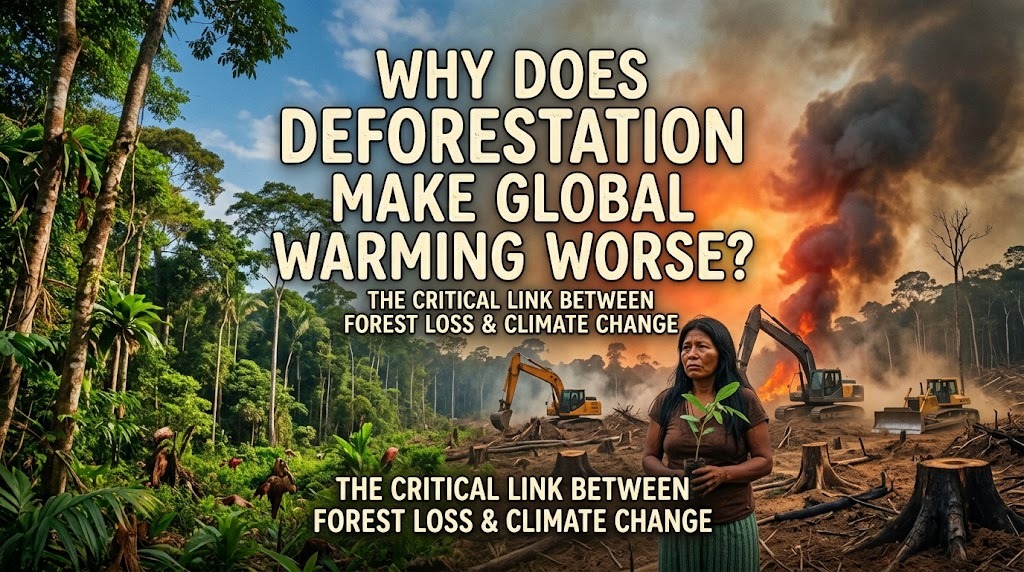
Deforestation is the large-scale removal of trees and forests to make space for agriculture, settlements, roads, mining, and other human activities. Although land clearing can support certain economic activities, it also creates serious environmental problems. One of its most significant consequences is the acceleration of global warming, which occurs when greenhouse gases accumulate in the atmosphere and trap additional heat.
Forests play an important role in regulating Earth's climate because they absorb carbon dioxide, store carbon, and support natural water cycles. When forests are destroyed, these functions can be weakened, while the carbon stored in trees and soil may be released into the atmosphere. Understanding why deforestation makes global warming worse helps explain the importance of forest conservation and responsible land management.
DEFORESTATION RELEASES STORED CARBON INTO THE ATMOSPHERE
Trees absorb carbon dioxide from the atmosphere through photosynthesis and use the carbon to build their trunks, branches, leaves, and roots. Over time, forests store substantial amounts of carbon in their vegetation and soil. When trees are cut down and burned, much of this stored carbon is released into the atmosphere as carbon dioxide.
Even when cleared trees are not burned immediately, their carbon may be released as the remaining vegetation decomposes. Soil disturbance during land clearing can also contribute to carbon emissions, depending on the type of forest and how the land is managed. These emissions increase the concentration of greenhouse gases, strengthening the greenhouse effect and contributing to rising global temperatures. Therefore, deforestation can accelerate global warming by transferring carbon from forests into the atmosphere.
DEFORESTATION REDUCES THE EARTH'S NATURAL CARBON ABSORPTION
Healthy forests act as natural carbon sinks because they absorb more carbon dioxide than they release over certain periods. Through photosynthesis, trees remove carbon dioxide from the atmosphere and store carbon in their tissues. Forest soils and other vegetation can also hold carbon, helping regulate the amount of this greenhouse gas in the environment.
When forests are cleared, fewer trees remain to absorb carbon dioxide in the future. If the cleared land is replaced with vegetation or land uses that store less carbon, the overall carbon storage capacity may decline significantly. This means that deforestation can worsen global warming not only by releasing stored carbon but also by reducing the Earth's ability to remove carbon dioxide from the atmosphere. Protecting existing forests is therefore an important part of climate change mitigation.
FOREST LOSS DISRUPTS NATURAL WATER CYCLES
Forests influence the movement of water between the land and atmosphere. Trees absorb water through their roots and release some of it as water vapor through a process called transpiration. This process contributes to atmospheric moisture and can influence rainfall patterns, particularly in regions with extensive forest cover.
When large forest areas disappear, less water may be released into the atmosphere through transpiration. Land clearing can also increase surface runoff, soil erosion, and the risk of flooding under certain conditions. Changes in local moisture and temperature can affect nearby ecosystems and agricultural activities. Although rainfall patterns are influenced by many factors, extensive deforestation can weaken important natural processes that help regulate regional climates.
DEFORESTATION DAMAGES BIODIVERSITY AND ECOSYSTEMS
Forests provide habitats, food sources, and breeding areas for many species. When trees are removed, animals and plants may lose the conditions they need to survive. Some species can move to other habitats, but others may struggle to adapt, particularly when forest loss is extensive or fragmented.
The loss of biodiversity can also affect the way ecosystems function. Animals help disperse seeds, insects pollinate plants, and microorganisms support soil processes. When these relationships are disrupted, forest regeneration and other ecological functions may become less effective. Healthy ecosystems can support carbon storage, soil protection, and water regulation, so damaging them can create additional environmental pressures. Forest conservation helps protect biodiversity while maintaining the ecological processes that contribute to climate stability.
PROTECTING FORESTS CAN HELP LIMIT GLOBAL WARMING
Reducing deforestation is an important way to address global warming. Protecting existing forests prevents the release of large amounts of stored carbon and preserves their capacity to absorb carbon dioxide. Forest protection can also support biodiversity, maintain water cycles, and protect the livelihoods of communities that depend on forest resources.
Restoring degraded forests and planting suitable native trees can help rebuild carbon storage over time. However, tree planting cannot fully replace the ecological value of mature natural forests, which often contain complex habitats and large stores of carbon. Sustainable agriculture, responsible land-use planning, stronger forest monitoring, and efforts to prevent illegal clearing can help reduce pressure on forest areas. These measures are most effective when supported by local communities, businesses, and government policies.
CONCLUSION
Deforestation makes global warming worse by releasing stored carbon, reducing the Earth's natural capacity to absorb carbon dioxide, and disrupting ecological processes that help regulate the climate. Forest loss can also affect rainfall patterns, damage habitats, and weaken biodiversity. These effects demonstrate that forests are not simply collections of trees but complex ecosystems that provide important environmental benefits.
Protecting forests, restoring degraded land, and managing natural resources responsibly can help reduce greenhouse gas emissions and preserve ecosystem health. However, forest conservation should be combined with broader efforts to reduce emissions from fossil fuels, industry, agriculture, and other sources. Through coordinated action, society can limit future warming while protecting forests for people, wildlife, and future generations.
Recent Posts

Bagaimana Sistem SKS pada Program Kuliah... 22.11.2026/48 View

How Does Technology Make Daily Evaluation... 21.11.2026/76 View

Apa Strategi Menghadapi Kesenjangan antara Kompetensi... 21.11.2026/78 View

Mengapa Inventaris Aset Penting bagi Kelancaran... 21.11.2026/73 View

When Should Musicians Join a Record... 21.11.2026/78 View
