

Why Does Logical Intelligence Affect the Learning Process?
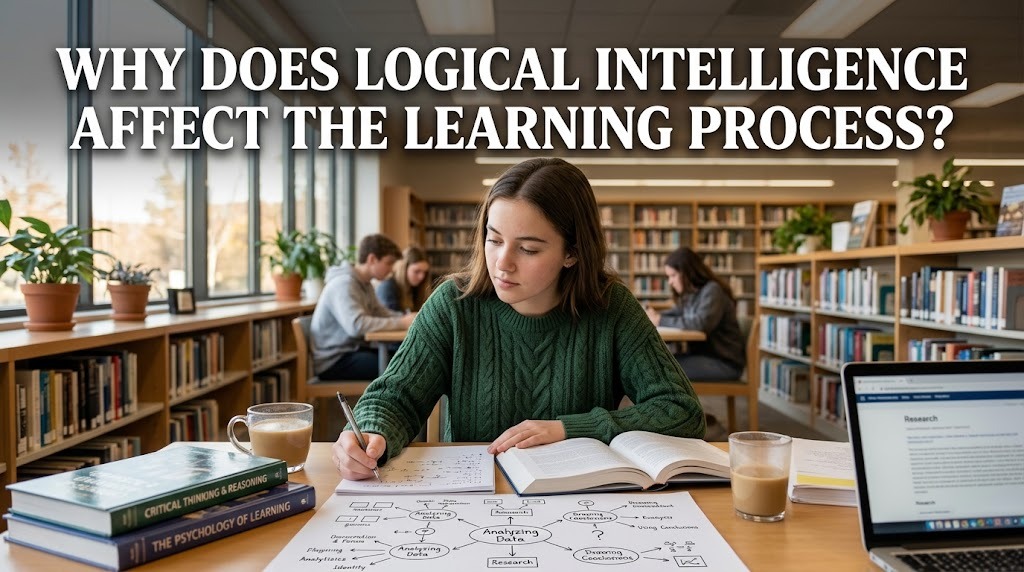
Logical intelligence has an important connection with the learning process because it helps students understand information, recognize patterns, connect ideas, and solve problems through reasoning. Learning is not only about remembering facts but also about understanding how different concepts relate to one another. Students can use logical thinking when analyzing lessons, completing assignments, and finding solutions to academic challenges. Developing this ability can therefore make learning more structured and meaningful.
UNDERSTANDING LOGICAL INTELLIGENCE IN LEARNING
Logical intelligence refers to the ability to reason, analyze information, recognize patterns, and understand relationships. In the learning process, these abilities help students examine new information and connect it with what they already know. This can make complicated concepts easier to understand because students can identify the structure behind the material. Logical intelligence can be useful across different subjects, not only mathematics.
Students may demonstrate logical thinking when they compare two concepts, identify a sequence, or determine why a particular result occurs. They can also use reasoning to organize information into categories or steps. This helps create a clearer mental structure of the lesson. As a result, logical reasoning can support deeper understanding instead of relying entirely on memorization.
HELPING STUDENTS UNDERSTAND COMPLEX MATERIAL
Some learning materials contain several concepts that are connected to one another. Logical intelligence can help students break complex information into smaller parts and understand how each part contributes to the whole. This approach can make difficult topics easier to study. Students can identify the main idea first and then examine supporting details.
For example, when learning a scientific process, students can focus on the sequence of events and the relationship between causes and results. In history, they can examine how one event may influence another. In mathematics, they can identify the steps required to solve a problem. These approaches allow students to use reasoning and connections to understand different types of material.
SUPPORTING CRITICAL THINKING
Logical intelligence can also support critical thinking skills during learning. Students are often exposed to different explanations, opinions, and sources of information. Logical reasoning helps them examine information carefully instead of accepting every statement immediately. They can consider evidence, compare ideas, and determine whether a conclusion is supported by the available information.
Critical thinking also encourages students to ask meaningful questions. They may ask why something happens, whether an explanation is reasonable, or what evidence supports a particular claim. These questions can lead to deeper classroom discussions and more active learning. Therefore, logical intelligence can help students become more careful and independent thinkers.
IMPROVING PROBLEM SOLVING AND DECISION MAKING
Academic learning often involves problems that require students to apply what they have learned. Logical intelligence helps students identify the problem, organize relevant information, and consider possible solutions. Instead of immediately guessing, they can follow a series of logical steps. This approach can make challenging assignments more manageable.
Logical thinking can also support decision making during the learning process. Students may need to decide which method to use, which information is relevant, or how to organize their study activities. They can compare different options and consider the possible results of each one. This encourages structured decision making and greater learning independence.
ENCOURAGING ACTIVE AND INDEPENDENT LEARNING
Students with developed logical thinking skills can become more active when dealing with new material. Instead of waiting for someone to provide every answer, they can explore information, test ideas, and search for relationships between concepts. This can encourage curiosity and make learning more engaging. Students can also evaluate their own understanding and identify areas that need further practice.
Logical intelligence can be strengthened through activities such as puzzles, experiments, research, coding, mathematical exercises, and problem-based learning. Teachers can encourage students to explain their reasoning rather than focusing only on the final answer. Reviewing mistakes can also help students understand how their thinking can be improved. These practices can gradually support independent learning and stronger reasoning abilities.
CONCLUSION
Logical intelligence affects the learning process by helping students understand complex information, connect concepts, analyze evidence, and solve academic problems. It supports critical thinking by encouraging students to examine information and develop conclusions through reasoning. Logical thinking can also make students more independent because they can approach challenges using organized steps. Activities such as puzzles, experiments, research, coding, and problem solving can help strengthen these abilities. With regular practice, logical intelligence can become a valuable foundation for effective learning and lifelong problem solving.
Recent Posts

Bagaimana Sistem SKS pada Program Kuliah... 22.11.2026/21 View

How Does Technology Make Daily Evaluation... 21.11.2026/63 View

Apa Strategi Menghadapi Kesenjangan antara Kompetensi... 21.11.2026/65 View

Mengapa Inventaris Aset Penting bagi Kelancaran... 21.11.2026/62 View

When Should Musicians Join a Record... 21.11.2026/59 View
