

Why Does Scientific Literacy Help Build an Informed Society?
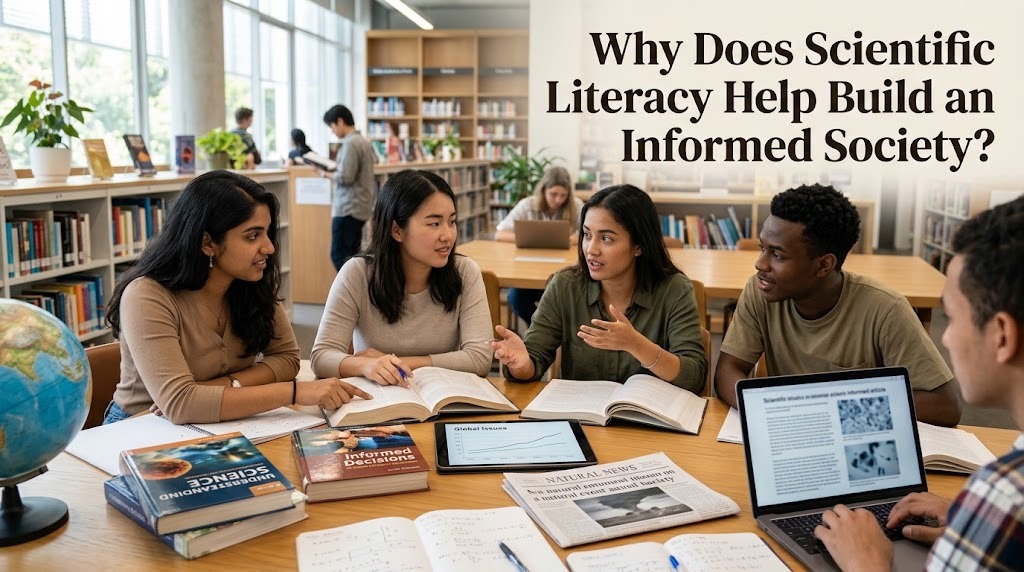
Scientific literacy plays an important role in helping people understand information related to science, technology, health, and the environment. In modern society, people encounter scientific information through education, news, websites, social media, and other digital platforms. The ability to understand and evaluate this information can help individuals make informed decisions. When more people can assess information based on evidence, communities can have better discussions about important issues. Therefore, scientific literacy can contribute to the development of a more informed society.
UNDERSTANDING SCIENTIFIC LITERACY
Scientific literacy is the ability to understand scientific concepts, evaluate evidence, and apply scientific knowledge to real-life situations. It is not limited to remembering scientific facts because people also need to understand how evidence can be used to support explanations. Scientific literacy encourages individuals to ask questions, examine information, and develop conclusions based on logical reasoning. These abilities are useful when people encounter scientific issues in their daily lives. As a result, scientific literacy can support responsible participation in society.
Scientific literacy also helps people understand the relationship between science, technology, and society. Many decisions in modern life are connected to scientific and technological developments. People may need to understand information about energy, environmental changes, health, food, or digital technology. Having basic scientific knowledge allows individuals to participate in discussions about these subjects more meaningfully. This makes scientific literacy valuable not only for students but also for society as a whole.
SCIENTIFIC LITERACY HELPS EVALUATE INFORMATION
An informed society needs people who can distinguish reliable information from unsupported claims. Scientific literacy helps individuals examine the source of information and consider whether a claim is supported by sufficient evidence. This is particularly important because digital platforms allow information to spread rapidly. Critical evaluation can help people avoid accepting claims simply because they are popular or frequently shared. Instead, they can compare information and look for trustworthy evidence.
Students can develop these habits through activities that require research, comparison, and analysis. They can learn to identify the difference between scientific evidence, personal opinions, and assumptions. These skills become increasingly important when scientific topics are discussed on social media or in online communities. People who carefully evaluate information can also avoid unnecessarily spreading misleading claims. In this way, scientific literacy supports responsible information sharing.
SCIENTIFIC LITERACY SUPPORTS INFORMED DECISIONS
People make decisions every day that may involve scientific information. These decisions can relate to health, food, technology, environmental practices, and the use of natural resources. Scientific literacy helps individuals understand relevant information and consider evidence before making a choice. It does not guarantee that every decision will be correct, but it provides a stronger basis for evidence based decision making. This can help individuals approach complex issues more carefully.
Informed decisions are especially important when a topic has different claims or explanations. A scientifically literate person can examine available evidence and recognize when additional information is needed. They can also understand that scientific knowledge may change when new evidence becomes available. This encourages people to remain open to reliable information and update their understanding when necessary. Such habits can strengthen the quality of decision making within a community.
SCIENTIFIC LITERACY ENCOURAGES PUBLIC PARTICIPATION
Scientific issues can affect communities in many ways, including environmental protection, public health, energy use, and technological development. People with scientific literacy can better understand the basic information needed to participate in discussions about these issues. They can ask relevant questions and examine explanations before forming their own views. Informed participation allows individuals to contribute more meaningfully to conversations within their communities.
Scientific literacy also encourages respectful discussion because evidence can provide a common basis for examining different claims. People may still have different opinions about how a problem should be addressed, but scientific information can help clarify the facts involved. Understanding the difference between evidence and opinion can make discussions more productive. This is one way scientific literacy can support constructive communication in society.
SCIENTIFIC LITERACY SUPPORTS RESPONSIBLE COMMUNITIES
An informed society depends not only on access to information but also on people's ability to use information responsibly. Scientific literacy encourages individuals to verify information before accepting or sharing it. It can also help people understand the possible consequences of spreading unsupported scientific claims. Responsible information behavior is especially important in the digital era, where information can reach large audiences quickly.
Schools, families, educational institutions, and communities can all contribute to developing scientific literacy. Providing access to reliable learning resources and encouraging people to ask questions can create a stronger culture of learning. Practical activities, scientific discussions, and digital information evaluation can also help strengthen these skills. When scientific literacy becomes part of everyday learning, more people can participate thoughtfully in society. This can support a community that values evidence, learning, and responsible communication.
CONCLUSION
Scientific literacy helps build an informed society by enabling people to understand scientific information, evaluate evidence, and make informed decisions. It also supports critical thinking, responsible information sharing, and meaningful participation in discussions about science and technology. In the digital era, these skills are especially important because information can spread quickly and vary greatly in quality. Developing scientific literacy through education and everyday learning can help individuals become more careful and responsible users of information. Ultimately, a scientifically literate society is better prepared to understand complex issues and respond to changes based on reliable knowledge.
Recent Posts

Bagaimana Sistem SKS pada Program Kuliah... 22.11.2026/33 View

How Does Technology Make Daily Evaluation... 21.11.2026/67 View

Apa Strategi Menghadapi Kesenjangan antara Kompetensi... 21.11.2026/67 View

Mengapa Inventaris Aset Penting bagi Kelancaran... 21.11.2026/65 View

When Should Musicians Join a Record... 21.11.2026/66 View
