

Why Does Shot Put Require Strength and Proper Technique?
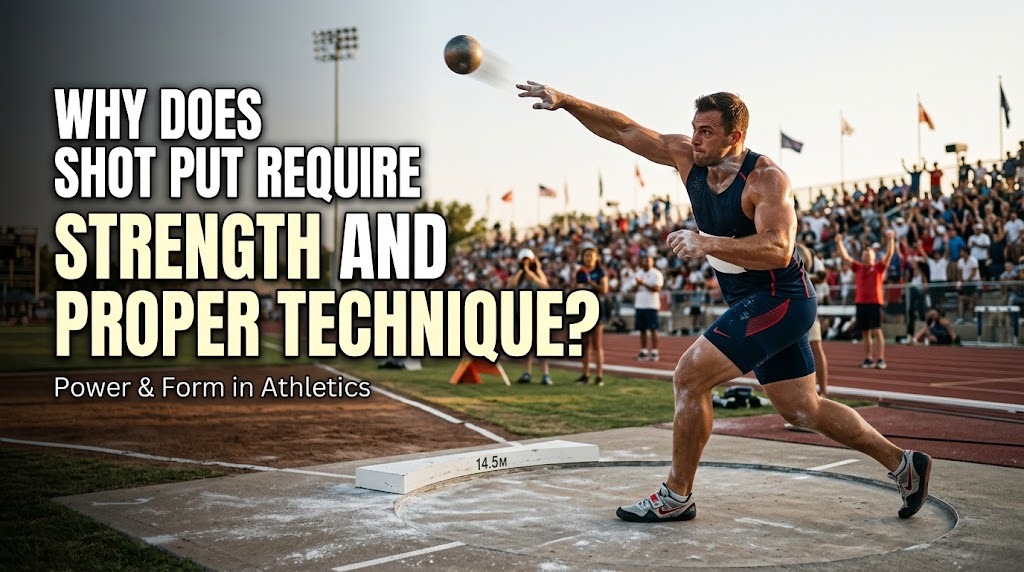
Shot put is a field event in athletics that requires athletes to throw a heavy metal ball, called a shot, as far as possible within the competition rules. Although strength is essential, successful performance also depends on proper technique, balance, coordination, and timing. Athletes must generate force through their legs and torso before transferring that force into the throwing arm. Understanding the relationship between strength and technique helps athletes improve their throwing distance while reducing the risk of injury.
UNDERSTANDING THE SHOT PUT EVENT
Shot put is different from throwing events such as javelin or discus because athletes must push the shot rather than throw it like a ball. The shot is held close to the neck or jaw and propelled from the shoulder using a pushing motion. Athletes compete from inside a circular throwing area and must follow specific rules regarding their movements and the landing sector. The result is measured from the throwing circle to the nearest point where the shot first lands within the valid sector.
WHY MUSCULAR STRENGTH IS IMPORTANT
Muscular strength allows shot put athletes to apply substantial force to the shot during the throwing movement. Strong leg, hip, core, shoulder, and arm muscles contribute to producing and transferring that force. However, strength alone does not guarantee a long throw because the athlete must also direct the force efficiently. Developing overall strength provides a foundation for powerful and controlled throwing movements.
THE ROLE OF EXPLOSIVE POWER
Explosive power is the ability to produce force quickly. In shot put, athletes have only a brief period to accelerate the shot before releasing it. Greater explosive power can help them generate a higher release velocity, which is an important factor in throwing distance. Exercises such as medicine-ball throws, jumps, and appropriately supervised resistance training can help develop power when they are matched to the athlete’s experience and physical condition.
HOW PROPER TECHNIQUE IMPROVES THROWING DISTANCE
Proper technique helps athletes use their strength efficiently. Instead of relying only on the arm, they coordinate movements from the lower body through the torso and into the throwing arm. This sequence allows force to travel through the body and contribute to the shot’s acceleration. Correct technique also helps athletes maintain balance, control the direction of the throw, and comply with competition rules.
THE IMPORTANCE OF BODY COORDINATION
Body coordination is essential because shot put involves several movements that must happen in the correct sequence. Athletes use their legs and hips to initiate movement, rotate or extend their torso, and drive the throwing arm forward. If these movements are poorly timed, some of the force produced by the body may not contribute effectively to the throw. Practicing coordinated movements helps athletes develop smoother and more powerful performances.
THE ROLE OF BALANCE AND BODY POSITION
Balance allows athletes to control their movements while generating force inside the throwing circle. A stable starting position helps them prepare for the throw, while controlled movement helps maintain their position during delivery. Athletes must also avoid stepping outside the circle or leaving it incorrectly after the shot lands. Improving balance and body awareness can support consistent technique and help prevent fouls.
RELEASE ANGLE AND RELEASE SPEED
The shot’s release speed, release angle, and release height all influence how far it travels. A higher release speed generally contributes to a longer throw when other conditions are comparable. The optimal release angle depends on factors such as the athlete’s release height and the speed they can achieve at different angles. Therefore, athletes should practice a release position that suits their abilities rather than assuming that one angle works equally well for everyone.
TRAINING METHODS FOR SHOT PUT ATHLETES
Effective shot put training combines technical practice, strength development, explosive exercises, and mobility work. Athletes can begin with lighter implements or controlled drills to learn the correct pushing action before progressing to more demanding throws. Strength exercises may include squats, presses, and core training, performed with suitable supervision and technique. Coaches can use video analysis and throwing measurements to identify areas for improvement and monitor progress over time.
SAFETY AND INJURY PREVENTION
Shot put training requires attention to safety because the implement is heavy and can cause serious injuries if handled carelessly. Athletes should warm up before throwing, use appropriate equipment, and follow instructions from a qualified coach. The throwing sector must remain clear, and no one should retrieve a shot until the coach or event official gives permission. Gradual training progression and adequate recovery also help manage the physical demands placed on the shoulders, elbows, back, and legs.
CONCLUSION
Shot put requires both strength and proper technique because athletes must generate force and transfer it efficiently into the shot. Muscular strength supports force production, while explosive power, coordination, balance, and release mechanics help convert that force into throwing distance. Consistent technical practice and structured physical training can improve performance while supporting safe participation. By developing these qualities together, athletes can build more effective and reliable throwing skills.
Recent Posts

Bagaimana Sistem SKS pada Program Kuliah... 22.11.2026/50 View

How Does Technology Make Daily Evaluation... 21.11.2026/80 View

Apa Strategi Menghadapi Kesenjangan antara Kompetensi... 21.11.2026/79 View

Mengapa Inventaris Aset Penting bagi Kelancaran... 21.11.2026/75 View

When Should Musicians Join a Record... 21.11.2026/80 View
