

Why Is Basic Research the Foundation of Technological Innovation?
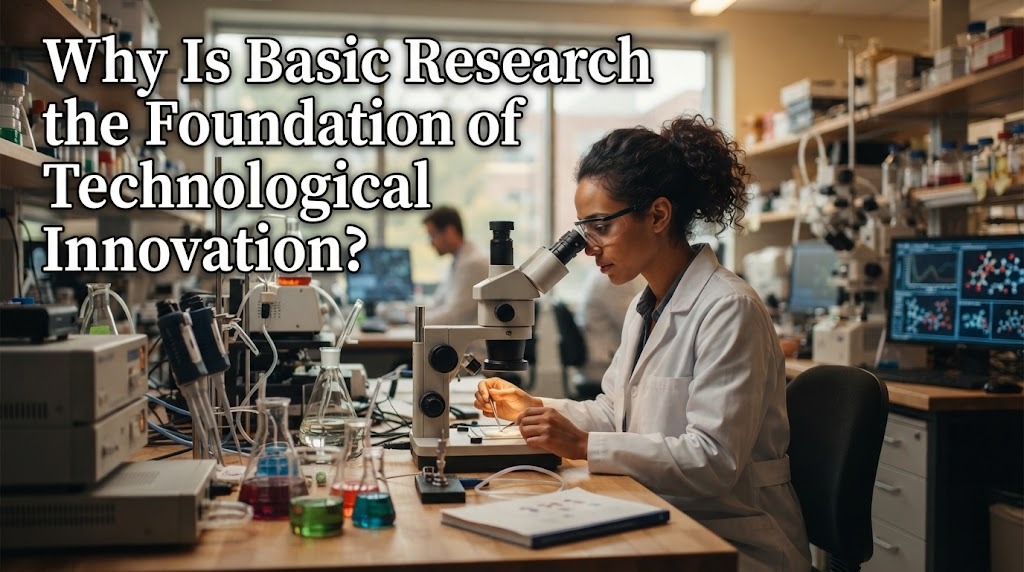
Basic research plays an important role in the development of modern technology. It helps scientists understand fundamental principles, discover new knowledge, and explain how natural and technological systems work. Although basic research does not always produce immediate practical results, its findings often become the starting point for important technological breakthroughs. Many innovations in medicine, communication, computing, and energy depend on scientific discoveries made through earlier research. Understanding why basic research is the foundation of technological innovation helps explain how scientific knowledge can create long-term benefits for society.
UNDERSTANDING BASIC RESEARCH AND TECHNOLOGICAL INNOVATION
Basic research is a type of scientific investigation that aims to expand knowledge and understand fundamental concepts. Unlike research that directly develops a product or solves a specific practical problem, basic research focuses on discovering how and why things happen. Scientists may investigate the behavior of materials, the structure of matter, or the principles behind biological processes. The results may not have an immediate commercial application, but they can provide valuable information for future discoveries.
Technological innovation refers to the development or improvement of products, processes, and systems using knowledge and creative ideas. It often requires more than technical skills because innovators must understand the scientific principles behind the technology they create. Basic research provides this essential understanding and helps researchers identify new possibilities. By connecting scientific discoveries with engineering and practical development, basic research creates opportunities for technologies that can improve everyday life.
HOW BASIC RESEARCH CREATES NEW SCIENTIFIC KNOWLEDGE
One major reason basic research supports technological innovation is its ability to generate new scientific knowledge. Researchers investigate questions that may not have clear answers and develop theories to explain unfamiliar phenomena. Through experiments, observations, and data analysis, they identify patterns and test scientific explanations. These findings help expand the understanding of the natural world and provide reliable foundations for future investigations.
New knowledge can also reveal possibilities that researchers did not previously recognize. For example, discoveries about the properties of semiconductors helped scientists develop increasingly advanced electronic devices. Research into the behavior of light and electromagnetic waves contributed to technologies used in telecommunications and optical systems. These examples demonstrate that scientific discoveries can become valuable technological resources, even when their practical applications emerge many years after the original research.
THE ROLE OF BASIC RESEARCH IN DEVELOPING NEW TECHNOLOGIES
Basic research provides the scientific principles needed to design and improve modern technologies. Engineers and technology developers use established knowledge to determine how materials, electronic components, chemical reactions, and physical systems behave. Without a strong scientific foundation, technological development may depend heavily on trial and error. Basic research reduces this uncertainty by helping researchers understand the mechanisms behind a particular process.
For example, fundamental discoveries in quantum physics contributed to the development of transistors, lasers, and other technologies that support modern electronics and communication systems. Research in molecular biology has also expanded scientific understanding that supports biotechnology and medical testing. In addition, studies of electrochemistry have helped researchers improve battery technologies used in portable electronics and electric vehicles. These developments show how basic research can create opportunities for practical innovations across different industries.
BASIC RESEARCH SUPPORTS LONG TERM INNOVATION
Technological progress often requires years of investigation, testing, and improvement. Basic research supports this process by providing knowledge that can be used for multiple purposes rather than addressing only one immediate problem. A single scientific discovery may inspire researchers from different fields to develop entirely different applications. This makes basic research valuable for long-term innovation and the continued development of new technologies.
Furthermore, basic research helps scientists respond to challenges that may become important in the future. Research into materials science, energy systems, and biological processes can provide a foundation for technologies that address environmental problems, resource limitations, and public health needs. Although researchers cannot always predict which discoveries will lead to major breakthroughs, maintaining scientific exploration increases the possibilities for future progress. This is why investment in basic research remains important even when immediate economic returns are uncertain.
THE CONNECTION BETWEEN BASIC RESEARCH AND APPLIED RESEARCH
Basic research and applied research have different goals, but both contribute to technological innovation. Basic research seeks to understand fundamental principles, while applied research uses scientific knowledge to address specific needs or practical problems. For instance, basic research may investigate how a particular material conducts electricity, while applied research may examine how that material can improve the performance of an electronic device. The two approaches often work together throughout the innovation process.
The results of basic research can guide applied research by providing theories, evidence, and new scientific methods. In return, practical challenges identified during applied research may inspire new fundamental questions. This relationship creates a continuous cycle of discovery, experimentation, and development. When universities, research institutions, governments, and industries collaborate, scientific knowledge can move more effectively from the laboratory into useful products and services.
CHALLENGES IN TURNING BASIC RESEARCH INTO INNOVATION
Despite its importance, basic research does not always lead directly to technological innovation. Some discoveries may take decades to find practical applications, while others may never become commercial products. Scientific investigations can also require expensive equipment, specialized facilities, skilled researchers, and long-term funding. These factors can make it difficult for research institutions to maintain consistent scientific programs.
Another challenge is the gap between scientific discovery and technological development. A promising research result may require additional experiments, engineering improvements, safety evaluations, and financial support before it can be used in real-world situations. Effective collaboration between scientists, engineers, businesses, and policymakers can help overcome these barriers. Long-term funding, access to research facilities, and strong scientific education are also essential for ensuring that valuable discoveries have opportunities to support future innovation.
WHY BASIC RESEARCH MATTERS FOR SOCIETY
Basic research contributes to society by expanding knowledge that can eventually improve health, education, communication, transportation, and environmental protection. Scientific discoveries may lead to better diagnostic tools, more efficient energy systems, stronger materials, and advanced digital technologies. These developments can improve quality of life, support economic growth, and create new employment opportunities. However, the benefits of basic research are not limited to financial returns or commercial products.
Basic research also strengthens scientific thinking and helps society make informed decisions. It encourages curiosity, critical analysis, and evidence-based problem-solving. By training researchers to investigate questions systematically, it develops skills that are valuable in universities, laboratories, industries, and public institutions. Supporting basic research therefore means investing in both future technological possibilities and the broader development of scientific knowledge.
CONCLUSION
Basic research is the foundation of technological innovation because it creates the scientific knowledge needed to understand, develop, and improve technologies. Its discoveries provide essential principles for engineering, medicine, computing, energy, and many other fields. Although practical applications may take time to emerge, basic research can produce long-term benefits that extend far beyond its original objectives.
The relationship between basic research and applied research also demonstrates that scientific discovery and practical development are closely connected. With sustained funding, strong research institutions, and collaboration between scientists and industry, basic research can support meaningful technological progress. Ultimately, investing in fundamental scientific knowledge helps society prepare for future challenges and discover new opportunities for innovation.
Recent Posts

Bagaimana Sistem SKS pada Program Kuliah... 22.11.2026/43 View

How Does Technology Make Daily Evaluation... 21.11.2026/72 View

Apa Strategi Menghadapi Kesenjangan antara Kompetensi... 21.11.2026/74 View

Mengapa Inventaris Aset Penting bagi Kelancaran... 21.11.2026/70 View

When Should Musicians Join a Record... 21.11.2026/74 View
