

Why Is Critical Thinking Essential in Science Olympiad Competitions?
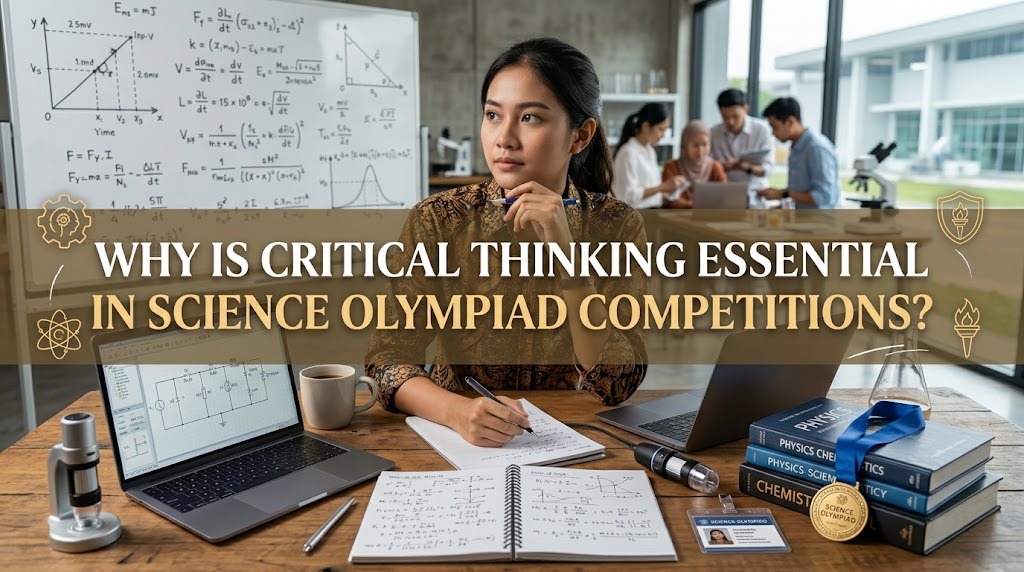
Science Olympiad competitions challenge students to understand scientific concepts, analyze complex information, and solve problems accurately. Unlike ordinary classroom exercises, these competitions often present unfamiliar questions that require more than memorizing formulas or definitions. Students must examine available information, identify relevant principles, and develop logical solutions. This is where critical thinking becomes essential. By developing this ability, participants can approach difficult questions more systematically, evaluate different possibilities, and make decisions based on scientific reasoning.
UNDERSTANDING CRITICAL THINKING IN SCIENCE
Critical thinking is the ability to examine information carefully, evaluate evidence, and reach conclusions through logical reasoning. In science, this skill helps students understand why a particular answer is correct rather than simply remembering information from textbooks. They learn to question assumptions, identify relationships between concepts, and consider whether an explanation is supported by evidence. This approach is important because scientific problems often involve several connected ideas. Through critical thinking, students can develop a deeper understanding of scientific principles and apply them in different situations.
HELPING STUDENTS SOLVE COMPLEX PROBLEMS
Science Olympiad questions frequently involve challenging problems that require several steps to solve. Students may need to interpret information, select relevant formulas, perform calculations, and evaluate the results. Critical thinking helps them divide complicated questions into smaller parts and determine the most appropriate approach. Instead of guessing an answer, they can develop a solution based on logical steps. This ability allows participants to handle unfamiliar problems with greater confidence and accuracy.
ANALYZING INFORMATION AND SCIENTIFIC EVIDENCE
Scientific competitions often require students to interpret data, diagrams, graphs, tables, or experimental results. Critical thinking enables them to identify important details and distinguish relevant information from unnecessary information. Students can compare different results, recognize patterns, and determine whether the available evidence supports a particular conclusion. They also learn to avoid accepting statements without examining their accuracy. These analytical abilities are useful when answering theoretical questions and interpreting scientific investigations.
ENCOURAGING LOGICAL AND SYSTEMATIC REASONING
Logical reasoning helps students connect scientific concepts and develop explanations that make sense. During Olympiad preparation, participants often encounter questions that require them to combine knowledge from multiple topics. For example, a physics problem may involve understanding motion, energy, and mathematical relationships at the same time. Critical thinking encourages students to follow a clear sequence of reasoning instead of jumping directly to a conclusion. A systematic approach also makes it easier to identify mistakes and review each step of a solution.
IMPROVING DECISION-MAKING DURING COMPETITIONS
Students often have limited time to complete Science Olympiad questions, making effective decision-making important. Critical thinking helps participants determine which questions to answer first, which methods to use, and when to move on from a difficult problem. They can evaluate the information available and select an approach that is appropriate for the situation. This skill also helps them avoid spending too much time on methods that are unlikely to produce a solution. Good decisions can improve time management and make competition performance more organized.
DEVELOPING SCIENTIFIC CURIOSITY
Critical thinking encourages students to ask questions and explore how scientific processes work. Rather than accepting information without examination, they become interested in understanding the reasons behind scientific phenomena. This curiosity can motivate them to read additional materials, conduct experiments, and explore topics beyond the school curriculum. Students may also discover connections between scientific theories and real-life situations. Developing curiosity makes learning more meaningful and encourages continuous intellectual growth.
SUPPORTING EXPERIMENTAL AND RESEARCH SKILLS
Some Science Olympiad competitions include practical experiments that require students to observe, measure, and interpret results. Critical thinking helps participants identify variables, understand experimental procedures, and evaluate whether their findings are reasonable. They must also consider possible sources of error and explain differences between expected and observed results. These activities develop scientific investigation skills and encourage students to base conclusions on evidence. Such abilities are valuable for future research and academic activities.
HELPING STUDENTS LEARN FROM MISTAKES
Mistakes are a natural part of learning, especially when students work on challenging scientific problems. Critical thinking helps participants examine why an answer is incorrect and identify the reasoning that led to the mistake. Instead of simply memorizing the correct solution, they can review their approach and understand which concept needs improvement. This process makes future problem-solving more effective. Learning from mistakes also develops patience, independence, and resilience when facing difficult questions.
STRENGTHENING INDEPENDENT AND CREATIVE THINKING
Critical thinking encourages students to develop their own approaches instead of depending entirely on memorized examples. Some Olympiad problems can be solved through different methods, allowing participants to compare possible solutions. Creative thinking helps them explore alternative strategies, while critical thinking helps evaluate whether those strategies are logically valid. Combining these abilities can lead to more flexible and effective problem-solving. Students also become more confident in explaining their ideas and defending conclusions with scientific evidence.
HOW STUDENTS CAN DEVELOP CRITICAL THINKING SKILLS
Critical thinking can be improved through regular practice and active learning. Students should focus on understanding scientific concepts, analyzing different types of questions, and reviewing the reasoning behind each answer. Several activities can support this development:
- Practice challenging questions: Solve problems that require analysis rather than simple memorization.
- Review previous mistakes: Identify incorrect assumptions and understand the correct reasoning.
- Discuss scientific ideas: Exchange explanations with teachers, mentors, and fellow students.
- Analyze experimental results: Interpret graphs, measurements, and observations carefully.
- Ask deeper questions: Explore why scientific principles work and how they apply to real situations.
These habits can gradually improve students' ability to think logically and approach Science Olympiad challenges with greater confidence.
CONCLUSION
Critical thinking is essential in Science Olympiad competitions because it helps students analyze information, solve complex problems, evaluate evidence, and make logical decisions. It also supports scientific curiosity, experimental skills, independent learning, and creative problem-solving. By practicing these abilities consistently, students can develop a deeper understanding of science rather than relying only on memorization. More importantly, critical thinking provides valuable skills that extend beyond competitions and support academic development, research activities, and everyday decision-making.
Recent Posts

Bagaimana Sistem SKS pada Program Kuliah... 22.11.2026/49 View

How Does Technology Make Daily Evaluation... 21.11.2026/76 View

Apa Strategi Menghadapi Kesenjangan antara Kompetensi... 21.11.2026/78 View

Mengapa Inventaris Aset Penting bagi Kelancaran... 21.11.2026/74 View

When Should Musicians Join a Record... 21.11.2026/78 View
