

Why Is Documenting Regional Languages Important for Future Generations?
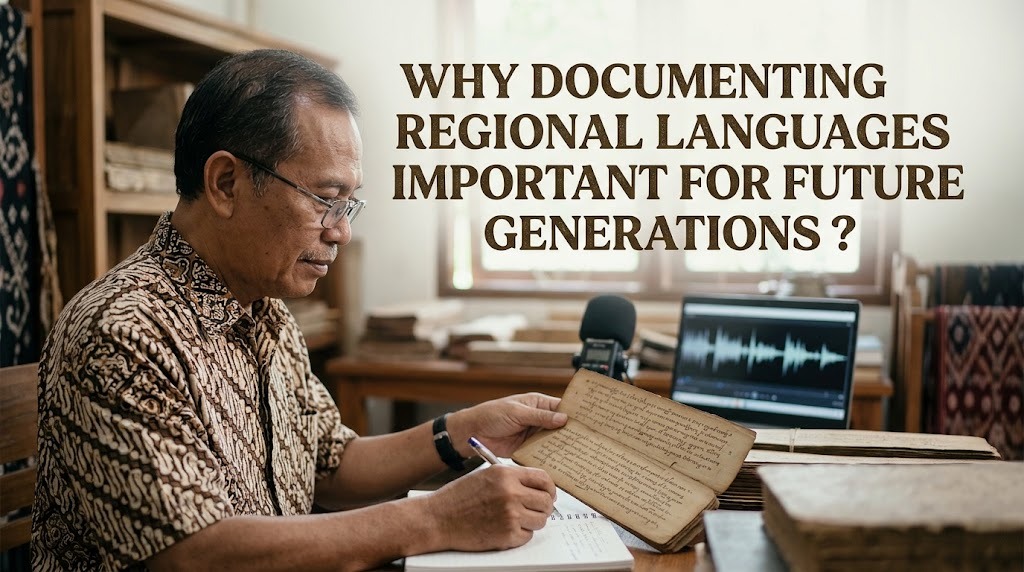
Indonesia has hundreds of regional languages that reflect the country's cultural diversity, history, and local knowledge. Each language contains unique vocabulary, expressions, stories, and ways of understanding the world. However, some regional languages are gradually losing speakers as younger generations increasingly use Indonesian or other widely spoken languages in everyday communication. Documenting these languages is an important step toward protecting them from disappearing. Language documentation helps preserve valuable cultural knowledge and ensures that future generations can learn about their linguistic heritage.
PRESERVING CULTURAL IDENTITY AND HERITAGE
Regional languages are closely connected to the identities of the communities that speak them. They contain traditional expressions, local names, oral histories, and cultural concepts that may not have exact equivalents in other languages. When a language disappears, the community may lose an important way of expressing its experiences and traditions. Documenting regional languages helps preserve these cultural elements for future generations.
Language records can include traditional songs, folktales, ceremonies, proverbs, and conversations with native speakers. These materials provide examples of how a language is used in real life and how it reflects community values. Preserving a regional language means protecting not only words but also the cultural identity and collective memory connected to them.
PROTECTING LANGUAGES AT RISK OF DISAPPEARING
Some regional languages face declining numbers of speakers because they are used less frequently at home, in schools, and in public settings. In certain communities, children may understand a language but struggle to speak it fluently. When fewer young people learn a language naturally, its future becomes increasingly uncertain. Documentation can help preserve information about the language before important knowledge is lost.
Researchers and community members can record pronunciation, vocabulary, grammar, conversations, and traditional stories. These records provide evidence of how the language was spoken at a particular time. Although documentation alone cannot guarantee that a language will survive, it creates valuable resources for future learning and revitalization. Recording endangered languages early helps prevent linguistic knowledge from disappearing without a trace.
SUPPORTING EDUCATION AND LANGUAGE LEARNING
Documented language materials can become useful resources for schools, teachers, students, and independent learners. Dictionaries, grammar guides, audio recordings, and reading materials help people understand a regional language more systematically. Teachers can use these resources to introduce local vocabulary and pronunciation in classroom activities. Students can also use documented materials to complete research projects about their linguistic and cultural heritage.
Learning resources are especially valuable when native speakers are becoming fewer or when traditional teaching materials are difficult to find. Audio and video recordings allow learners to hear pronunciation, intonation, and natural expressions. Accurate documentation creates a foundation for developing educational materials that make regional languages easier to learn and teach.
RECORDING TRADITIONAL KNOWLEDGE AND ORAL HISTORY
Regional languages often carry knowledge about local environments, traditional agriculture, medicinal plants, community relationships, and historical events. Much of this knowledge is passed from one generation to another through spoken communication rather than written documents. If the people who hold this knowledge pass away without sharing it, some information may become difficult to recover. Recording their experiences can help preserve valuable knowledge.
Interviews with elders, traditional leaders, storytellers, and other knowledgeable community members can provide important historical and cultural information. These recordings should be accompanied by explanations of the context in which particular words, stories, or practices are used. Researchers should also respect community consent and cultural restrictions on sensitive information. Documenting oral traditions helps preserve knowledge that may not be available in written archives or other historical sources.
USING DIGITAL TECHNOLOGY FOR LANGUAGE DOCUMENTATION
Digital technology makes it easier to collect, organize, store, and share language materials. Audio recorders and video cameras can capture natural conversations, songs, storytelling sessions, and traditional ceremonies. Digital dictionaries and searchable databases allow learners and researchers to find words and examples more efficiently. Online archives can also connect communities with people who live far from their ancestral regions.
Technology can help make language documentation more accessible, but digital records must be carefully managed. Files need clear labels, accurate translations, appropriate storage, and regular backups to reduce the risk of loss. Communities should also have a voice in deciding which materials can be shared publicly and which should remain private. Digital tools are most effective when they combine reliable documentation with responsible access and long-term preservation.
INVOLVING COMMUNITIES IN PRESERVATION EFFORTS
Regional language documentation is more effective when native speakers and local communities participate directly. Elders can explain traditional vocabulary, pronunciation, expressions, and stories that may be unfamiliar to younger speakers. Young people can help record interviews, create digital learning materials, and organize language activities. Schools, universities, cultural organizations, and local governments can support these efforts through training, funding, and educational programs.
Community participation also helps ensure that documentation reflects how people actually use their language. Instead of relying only on outside researchers, preservation projects can encourage residents to become recorders, editors, teachers, and custodians of their own linguistic heritage. The community should retain meaningful control over its cultural materials and receive appropriate recognition for its contributions. When communities take an active role, language documentation becomes a shared effort that supports both cultural pride and future language use.
CONCLUSION
Documenting regional languages is essential for preserving Indonesia's linguistic diversity, cultural identity, traditional knowledge, and oral history. Records of vocabulary, grammar, stories, and conversations can support education and help future generations learn languages that are becoming less widely spoken. Digital technology makes preservation more practical, while community participation helps keep the process accurate and respectful. However, documentation should be combined with everyday language use, intergenerational learning, and other revitalization efforts. By recording and actively using regional languages, Indonesians can help ensure that their linguistic heritage remains meaningful for generations to come.
Recent Posts

Bagaimana Sistem SKS pada Program Kuliah... 22.11.2026/49 View

How Does Technology Make Daily Evaluation... 21.11.2026/77 View

Apa Strategi Menghadapi Kesenjangan antara Kompetensi... 21.11.2026/78 View

Mengapa Inventaris Aset Penting bagi Kelancaran... 21.11.2026/74 View

When Should Musicians Join a Record... 21.11.2026/79 View
