

Why Is Industry 5.0 Becoming an Important Global Trend?
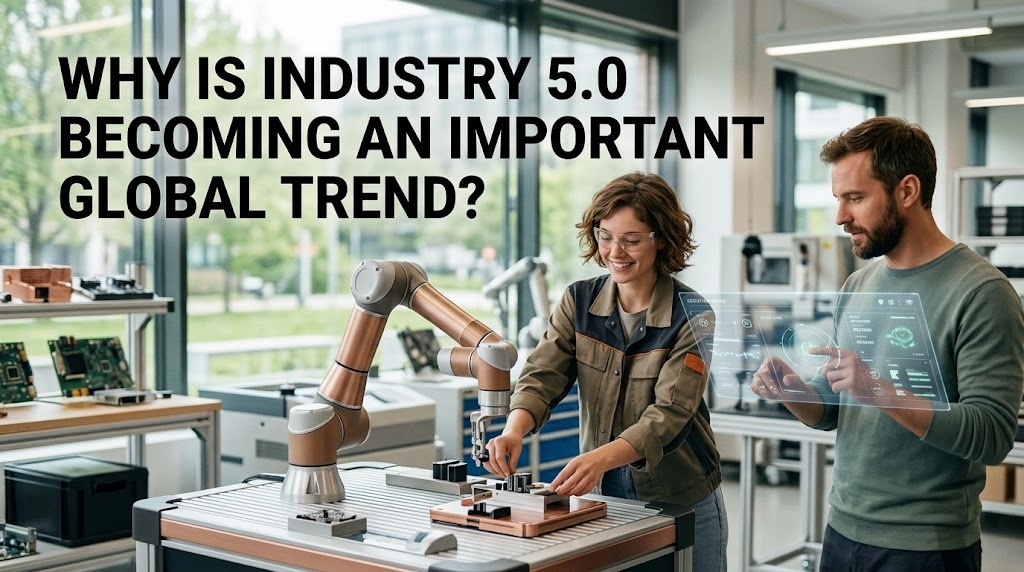
Industry 5.0 is an emerging approach to industrial development that combines advanced technology with human creativity, skills, and decision-making. It builds on Industry 4.0, which focuses on automation, digital systems, artificial intelligence, and connected machines. While Industry 4.0 emphasizes improving productivity through technology, Industry 5.0 places greater importance on human well-being, sustainability, and resilience. This approach encourages industries to use technological innovation to create value for businesses, workers, and society.
Industry 5.0 is becoming an important global trend because industries face growing challenges related to environmental protection, changing customer expectations, workforce development, and economic uncertainty. Companies need to remain competitive while also creating safe working environments and reducing their environmental impact. By combining human capabilities with intelligent machines, businesses can develop more flexible and responsible production systems. Understanding Industry 5.0 helps explain how the future of manufacturing and other industries may become more human-centered and sustainable.
THE MEANING AND MAIN PRINCIPLES OF INDUSTRY 5.0
Industry 5.0 is an industrial approach that aims to balance technological progress with human and environmental needs. It does not simply replace Industry 4.0 or abandon automation. Instead, it builds on digital technologies and encourages their use to support human workers, improve resilience, and promote sustainability. Its central idea is that technology should serve people and society rather than focus exclusively on production speed or financial performance.
The concept is commonly associated with three major principles: human-centricity, sustainability, and resilience. Human-centricity means designing industrial systems that support workers' safety, skills, and well-being. Sustainability involves reducing waste, using resources responsibly, and minimizing environmental damage. Resilience means helping businesses withstand disruptions such as supply chain problems, natural disasters, and economic uncertainty. Together, these principles encourage companies to develop industrial systems that are productive, adaptable, and socially responsible.
HUMAN AND MACHINE COLLABORATION
One of the most important features of Industry 5.0 is human-machine collaboration. Instead of relying entirely on automated systems, businesses can combine the speed and precision of machines with human creativity, judgment, and problem-solving abilities. Collaborative robots, often called cobots, are designed to work alongside people in suitable environments. They can assist with repetitive or physically demanding tasks while employees focus on activities that require experience, decision-making, and flexibility.
For example, a manufacturing company may use a robot to handle heavy components while a trained worker checks product quality and makes adjustments when necessary. This arrangement can improve productivity while reducing certain physical risks. However, successful collaboration requires appropriate training, workplace safety procedures, and well-designed equipment. Companies must also ensure that workers understand how to operate and supervise the technology. When implemented responsibly, human-machine collaboration can improve working conditions and make industrial production more adaptable.
THE ROLE OF ARTIFICIAL INTELLIGENCE AND SMART TECHNOLOGY
Artificial intelligence (AI) is an important technology supporting the development of Industry 5.0. AI systems can analyze large amounts of information, identify patterns, and help businesses make better decisions. When combined with sensors, robotics, cloud computing, and the Internet of Things, AI can support more responsive and personalized production processes. These technologies allow companies to monitor equipment, predict maintenance needs, and adjust operations according to changing conditions.
For example, a factory can use AI to detect possible machine failures before they cause major interruptions. Another business may use data analysis to produce customized products based on customer preferences. In healthcare equipment manufacturing, intelligent systems can help monitor quality and improve production accuracy. Nevertheless, AI should not be treated as a perfect decision-maker because its results depend on data quality, system design, and human oversight. Industry 5.0 therefore emphasizes using advanced technology together with human expertise to achieve reliable and responsible outcomes.
SUSTAINABILITY AND ENVIRONMENTAL RESPONSIBILITY
Environmental sustainability is a major reason Industry 5.0 is attracting global attention. Traditional industrial development has often depended on large amounts of energy and raw materials, contributing to pollution and resource depletion. Industry 5.0 encourages businesses to consider the environmental consequences of their production methods. Companies can use smart monitoring systems to reduce energy consumption, improve material efficiency, and identify opportunities to minimize waste.
For instance, intelligent manufacturing systems can help factories monitor electricity use and adjust equipment to avoid unnecessary consumption. Businesses can also adopt recycling programs, repairable product designs, renewable energy, and more efficient supply chains. These practices may reduce environmental impacts while helping companies manage operating costs over time. However, sustainable production requires more than installing new technology. It also depends on responsible purchasing, effective environmental policies, and measurable sustainability targets. By integrating these efforts into industrial planning, businesses can contribute to a greener and more sustainable economy.
ECONOMIC BENEFITS AND CHANGING WORKFORCE SKILLS
Industry 5.0 can provide economic benefits by helping companies improve product quality, respond to customer needs, and develop innovative products and services. Human-machine collaboration can support customized production without sacrificing all the efficiency gained through automation. More resilient production systems can also help businesses respond to supply disruptions and unexpected changes in demand. These improvements may strengthen competitiveness and create opportunities for companies in international markets.
At the same time, the transition requires workers to develop new capabilities. Employees may need stronger digital literacy, critical thinking, communication, creativity, and technical skills to work effectively with intelligent systems. Employers can support this transition through professional development, vocational training, and collaboration with educational institutions. Although some tasks may become automated, new responsibilities can emerge in areas such as robot supervision, data management, system maintenance, and technology ethics. Ensuring that workers have access to training is essential so that industrial innovation does not leave large groups of people behind.
CHALLENGES AND THE FUTURE OF INDUSTRY 5.0
Despite its potential benefits, Industry 5.0 faces several challenges. Implementing advanced technology can require significant investment in equipment, software, infrastructure, and employee training. Small and medium-sized businesses may find these costs difficult to manage, particularly when they have limited access to financing or technical expertise. Organizations must also address cybersecurity threats, data privacy, and the safe use of automated equipment.
Another challenge is ensuring that technology genuinely improves human well-being rather than creating excessive monitoring or increasing pressure on workers. Companies need clear policies that protect employee rights and establish responsibility for decisions made with AI systems. Governments and educational institutions can help by supporting digital infrastructure, workforce development, research, and responsible innovation. The future of Industry 5.0 will depend on how effectively businesses integrate technological capabilities with human needs. With careful planning and cooperation, industries can become more innovative, sustainable, and resilient.
CONCLUSION
Industry 5.0 is becoming an important global trend because it offers a broader vision of industrial progress. By combining artificial intelligence, robotics, and digital systems with human creativity, it seeks to improve productivity while supporting worker well-being, environmental sustainability, and business resilience. Its principles encourage industries to move beyond efficiency alone and consider their responsibilities to people and the planet.
However, achieving these goals requires investment, appropriate regulations, strong cybersecurity, and continuous workforce training. Businesses must ensure that technological innovation creates meaningful benefits for employees, customers, and communities. By adopting a balanced and responsible approach, Industry 5.0 can help shape an industrial future that is more human-centered, sustainable, and adaptable to global challenges.
Recent Posts

Bagaimana Sistem SKS pada Program Kuliah... 22.11.2026/50 View

How Does Technology Make Daily Evaluation... 21.11.2026/79 View

Apa Strategi Menghadapi Kesenjangan antara Kompetensi... 21.11.2026/79 View

Mengapa Inventaris Aset Penting bagi Kelancaran... 21.11.2026/75 View

When Should Musicians Join a Record... 21.11.2026/80 View
